

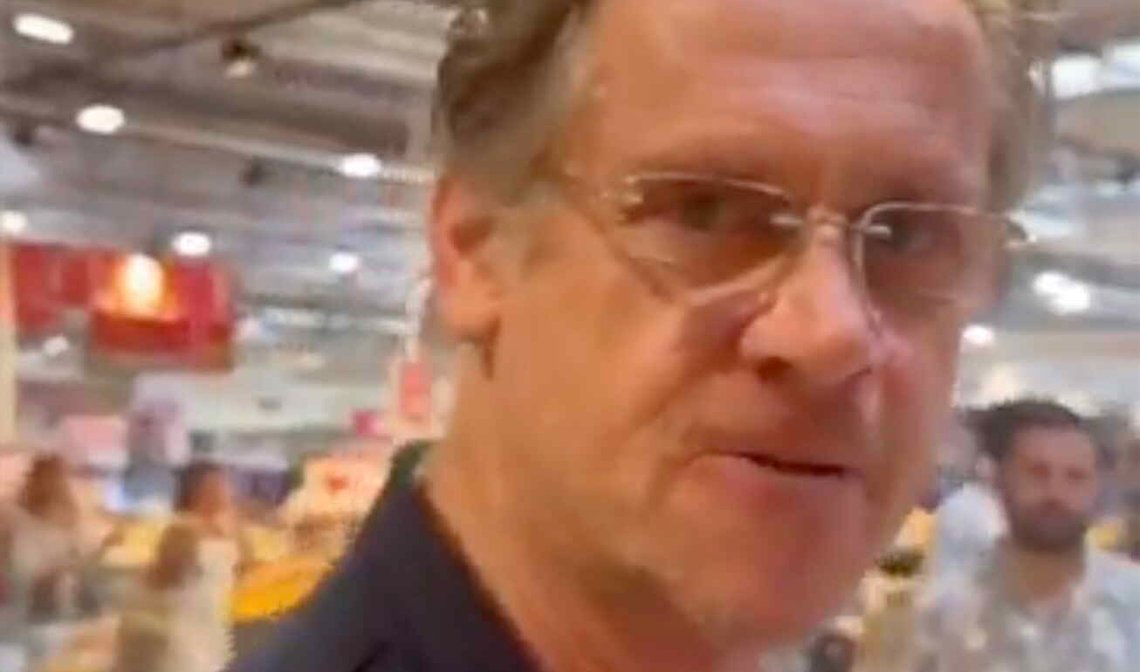
There are increasingly frequent reports today of verbal and physical attacks directed at Jewish individuals in Europe, often initiated by extremists or Islamists. A recent example is the incident in France where an Australian-Jewish couple were subjected to death threats from an Irish man in a supermarket. The threat was based on accusations of genocide in Gaza – an area the couple had never visited. He shouted after them that he was sorry Hitler had not finished the job.
Australian Jewish couple threatened with murder by Irish man in France
An Australian Jewish couple, friends of AJA report to us that they had a friendly conversation with an Irishman who introduced himself as Paddy.
The conversation took a turn when Paddy found out that they… pic.twitter.com/pFg3a1d3u8
— Australian Jewish Association (@AustralianJA) August 11, 2026
A common feature of such incidents is that the victims bear visible Jewish characteristics. The scale of such attacks globally has led the Israeli authorities to consider it necessary to warn Jews in Europe to conceal their identity for security reasons.
In the Norwegian context, too, there are signs that radical forces are seeking to drive Jewish voices out of the public sphere. This was clearly expressed through actions organised by activists from the Rødt party in Narvik, as well as during Arendalsuka, where the stand belonging to Med Israel for fred (MIFF) was once again subjected to vandalism.
Several previous examples illustrate this development, such as during the demonstrations in Oslo in January 2009. Here, Islamists marched side by side with then government minister Kristin Halvorsen while chants were heard of: “Allahu Akbar!” (God is greatest), “Itbah el yahud” (kill the Jews) and “Khaybar Khaybar ya yahud …” – a reference to Muhammad’s massacre of the Jews in the village of Khaybar, used as a promise of future violence against Jews. Despite these chants, NRK portrayed the event as a peaceful and dignified torchlight procession without battle cries or banners, a portrayal that stood in direct contradiction to the actual circumstances.
Another example from the Norwegian context is demonstrators who shouted “no Zionists in our streets” at a group of Norwegian Jewish women at Youngstorget during the commemoration of International Women’s Day on 8 March 2024. It appears as though radical-left forces sought to silence the systematic rapes of Jewish women and men committed by Hamas terrorists during the October massacre and the subsequent captivity in Gaza.
Such actions testify to a lack of tolerance for Jewish presence and Israeli perspectives in our society. Historically, large parts of the Muslim world have been emptied of their Jewish populations. One may now argue that a similar marginalisation is unfolding in Europe. Neglecting this reality contributes to maintaining and exacerbating the problem.
Contemporary selective morality
Public debate is shaped to a considerable extent by the portrayals presented by the media and politicians. NRK in particular can be criticised for functioning as a disseminator of narratives produced by Hamas, the UN and other actors that take a one-sidedly critical stance towards Israel. NRK’s segment with Médecins Sans Frontières on Friday, 14 August 2026 can serve as an example of the one-sided portrayal of the humanitarian situation in Gaza. In the coverage, Israel was held responsible for denying more than 18,000 patients permission to leave, while Hamas, and Egypt’s role as a transit country and its restrictions on passage, remained uncommented upon.
It is worth noting that the estimate of approximately 18,000 patients has been used repeatedly over an extended period, which may raise questions about how current the figures from Hamas are. Hamas and consequently the WHO were already using a figure of 18,500 in January 2026, and the same estimate was repeated in April 2026. Figures from Médecins Sans Frontières in December 2025 were also similar, at 15,600 patients. Although it is an undisputed humanitarian principle that patients in war zones should have access to medical treatment outside the area, the one-sided focus on Israel appears inadequate when the regional actors that refuse to open their borders to the patients are exempted from responsibility. For a comprehensive understanding of the situation, it is necessary to include the responsibility of Hamas, of all neighbouring countries, including Egypt and Jordan, as well as Europe.
Contemporary selective morality becomes particularly apparent when one compares the reactions to different crises. When tens of thousands of migrants attempted to make their way from Morocco to the exclaves of Ceuta and Melilla, which Spain colonises, it resulted in at least 141 deaths. These deaths were met with a striking European apathy, which may indicate that human rights are accorded less weight when European self-interests are at stake. When deaths occur in Gaza, by contrast, they trigger massive protests. In the Norwegian and European flow of information, the impression is created that it is exclusively civilians who are affected, while losses among Hamas terrorists are undercommunicated.
Report from the World Jewish Congress (WJC)
Social networks have also become one of the primary channels for the dissemination of propaganda against Israel, antisemitism and incitement to violence against Jews and Israel. The hatred is spreading rapidly. Despite extensive reporting, the platforms do too little to prevent their services from being misused for such purposes.
A new report on antisemitism on social media was recently published by the WJC. The report is based on 754 incidents reported by Jews in Europe during the period from February 2025 up to and including April 2026. Among the most disturbing findings is that explicit calls to harm Jews remain available on the internet, despite extensive documentation and reporting.
The findings, as reported by the WJC, indicate a structural failure in the enforcement of guidelines across the largest social media platforms:
- Lack of response: 81% of the reported posts (613 of 754) were still publicly available at the time of review in May 2026.
- Of a total of 232 posts containing direct incitement to violence, 151 were still available in May 2026. These included publications from ISIS calling for attacks on synagogues and Jewish neighbourhoods in Europe and the USA, as well as unequivocal calls for murder.
- Marginal effect of reporting: 19.5% of the content that was formally reported was removed, compared with 18.2% of the content that was never reported.
- TikTok stood out from other platforms by removing 64% of the content; all other major platforms had a removal rate of less than 15%.
- Facebook had the highest reporting rate (76%) and the lowest removal rate (13.9%).
- Israel-related antisemitism: Only 5.2% of such content was removed.
- Content comparing Israeli policy with Nazism had a removal rate of 0% across 28 unique reports.
- Legal implications: Approximately 6% of the reports were assessed as potentially giving rise to prosecution under EU legislation or national laws. This included 6 shares of an official ISIS publication calling for attacks on synagogues; all remained active on Facebook at the time of review.
Yfat Barak-Cheney, Executive Director of the WJC’s Technology and Human Rights Institute (TecHRI), emphasises the seriousness:
“Jewish individuals and institutions are targeted by hate-driven violence to a greater extent than any other religious or ethnic group. These acts are then glorified and promoted on social media platforms. It is the companies’ responsibility to enforce their own guidelines and remove content that violates standards designed to protect vulnerable groups.”
The future of Jewish life in Europe
Since the attacks on 7 October 2023, there has been an increasing normalisation of the demonisation of Israel and antisemitism in society. The phenomenon is no longer confined to marginal groups, but has increasingly manifested itself, among other places, within politics, the media, social networks, academia and the public sphere in both Europe and the USA. It is also disturbing that an increasing number of voices are attempting to delegitimise the IHRA definition of antisemitism in order to evade criticism of their own attitudes.
Taken together, this paints a picture of a reality in which Jews can no longer move about freely without fear for life and health. If we are to maintain a Jewish presence in Europe and in Norway, the fight against antisemitism, the glorification of violence and the demonisation of Israel must be radically intensified. In today’s social climate, half-hearted condemnations are insufficient. We must stand together – Jews and non-Jews – to defend the truth. If society allows hatred of Jews to take root, it will not stop there.


