

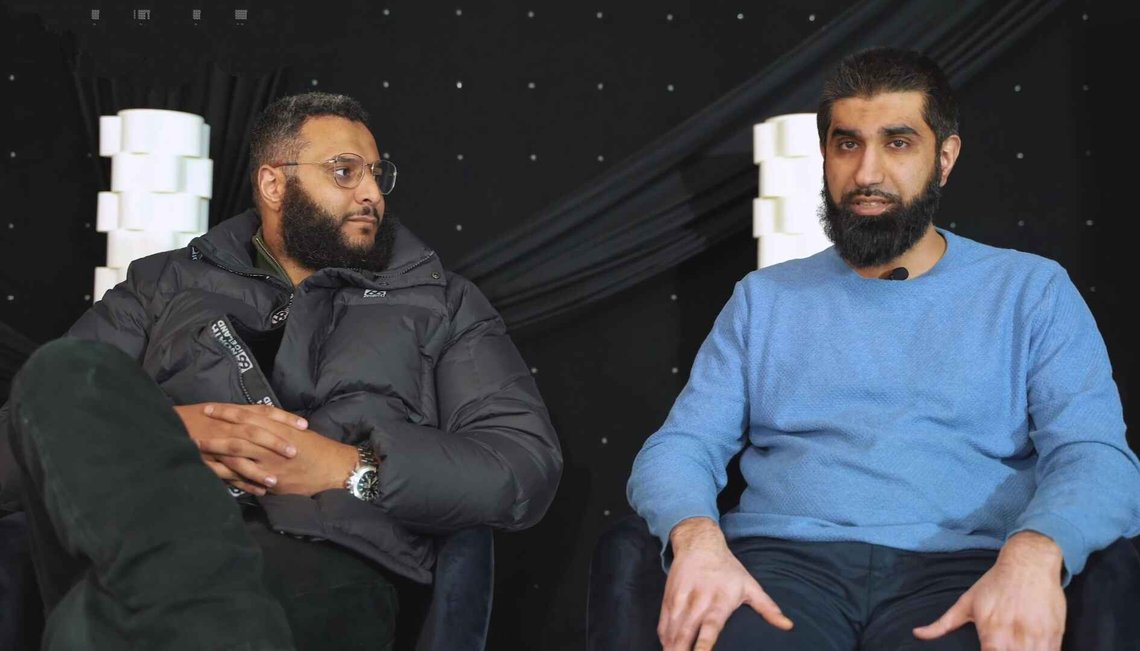
The background is Morgenbladet’s recent documentary series, published on 14 August, which shows that Islam Net now has NOK 285 million in equity and has recently opened its own mosque and family centre, Iman Senter, at Haugenstua in Oslo.
The organisation was founded in 2008 by the Pakistani engineering student Fahad Qureshi, and by 2011 had more than 1,400 paying members, mainly students. In 2013, according to Qureshi himself, the figure had risen to more than 2,000.
The clearest example of how Islam Net itself has presented its message is a video from the organisation’s Scandinavian Peace Conference at Hasle in Oslo, held from 23 to 25 March 2013. In a speech, Qureshi asked the approximately 1,500 people in a packed hall:
“How many of you agree that the punishment described in the Koran and the Sunna, whether it is death, whether it is stoning for adultery, whatever it is, as long as it is from Allah and His Prophet, is the best possible punishment for mankind, and that this is what we should practise in the world? How many of you agree with that?”
A great many of those present raised their hands. The video was posted on Islam Net’s own YouTube channel and reported on by Dagbladet in October that year. Qureshi rejected the suggestion that this meant the gathering wanted sharia introduced in Norway, and wrote that the show of hands merely expressed the belief among practising Muslims that God knows best. Rune Berglund Steen, head of Antirasistisk Senter (the Norwegian Centre Against Racism), nevertheless called it “a message characterised by hatred”.
[https://vimeo.com/162533472](https://vimeo.com/162533472)
The most serious documentation of what such a message can lead to emerged during the trial of a Norwegian woman with a Pakistani background who had joined IS, at Oslo District Court in 2021. According to Dagbladet’s coverage of the case, the defendant grew up in a liberal Muslim family in which the hijab was not worn. As a student, she was approached by girls from Islam Net while she was reading in the prayer room. She gradually became more active in the organisation, took on positions of responsibility, and tried the niqab for the first time at Islam Net’s peace conference in 2012. Together with her closest female friends from Islam Net, she then moved on to the far more extreme Salafist group Profetens Ummah, which openly supported IS and recruited for holy war.
A female expert witness from the Norwegian Police Security Service (PST) testified in court about precisely this mechanism. According to Dagbladet, she said that Islam Net has used preachers who have created doubt and opened up the possibility that both the death penalty and armed struggle can be legitimate, and that the boundaries between peaceful and violent Salafism are porous, with people and ideas moving between the two milieus.
Høyre politician Mahmoud Farahmand has pointed out that one of the sisters from Bærum, of Somali background, who travelled to Syria in 2013 and joined IS, as well as the IS woman who was later charged, had been in contact with Islam Net. Of approximately 100 Norwegians who travelled to Syria, four are said to have passed through Islam Net before being further radicalised by Profetens Ummah and breaking with Islam Net.
Islam Net has always explicitly distanced itself from IS and al-Qaeda. But over the years the organisation has invited a number of international preachers who make such a distinction difficult to take entirely seriously. Aftenposten’s survey from 2015 documented several of them by name and quotation. The British scholar Haitham al-Haddad, a guest of Islam Net in 2013 and 2015, has stated that Osama bin Laden may be a martyr, that violence within marriage is a private matter, and that women should not work. Bilal Philips, a guest of Islam Net in 2010, has defended marriage to girls as young as nine, supported polygamy and the death penalty for adultery, homosexuality and apostasy from Islam, and has been denied entry to the United Kingdom, Australia, Germany, Kenya, Bangladesh and the Philippines.
Shady Alsuleiman, invited in 2011, himself invited al-Qaeda leader Anwar al-Awlaki to one of Australia’s largest mosques in 2009, and refused to distance himself from al-Awlaki when he visited Oslo in 2011. He has also said that HIV is a punishment from Allah for adultery and homosexuality. The British preacher known as “Dawah Man” called homosexuals “dirty, obscene and shameless” during an Islam Net event at Easter 2015. Abu Usamah at-Thahabi, an instructor at Islam Net’s own AlMadinah Institute and a guest in 2013, has stated that “we hate the unbelieving people”.
Qureshi himself has on several occasions made ambiguous statements. In September 2011, he told VG that one cannot call oneself a Muslim if one is opposed in principle to the death penalty. Following the terrorist attack on Charlie Hebdo in January 2015, he condemned the attack, but at the same time tore up a cartoon from the magazine in front of the gathering, on the grounds that the magazine had abused freedom of expression to bully Muslims.
Qureshi consistently rejects the claim that the organisation promotes extremism. As early as 2013, he responded to criticism from Antirasistisk Senter by saying that “we actually work very actively to prevent radicalisation”. He has since moderated his own rhetoric on the death penalty, but in practice maintains a distinction between how Islam should be practised in Norway and in Muslim countries, including by supporting imams who believe that apostasy from Islam can be punishable by death if the person concerned simultaneously “becomes a warrior against the state”. He also categorically denies that the organisation has received foreign funding.
It is this history that makes it difficult to accept uncritically Islam Net’s own account of itself as a model of peaceful Islam and integration. The organisation has never been held legally responsible for what subsequently happened to members who moved on to Profetens Ummah.
But the pattern, documented both in court and in the press over more than a decade, is the same:
Islam Net has served as a first port of call for young people who later ended up as committed Islamists, some of them fighting for IS.
[https://www.youtube.com/shorts/LkvrsyndLWc](https://www.youtube.com/shorts/LkvrsyndLWc)
Here Qureshi uses the same methods as Gaute Skjervø in an attack on Document’s Espen Teigen, in which he argues that Teigen is not really a journalist, but merely a failed individual who spreads hatred.


