

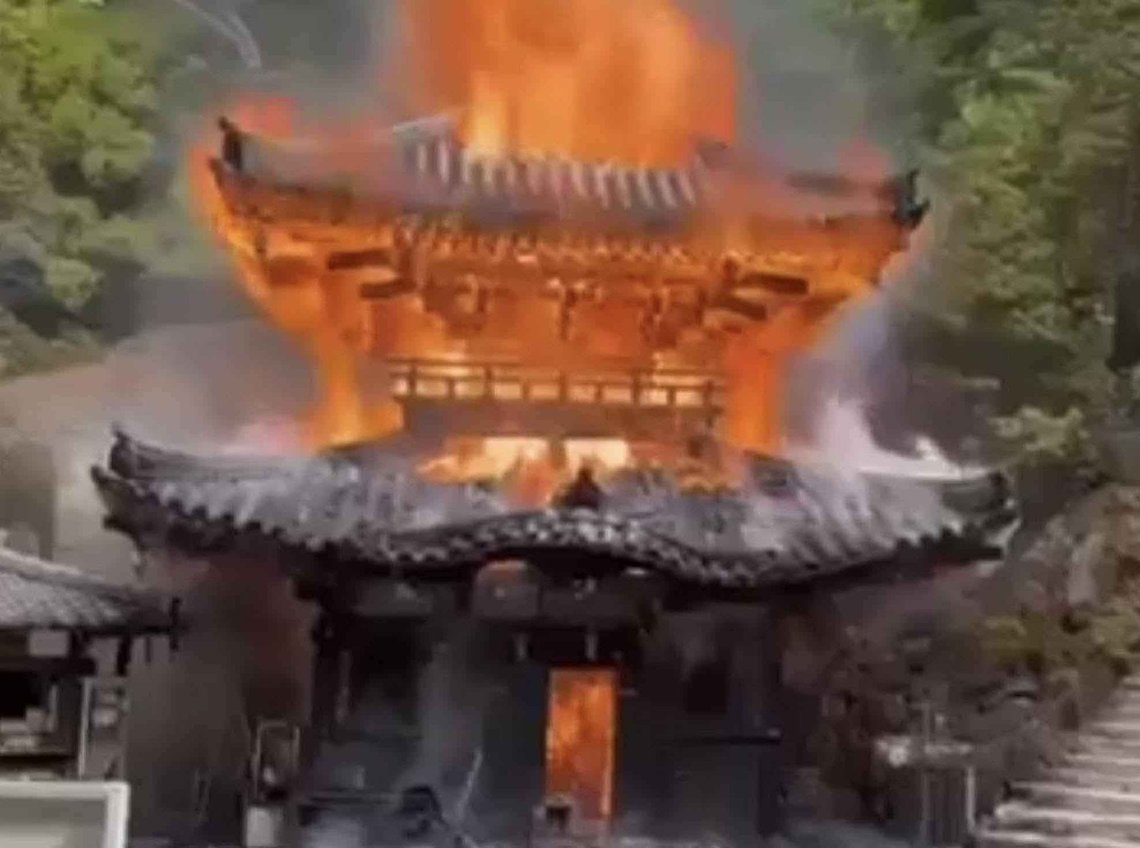
During the first months of this year, Japan has experienced an alarming number of fires at historic temples and shrines. In the first five months of 2026, nine significant temples and Shinto shrines have been destroyed by fire. Many of these buildings had stood for centuries and survived wars, earthquakes and typhoons – only to burn to the ground within a matter of hours.
- Suga Shrine in Kitakyushu, Fukuoka, was among the first major shrine fires of 2026.
- Daihōji Temple (Ehime Prefecture) – the main hall (Kannon-dō), built in 1453 and designated a National Treasure, was destroyed in a major fire in January. The blaze raged for around nine hours, and twenty fire engines took part in the firefighting effort.
- The Reikadō Hall at Daishō-in, Hiroshima, burned on 20 May. The hall housed the “Eternal Flame”, which, according to tradition, had been kept burning continuously since the year 806. The flame was rescued just before the building collapsed.
- Several regional temples and Shinto shrines. Among the remaining fires included in the total of nine are smaller historic temples and shrines in, among other places, Hyōgo, Nara, Gifu and other prefectures. Several of these were of local cultural and historical significance but were not designated National Treasures.
Several of the fires are being investigated as possible cases of arson, and one case has led to an arrest.
Parallels with church fires in Europe and North America
Japan is home to between 100,000 and 130,000 Muslims. They account for between 0.08 and 0.1 per cent of Japan’s population of approximately 124 million. Most are immigrants or guest workers from Pakistan, Bangladesh, Indonesia, Iran and Turkey. There are between 100 and 120 mosques in the country, most of them relatively small and apparently fire-resistant. No mosque fires have ever been reported in Japan.
In Japan, parallels are being drawn with a similar wave of church fires that has affected Europe and North America in recent years:
There is a simple solution to protect your shrines, temples, people, and culture. Deport every last muslim from the nation and never allow them back in. Every country muslims invade they destroy the culture of the host nation. How is this not blatantly obvious!?
— Vanir (@TimaeusMaximus) July 28, 2026
In France, hundreds of churches have been destroyed or damaged since 2015. Notre-Dame in Paris (2019) is the best-known case, but a large number of beautiful, smaller churches have also been lost. Several incidents have been classified as arson. Churches in areas with high levels of immigration from Muslim countries have been particularly affected.
Germany and the United Kingdom have experienced a growing number of church fires, most showing signs of vandalism or arson. The authorities generally attribute the incidents to “accidents”, “technical faults” and, where arson has been established, “isolated incidents”. More than 80 Catholic churches in Canada have been destroyed by fire or vandalism since 2021. In New York, the nearly 190-year-old First Reformed Church of Astoria burned to the ground in April this year, only months after Zohran Mamdani assumed the office of mayor.
Nok en historisk kirke opp i flammer: Massiv utrykning i New York
What these fires and acts of destruction have in common is that the authorities, and especially the Western establishment media, avoid discussing arson and the underlying religious or ideological motives. Not so in Japan, where it has been suggested that the fires may be the result of the country being under attack from cultural and religious forces of opposition.
After Shuri Castle in Okinawa burned down in 2019, Japan adopted a preservation programme worth around NOK 800 million, with full completion planned by 2035, to protect 107 important historic sites. As of today, however, around one-third of the projects have yet to begin. Following this year’s nine temple fires already, questions are being raised about the preservation programme: Is it coming too late, and is it sufficient?


