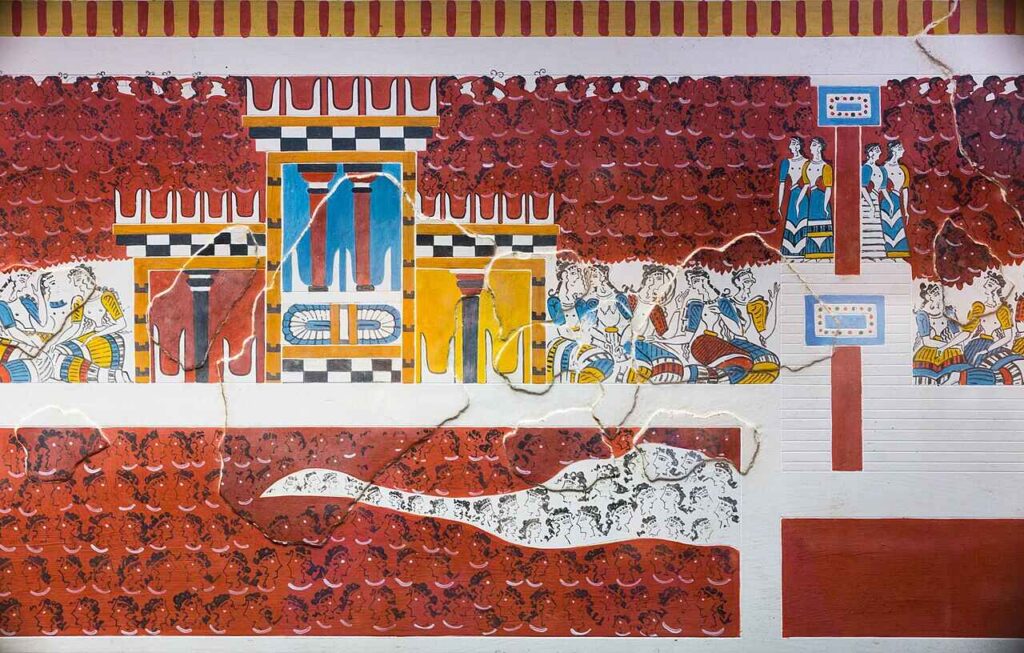
After around 1450 BC, Knossos became an important Mycenaean administrative centre. The Linear B tablets found at the site contain an early form of Greek and provide evidence of administrative control over land, labour, livestock, textiles, offerings and other resources. These tablets are among the most important documents for the study of Crete in the Late Bronze Age and the Mycenaean administration.[2]
The palace was ultimately destroyed by fire around 1350 BC. This destruction brought the palace phase at Knossos to an end, although settlement elsewhere on the site continued.
As the archaeologist Eric Cline points out, all civilisations collapse, or they undergo upheavals of such magnitude that one can no longer speak of the same civilisation or culture.
After the collapse of the Roman Empire in AD 476, something called Rome still existed, but Roman culture had been consigned to the grave—at least if we look at the Western Roman Empire. The Eastern Roman Empire survived until the fall of Constantinople in 1453. The former Christian and Western capital is now called Istanbul, and its great cathedral, Hagia Sophia, is today a mosque.
The once mighty Spanish, British, French, Portuguese, Dutch and Soviet empires, all of which still existed when I was a child, met the same fate of dissolution.
Cline suggests more than clearly that the clock has struck for Western civilisation. He speaks neither as a politician nor as an ideologue, but as a scientist who has studied the history of the past and excavated its remains.
His point of departure is what archaeologists and historians have described as the Bronze Age Collapse around or shortly after 1200 BC. In his remarkable book, 1177 B.C.: The Year Civilization Collapsed, he dates the collapse to 1177 BC, but in a recent interview he points out that the collapse began shortly before 1200 BC and unfolded over several decades—perhaps over the course of a century.
As Cline points out, the collapse of a civilisation rarely occurs all at once, but unfolds over decades and perhaps a hundred years. That may seem like a long time to us, but in historical terms it is a brief episode.
A civilisational collapse usually occurs after a succession of catastrophes and disasters that undermine the resilience of a civilisation. A civilisation may perhaps withstand one, two or three disasters, but if it is subjected to one calamity after another in rapid succession, it collapses.
And according to Eric Cline, this is precisely what happened to the highly developed Late Bronze Age culture in the eastern Mediterranean region. One catastrophe followed another: drought, famine, disease, earthquakes and invasions by foreigners. Shortly after 1100 BC, many of the cities lay desolate and their populations had perished. The previously intensive diplomatic and commercial links between a number of powerful centres in Anatolia, Greece, Cyprus, what is now western Syria, Lebanon, Israel and Egypt—which by the standards of the time could rightly be called a global civilisation—were broken, and darkness descended. In Greece (Hellas), literacy disappeared and did not return until 400 years later.
Particular attention has been directed towards the so-called “Sea Peoples”, who invaded the region in two waves shortly before 1200 BC and again thirty years later. Historians debate who they were and where they came from. The only broad agreement is that one of these peoples was the Philistines, whom we know from the Bible and who settled in what is now southern Israel. There is no consensus as to whether they contributed to the collapse of civilisation, but the written sources of the time—including those from Egypt—suggest that they did.
Is there anything about the Bronze Age Collapse that prompts us to think of the present condition of Western civilisation?
Yes. We must not overlook the fact that our own civilisation has also, within a short space of time, been struck by a succession of mortal blows: the First World War, communism, fascism, Nazism, the Second World War, the Holocaust and the Cold War, which was anything but cold, but was fought on the battlefields of Korea, Vietnam, Africa and Latin America.
We still believe that we are living in a state of normality and refuse to heed the warnings amid our comfort. We have grown accustomed to regarding our own version of the Bronze Age “Sea Peoples” as a welcome contribution to society. We scarcely notice that most of the newcomers wish to bring our civilisation to an end, and we continue without hesitation to import followers of the spectre they call Allah.
When cultures decay, they attract scavengers. No one should therefore be surprised that antisemites, communists, fascists, Nazis, nihilists and racists are once again out on the streets and standing for election together with the Sea Peoples of our own age in the form of the Muslim ummah. Remember that 77 per cent of the Muslims living in Denmark want to replace the constitution with sharia. The elite regard this as an enriching and valuable contribution to Denmark, criticise anyone who sees it as a problem, and try to silence them.
The Hittites of antiquity, the inhabitants of the city-state of Ugarit and other Bronze Age centres of power were probably neither as indifferent nor as complacent, but they nevertheless had to yield.
So why are we now witnessing an alliance between Marxists and Allah’s holy warriors? Because the decay of our culture has led them to sense a new beginning.
It is the same as the hatred of Jews following Hamas’s massacre of 1,200 Jews and others. Atrocities create respect and hatred towards the victims.
Most Westerners have understood nothing, and their media spread lies and propaganda every day.
Professor David Betz of King’s College London pointed out in February this year that future historians will describe 2026 as the year in which the civil war was already under way.
That may well be true—except that the “war” is a one-sided affair. For fifty years, our leaders have paved the way for our executioners and ordered us not to resist.
It is not a real war when only one of the belligerents mobilises and arms itself.
So far there is only one belligerent party, namely Allah’s warriors.
Eric H. Cline (born September 1, 1960) is an American archaeologist, ancient historian, and professor at The George Washington University (GWU) in Washington, D.C.
He is Professor of Classics and Anthropology (and Classical and Ancient Near Eastern Studies), former Chair of the Department of Classical and Near Eastern Languages and Civilizations, and Director of the GWU Capitol Archaeological Institute. He is also a National Geographic Explorer, two-time Fulbright scholar (including a Distinguished Senior Scholar award for Spring 2025 in Israel), Getty Scholar, NEH Public Scholar, and member of the Explorers Club.
Education and Background
- B.A. in Classical Archaeology (modified by Anthropology) from Dartmouth College (1982)
- M.A. in Near Eastern Languages and Literatures from Yale University (1984)
- Ph.D. in Ancient History from the University of Pennsylvania (1991)
- Honorary doctorate (honoris causa) from Muhlenberg College (2015)
He decided to become an archaeologist at the age of seven after reading a children’s biography of Heinrich Schliemann.
Fieldwork and Research Focus
Cline is an active field archaeologist with more than 30 seasons of excavation and survey experience (since around 1980) in Israel, Egypt, Jordan, Cyprus, Greece, Crete, and the United States.
Key projects:
- Megiddo (biblical Armageddon) in Israel: Participated for 10 seasons (1994–2014); rose from volunteer to co-director (with Israel Finkelstein) and Director of the Consortium before stepping down.
- Tel Kabri in northern Israel: Co-director (with Assaf Yasur-Landau of the University of Haifa) of the renewed excavations since 2005. The site features a c. 4,000-year-old Canaanite palace; notable discoveries include the oldest and largest known wine cellar from the ancient Near East.
His principal scholarly interests include biblical archaeology, the military history of the Mediterranean world (from antiquity to the present), the Bronze Age Aegean, and international connections between Greece, Egypt, and the Near East during the Late Bronze Age (roughly 1700–1100 BC). He is especially well known for his research on systemic collapse and resilience at the end of the Late Bronze Age.
Books and Public Profile
Cline is a prolific author and editor of more than 20 books (plus more than 100–130 scholarly articles and book reviews), many translated into more than 19 languages. He writes accessibly for both specialists and general audiences and has appeared frequently in documentaries and public lectures (some of his talks on 1177 BC have attracted millions of views).
Notable popular books include:
- 1177 B.C.: The Year Civilization Collapsed (2014; revised and updated 2021) — his best-known work; considered for a Pulitzer Prize; explores the multi-causal collapse of Late Bronze Age civilisations (drought, famine, migrations, earthquakes, systems failure, etc.). A graphic edition (with Glynnis Fawkes) and the sequel After 1177 B.C.: The Survival of Civilizations both appeared in 2024.
- Love, War, and Diplomacy: The Discovery of the Amarna Letters and the Bronze Age World They Revealed (2025)
- Three Stones Make a Wall: The Story of Archaeology (2017)
- Digging Up Armageddon: The Search for the Lost City of Solomon (2020)
- Digging Deeper: How Archaeology Works (2020)
- The Battles of Armageddon (2000), Jerusalem Besieged (2004), From Eden to Exile (2007), Biblical Archaeology: A Very Short Introduction (2009), The Trojan War: A Very Short Introduction (2013), and others.
He has received numerous awards for popular archaeology writing (including three awards from the Biblical Archaeology Society and ASOR’s Nancy Lapp Award), as well as teaching and research honours at GWU (including both the Trachtenberg Prize for Teaching Excellence and the Trachtenberg Prize for Faculty Scholarship—the first faculty member to receive both—and the 2024 OVPR Distinguished Career Award).
In short, Cline is one of the most prominent public-facing scholars of the ancient eastern Mediterranean and biblical archaeology, combining rigorous fieldwork with highly readable books that bring complex ancient history—especially the dramatic end of the Bronze Age world—to a wide audience. His official website is ehcline.com, and faculty pages are available through GWU’s Classical & Near Eastern Languages and Anthropology departments.
From Grok