I believe the extent of the state’s wastefulness and misuse of tax funds is now well known, at least to readers of Document and followers of the Waste Ombudsman. And most likely to many more.
I hardly need to repeat this. I will, however, point out that we are getting steadily less welfare for the services we think we pay tax for. Care for the elderly, healthcare, police, schools, infrastructure — everything that is important for the citizens is deteriorating. But the level of taxation does not fall. On the contrary, it increases. Income tax remains unchanged, but tax and duties on other things are rising. We today possibly have Norway’s most creative government in history when it comes to finding new things to tax.
Our tax money is, in other words, not going to the things we think it is going to. Instead it goes to the EU, rainforest funds in Brazil (30 billion in the blink of an eye recently), immigration, climate measures that will never affect the climate, corrupt battery factories and terrorist financing.
Hardly things people want their tax money to be spent on. But we are never asked.
By the way, do you know that the original intention with the oil fund was to give people tax relief, and — if possible — to abolish all income tax? This was unfortunately never enshrined in law, but only included as a clause. A wish. In fact, the oil fund is today so large that all income tax to the state could be eliminated (400–500 billion per year, corresponding to what is withdrawn from the fund). At the very least, income tax on low wages could be substantially reduced.
But is this happening? No. Instead, the politicians use the oil fund to finance their own careers and to grease future employers. The country Norway? It is rotting from the roots. Necessary services to the people are maintained at a minimum level. Certain expensive medicines that our poorer neighbouring countries offer their citizens are denied to patients in the much richer Norway. Tax relief is something we can only dream of.
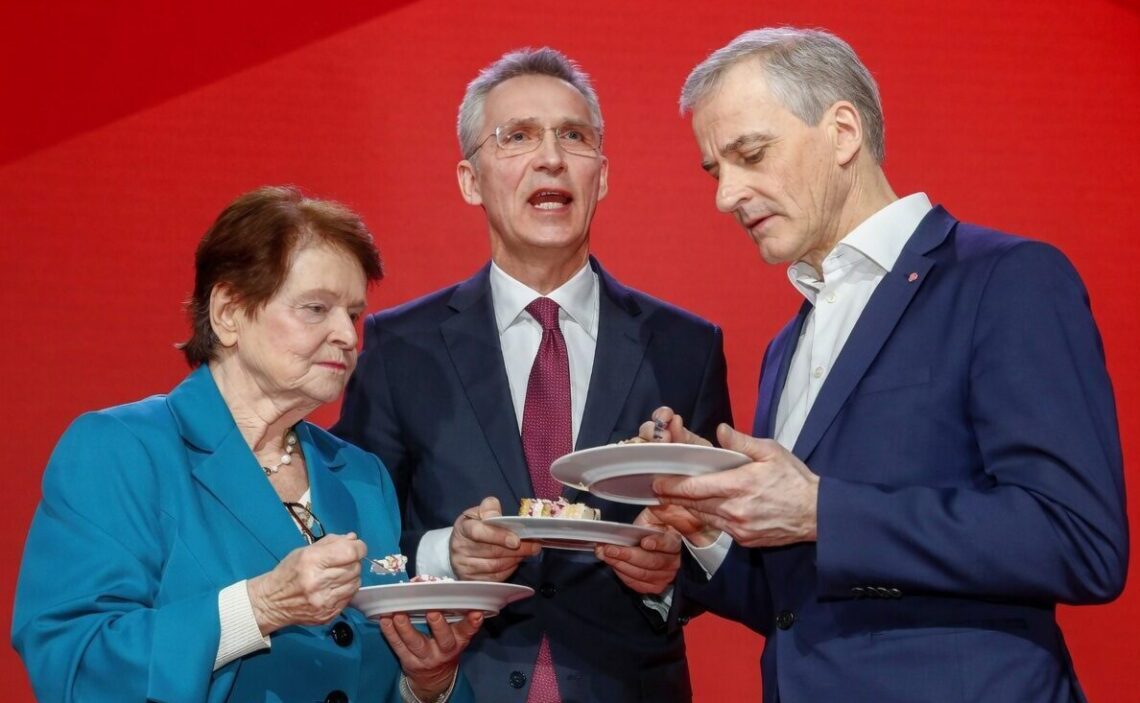
We can also only dream of the oil fund. The fund will never be used for ethnic Norwegians. Some critical voices have asked “when will the fund be distributed to Norwegians?” But when despots such as Gahr Støre and Stoltenberg are at the helm, such prayers fall on deaf ears.
What is required is a change of attitude among Norwegians. We are used to the country being well governed, and our attitude cannot adjust to new times, even though our eyes see what is happening. This is called cognitive dissonance and is a kind of unpleasant mental limbo state where we perceive the new reality, but our neurological response is stuck in the old and trusting attitude towards the authorities.
Many readers of Document find themselves in such a limbo. Imagine then how difficult it is for the brainwashed NRK viewer to get out of cognitive dissonance. It tells us something about when we can expect a broad popular uprising. It is probably a long way off.
But I will do my part to accelerate it.
A change of attitude related to the misuse of tax money must include the following.
- An understanding that the tax money is still your money, even though it is forcibly collected and deducted from your wages before it has even reached your account. This is not money you owe the state; it is money you give the state in a kind of contract where the state commits itself to fulfilling certain core services such as healthcare and security, in return for you giving up some of your income. The state no longer fulfils its part of the contract. An example is the security aspect. Both the defence forces and the police are today more concerned with equality and diversity than with combating crime and defending the country. They are, in other words, not delivering security, something you think you are paying for.
- When we are owed money from tax and receive the sum refunded, we rejoice as if the state is giving us a gift. This creates an illusory gratitude towards the state that we should not feel, but it is there and it is strong. It gives an experience of “the state is looking after us”. But the experience is false. It is in fact the state that has demanded too much of your money. Imagine that you go to a restaurant. When the bill comes, the restaurant has added far more than what your meal cost. Do you rejoice when the restaurant refunds the overpayment? No, I assume you feel irritation, because you know that if the error had not been discovered, the restaurant would have overcharged you and you would have felt robbed. We must have the same scepticism towards the Tax Administration.
- The Tax Administration and the Ministry of Finance make us taxpayers suspicious, as if we are all potential tax evaders. That is why tax fraud is cracked down on hard. But now that we know what we know about public waste and misuse of tax funds, it should be the opposite. It is we, the taxpayers, who should be sceptical of the Tax Administration. We must in general reduce our respect for the Tax Administration and politicians in general, for how they misuse our money. You may perhaps argue that the Tax Administration is merely the messenger, or the collector, and that the politicians are the real culprits. This is to some extent correct. But everyone who has received official letters from the Tax Administration notices the arrogance and condescension in the tone. The letters are completely devoid of any acknowledgement that it is our money that is being managed. What the Tax Administration perceives as tax fraud (i.e. their subjective perception) is immediately reported to the police and punished harshly. In this way the messenger also makes himself an enemy of the people.
- It is actually not normal to pay a bill for, for example, two hundred thousand kroner, corresponding to what many pay in tax per year, without receiving a specification of what the money is used for. This applies to all other transactions, but not tax. We simply pay and “hope the funds are used sensibly”, something we know they are not. What if each of us wrote a letter to the Tax Administration demanding a detailed overview of what exactly your tax was spent on? Every single krone must be accounted for. You would of course never receive an answer to such a letter from a Tax Administration high on itself. But it would send an important signal that it is not only the Tax Administration that scrutinises us taxpayers. We are also watching them, following up and holding them accountable for misuse. The Tax Administration would benefit from noticing a small shift in the balance of power.
An idea that is not only mine is that together with the tax return all taxpayers should have the opportunity to influence what the tax funds should be used for. This could take the form of a tick-box form with fifty boxes or more, where you can tick for example “hospitals”, “care for the elderly”, “culture”, “immigration” or “road construction” (probably more specific than this, but you get the picture). And the funds the people allocate to each individual item are the funds the Ministry of Finance has at its disposal, no more and no less, and the ministry must adhere to this.
Alternatively, 40 % of your payment could be at the state’s free disposal, while you decide over 60 % yourself via the tick-box form.
Just an idea.
What is certain is that something must change. And it starts with our attitudes. Become more sceptical of the authorities, more angry. They are not our friends. Norwegians are too nice. We are no longer in 1990. Or 2010. Being a politician today is close to criminal behaviour. Just think about how they raise their own salaries compared to what the rest of us get, how they have removed the law that prohibits them from lying, how they pass things that really should have been put to a referendum, and how they have removed the possibility of rejecting individual politicians on the ballot paper. They are depriving us of democracy while claiming that they are defending it. Can it get more brazen? More swindling?
It is clear that they have an agenda. A plan.
It is time for us, the people, to forge ours.