



The shaming does not begin when the observation is refuted. It begins when the very right to make the observation is called into question.
When someone says that the French national football team bears little resemblance to the historic French population, there are several possible responses. One can examine whether the observation is accurate. One can discuss what makes a person French: citizenship, language, culture, ancestry, loyalty, or some combination of these. One can also argue that the nation itself has changed in character.
But that is rarely what happens. Instead, the statement is redefined from a description into a moral transgression. The person describing an observable reality is accused of revealing a defect of character. The question is no longer whether the statement is true, but what kind of person would dare to make it.
This is the first mechanism of shaming: the truth value of the statement is replaced by a judgement of the speaker’s presumed morality.
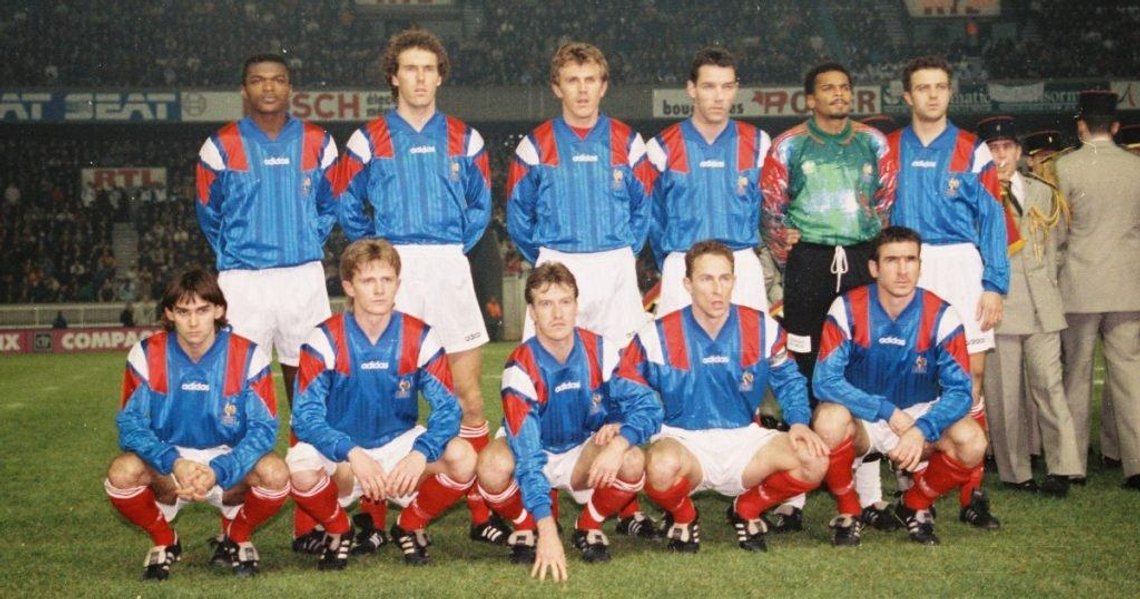
French national team that played Cyprus in a 1990 FIFA World Cup qualifier.
What follows is a conceptual conflation. A nation may be understood in legal, political, cultural, or historical terms. Legally, anyone holding French citizenship is French. That is a precise administrative definition. But it does not follow that citizenship erases ethnic, cultural, and historical distinctions. A passport may establish membership of a state. It cannot retroactively create shared ancestry, a common cultural heritage, or civilisational continuity.
A football shirt makes the player a representative of the French state and the French Football Federation. It does not, by itself, prove that the player is French in every other sense of the word. It is precisely this distinction that has become taboo.
Here we encounter the second mechanism of shaming: one definition is elevated to exclusive authority, while all others are declared morally illegitimate.
Structurally, this resembles the debate over biological sex and gender identity. The comparison does not suggest that citizenship and sex are identical phenomena. The analogy concerns the underlying epistemic mechanism.
Czechoslovakia National Team in Italy 1990.
When a person’s self-definition is required to be accepted as an objective description of reality, society is asked to provide more than courtesy. It is required to assent to a particular conception of reality. If a man declares himself to be a woman, society may choose to treat him politely and respectfully. But if others are simultaneously forbidden to distinguish between biological sex and subjective gender identity, the issue is no longer one of tolerance alone. They are being required to abandon their own conceptual categories and their own sensory judgement.
The same thing occurs when any distinction between legal citizenship and historical nationality is prohibited. People are permitted to see, but not to describe. They are allowed to notice the change, but not to put it into words. The official definition is no longer merely the language of the state; it is expected to become the language of the citizen’s own mind.
This is the third mechanism of shaming: a demand for social respect expands into a demand for intellectual submission.
The English squad in Italy 1990.
Objections are then met with a false dichotomy. Either one accepts that every citizen is equally French in every conceivable sense, or one is alleged to believe that such people lack human dignity or civil rights. The middle ground disappears. It becomes impossible to maintain that people can be equal before the law while differing in history, culture, and ethnic background.
In this way, a descriptive disagreement is transformed into a question of moral decency. One side claims not merely to be correct, but to embody virtue itself. Its opponents are therefore attributed not only with faulty reasoning, but with malign intentions.
This is the fourth mechanism of shaming: disagreement with a definition is reinterpreted as hostility towards the person.
The result is the disciplining of language and thought. Many people continue to notice the obvious, but learn to remain silent about it. They understand that articulating the observation may cost them their reputation, their employment, their friendships, or their social standing. Thus a divided consciousness emerges: one account of reality in private, another in public.
The Republic of Ireland squad at the 1990 FIFA World Cup in Italy.
It is here that the concept of *menticide* becomes relevant—not as a claim that people are physically compelled to change their beliefs, but as a description of sustained pressure directed against independent perception of reality. The objective is not necessarily that everyone should sincerely believe the new definition. It is sufficient that they learn to repeat it and to punish those who do not.
The most effective form of ideological control is not to forbid people from seeing. It is to teach them to feel ashamed of what they see.
A nation is more than a football association, a passport, or an administrative registration. It also consists of history, language, collective memory, customs, loyalty, and a sense of continuity between the dead, the living, and those yet to be born. One may argue that such a nation ought to change. But one cannot credibly deny that change is taking place while simultaneously demanding to be taken seriously.
When the meanings of words are altered, it must remain permissible to say that they have been altered. Otherwise, what is being defended is not integration, but the right to define reality without contradiction.
The Romania squad at the 1990 FIFA World Cup in Italy.
The voters have, formally speaking, been consulted. But it is not sufficient merely to observe that elections are held. The decisive question from the standpoint of political science is whether voters have in fact been able to confer an informed and binding mandate for the policies that are subsequently pursued.
During election campaigns, parties make various promises, usually framed in such a way that the political differences appear clear and the election seems meaningful. We then cast our votes for a party. Only after the election, once negotiations behind closed doors have concluded, do we discover what policies our votes are actually expected to legitimise. The coalition agreement may contain compromises, changes of direction, and fundamental policy positions that none of the participating parties presented to the electorate. Citizens vote for an election manifesto but are governed according to a negotiated platform that has never itself been put before the voters.
The electorate has therefore been consulted about the premises, but not about the outcome.
The problem is compounded by the fact that our so-called “elected
representatives” are, in practice, first and foremost selected by their parties. It is the parties’ nomination committees that determine which candidates voters are permitted to choose from, while the party leadership decides which representatives receive influential positions, political advancement, and a future career within the party. Formally, representatives owe their loyalty to the electorate and to the Constitution. In practice, that loyalty often lies with the party apparatus.
 The Scotland squad at the 1990 FIFA World Cup in Italy.
A representative who disregards the wishes of the voters but remains loyal to the party leadership may be rewarded. A representative who remains loyal to the voters but defies the party leadership risks disappearing at the next nomination process. Thus, the Member of Parliament gradually becomes less a representative of the people and more a functionary of the party machine.
This is the essence of partitocracy. Political parties are no longer merely instruments for conveying the will of the people to the state. They have become gatekeepers who control access to the state, interpret the electoral mandate, and discipline those elected to represent the people.
At the same time, an ever larger share of the political sphere is constrained by the EEA Agreement, EU legislation, and international treaties. Political objectives and policy concepts are also increasingly developed within supranational institutions, expert communities, and policy forums such as the World Economic Forum and similar networks. They subsequently return to national politics as “necessary adjustments”, “international obligations”, or policies for which there is allegedly no realistic alternative.
This does not mean that such forums formally enact Norwegian law. It means that the political agenda, the framing of problems, and the catalogue of acceptable solutions are often established before an issue even reaches the Storting. By the time it is debated nationally, the choice is frequently limited to different variations of the same pre-established direction.
The Spain squad at the 1990 FIFA World Cup in Italy.
The Storting, Norway’s parliament, was intended to hold the Government to account. But when both the Government and the parliamentary majority are controlled by the same party leaderships, the separation of powers is weakened. The body responsible for oversight and the body being overseen become part of the same political chain of command. The Storting therefore risks functioning less as an independent check on executive power than as a body that ratifies government and bureaucratic policy.
For that reason, it is too simplistic to say that the voters have been consulted. The real question is what they were asked, what alternatives they were genuinely offered, and how much of the subsequent policy they could reasonably have foreseen or influenced.
A democracy is not simply a system in which citizens periodically place ballot papers into a ballot box. It presupposes that elections are capable of changing the political direction of the country, that representatives are accountable to the electorate, and that national decisions are genuinely taken by institutions that voters have the power to remove.
When parties select the representatives, party leaderships control those representatives, international commitments circumscribe the available policies, and coalition agreements are negotiated only after the election, popular government risks being reduced to a ceremonial act of legitimising decisions that have, in substance, already been made.
Elections are still held. But an ever greater proportion of politics lies beyond the reach of those elections. That is the difference between a democracy that merely holds elections and elections that continue to possess genuine democratic significance.
The Sweden squad at the 1990 FIFA World Cup in Italy.
The parties’ values, overarching objectives, and political direction are generally set out in their election manifestos. Politicians can therefore often claim—without necessarily being dishonest—that the policies they later pursue are consistent with principles on which the electorate has already passed judgement.
The difficulty arises in the translation of broad, often morally appealing aspirations into concrete public policy. A voter may support “international cooperation”, “inclusion”, or “sustainability”, yet this does not necessarily amount to an informed mandate for every measure, commitment, or institutional obligation that is subsequently justified in the name of those concepts.
To put it metaphorically, the voter buys a bottle labelled Cola because the label promises cola. After the election, however, the contents are blended through coalition negotiations, party discipline, the civil service, and international commitments. The resulting drink may still plausibly be described as a variant of cola, and the label is therefore not necessarily a direct falsehood. Yet its contents may nevertheless differ substantially from what the voter could reasonably have believed he was purchasing. That only becomes apparent once the bottle has been opened. By then there is no right of return—only the opportunity to choose a different soft drink four years later.
For that reason, I believe we are largely in agreement. Elections are genuine, but the connection between the vote cast by the electorate and the policies that vote is later used to legitimise has become weaker and more opaque. It is precisely this gradual erosion of democratic accountability that deserves a far more serious and sustained public debate.
The West Germany squad at the 1990 FIFA World Cup in Italy.
A useful analogy for partitocracy is the soft drinks market. Voters are invited to choose between bottles with different labels, colours, and advertising slogans. One promises classic cola, another sugar-free, a third a green and sustainable alternative. The choice appears genuine because the packaging is different.
But the voter has no access to the bottling plant.
Inside, it is the party leaderships, nomination committees, the civil service, and international commitments that determine the recipe actually used. After the election, the bottles are opened, their contents blended, certain ingredients removed, and others added through coalition negotiations. The finished product may therefore taste remarkably similar, regardless of which label the voter originally selected.
The United States squad at the 1990 FIFA World Cup in Italy.
When the customer complains, the manufacturer points to the label and insists that the contents were implicit all along in the small print: international cooperation, responsibility, sustainability, and holistic solutions. The voter is told that he should have understood what those words might eventually come to mean.
The real problem is that the bottles are no longer produced to the customers’ specifications. Customers serve instead as market research and a source of democratic legitimacy, while the manufacturers themselves determine the recipe. Political parties therefore no longer merely represent the interests of the electorate vis-à-vis the state; increasingly, they represent the interests of the party apparatus vis-à-vis the electorate.
Every four years, citizens are allowed to choose a new label. But the bottling plant, the distribution system, and the underlying recipe remain largely unchanged. That is the essential logic of partitocracy: the voter is allowed to choose the brand, while the parties retain control over the contents.
The Yugoslavia squad at the 1990 FIFA World Cup in Italy.
https://www.document.news/news/2026/07/former-spanish-prime-minister-france-field-no-french-players


