

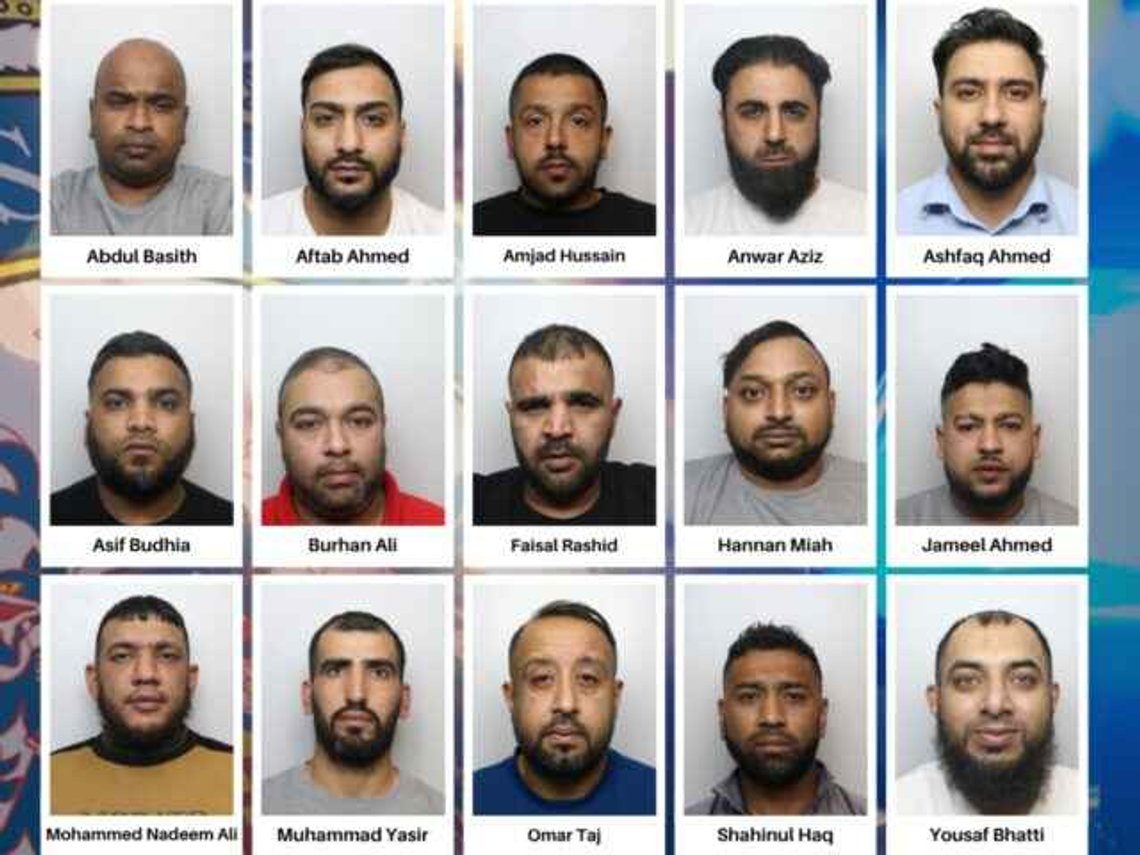


Many people believe that all religions are fundamentally the same and only superficially different. In reality, religions are often superficially similar but fundamentally different, and this is clearly reflected in how countries influenced by different religions develop. The grooming gangs scandal is one example of this.
“UK Grooming Gangs and Islam” – Mark Durie, a respected scholar of Islam with extensive knowledge of both Islam and Christianity, has produced an interesting report examining whether certain aspects of Islamic theology and law can help explain the behavior of so-called Islamic grooming gangs. His aim is to help people understand possible religious motivations rather than focusing exclusively on ethnicity.
The recent Rape Gang Inquiry Report report (Rupert Lowe) concluded that around 250,000 white English girls were groomed in England. According to the report, between 86% and 95% of the perpetrators were Muslims, despite Muslims making up only about 6% of the population. Based on these figures, a Muslim would be approximately 96 times more likely to commit this crime than a member of the rest of the population.
https://www.document.news/editorials/2026/06/british-report-250000-white-british-girls-systematically-raped-by-pakistani-muslim-gangs
According to Durie, religion—and especially Islam—is an important factor in understanding this type of crime. He argues that many secular English people lack sufficient knowledge of religion and therefore fail to recognize that the problem may, in some cases, have a religious dimension. People raised in Christian cultures often assume that other cultures function in the same way as their own. Although this assumption is well-intentioned, it has had terrible consequences for vulnerable groups.
Durie describes the grooming gangs scandal in the United Kingdom as a systematic failure to understand the motives behind organized sexual exploitation of girls, particularly in cases where the perpetrators were predominantly Muslim men and the victims non-Muslim girls. These gangs have operated in more than 50 cities, and over 19,000 girls have been sexually exploited. The scandal is so extensive that it can be regarded as one of the worst scandals in recent English history.
Through his research, Durie explores how aspects of Islamic theology and law may help explain the behavior of the grooming gangs. His goal is to provide a more nuanced picture by considering religious motivations rather than reducing the issue to ethnicity alone.
We have not yet seen comparable large-scale cases in Norway. In Sweden, however, the situation has changed significantly over time. The country was once best known for IKEA, Volvo, and meatballs, whereas today it is also associated with violence and crime. According to articles from Document and Swedish media, there have been hundreds of sexual assaults against elderly people, including cases in which a man from Iraq raped a 100-year-old woman. As someone who worked in healthcare for seven years, this is particularly difficult for me to comprehend. Grooming gangs are not the same as the rape of elderly women, but they nevertheless share certain similarities.
Dr. Durie’s point is not that Islam is interpreted uniformly. He emphasizes that Islam is diverse and that the sharia legal system is applied more extensively in some places (such as Pakistan) and less extensively in others (such as Indonesia). However, one thing to remember is that Islam is governed by a book (the Qur’an) and the life and teachings of one man (Muhammad). At times, Islamic countries have yielded to external pressure, but this does not change classical Islamic teachings and history, which provide substantial support for Durie’s arguments. Read Stephen M. Kirby’s Islam According to Islam if you want to learn more about what Islam’s own sources say.
Dr. Durie’s Main Points from the Report
1. The Doctrine of Muslim Superiority Over Non-Muslims
- Muslims are described as the best people, while the People of the Book (Christians and Jews) are portrayed negatively (Qur’an 3:110).
- Islam is the religion of guidance and truth that is destined to prevail over all other religions (Qur’an 48:28).
- Those who reject Islam and do not believe are described as the worst of creatures (Qur’an 8:55).
2. The Doctrine of Loyalty and Disavowal (“Love and Hate for the Sake of God”)
- Muslims are advised not to take non-Muslims as close allies or friends (Qur’an 3:28).
- Muslims are warned against taking Jews and Christians as allies (Qur’an 5:51–52, 56).
- According to this interpretation, there exists a lasting hostility between Muslims and the People of the Book (Qur’an 60:4).
3. Male Superiority and Dominance Over Women
- Men are granted a degree of authority over women (Qur’an 2:228).
- Women are described as lacking in certain respects compared with men (Sahih al-Bukhari 304).
- Men may have multiple wives (Qur’an 4:3).
- Men are permitted to discipline their wives (Qur’an 4:34).
- There are said to be more women than men in Hell (Sahih al-Bukhari).
4. The Isolation and Segregation of Women Under Male Authority
- Women are instructed to remain in their homes (Qur’an 33:33).
- Durie cites a statement by Australia’s Grand Mufti, Sheikh Taj Aldin al-Hilali, who argued that women bear responsibility for what happens to them if they are unveiled and outside the home.
5. Religious Practices Related to Forced Marriage and the Absence of a Clear Age of Consent
- Muhammad married Aisha when she was six years old and consummated the marriage when she was nine.
- Islam does not establish a universal minimum age for marriage.
- The Qur’an refers to situations involving girls who had not yet reached puberty (Qur’an 65:4).
6. The View of Female Sexuality as Dangerous or Threatening
- Female circumcision has existed in parts of Islamic history, although most Muslims today reject it.
- An Islamic website argues that female sexual desire is reduced through circumcision.
- Qur’an 24:30–31 instructs women to guard their modesty and not display their beauty in ways that may tempt men.
7. The Practice of Sexual Slavery in Jihad Legislation
- Classical Islamic law permitted female captives to be used as concubines, a practice referenced in the Qur’an (4:24, 23:6, 70:30).
- The Arabic term saqaliba historically referred to Slavic peoples and often to European slaves in general, including white European women who were valued as slaves.
8. Dhimmitude and the Treatment of Conquered Non-Muslim Peoples
- Qur’an 9:29 instructs Muslims to fight unbelievers until they pay the jizya tax.
- Ibn Kathir stated that this ensured their continued humiliation and subjugation.
- Non-Muslim nations were traditionally considered part of the “House of War” (Dar al-Harb) until brought under Islamic rule.
- Ibn Khaldun wrote: “In the Muslim community, the holy war is a religious duty because of the universalism of the Muslim mission and the obligation to convert everyone to Islam, either by persuasion or by force.”
Durie does not claim that all Muslims practice these teachings or that Islam automatically leads to grooming gangs. Rather, he argues that Islamic doctrines interpreted literally and in accordance with classical Islam, combined with weak policing and political correctness, can contribute to such outcomes.
These doctrines are part of classical Islam, even though the majority of Muslims today do not practice them. Most of those involved in the grooming gang cases in Britain were Pakistanis with Islamic names, making Islam a common denominator among them. In Rid of My Disgrace: Hope and Healing for Victims of Sexual Assault, the authors argue that sexual abuse is fundamentally about violence, power, and the violation of another person’s dignity rather than about sex itself. These Islamic doctrines do not explain everything, but they help explain why Islam was a central part of the perpetrators’ motivations.
By comparison, Christianity emphasizes different values. Israel was chosen because it was the smallest and weakest nation (Deuteronomy 7:7–8), and Christians are called to find strength through weakness (2 Corinthians 12:9; James 2:5). Leadership in Christianity is not about domination but about serving others, and men are called to love their wives as Christ loved the Church (Matthew 20:26–28; Mark 10:42–45; Ephesians 5:25).
Christianity emphasizes self-control and dealing with one’s own sin rather than controlling others (Matthew 7:3–5; Proverbs 25:28). It has never maintained a timeless, fixed doctrine regarding the age of marriage and generally follows secular laws on this matter. Sexual relations are permitted only between a man and a woman within marriage (Hebrews 13:4; 1 Corinthians 7:2; Matthew 19:4–6). Christianity also emphasizes impartial justice (Romans 2:11; Exodus 19:15; Exodus 23:3) and teaches that all people are created in the image of God (Genesis 1:27; Matthew 6:26; Galatians 3:28). According to this argument, these values produced societies fundamentally different from those shaped by Islam.
Norwegian society is built on Christian traditions, including both Catholic and Eastern influences through Saint Olaf, Christian law, Magnus Lagabøte, the National Law Code, the Reformation, the Haugean movement, and other historical milestones. This has shaped our psychology, culture, and values, and is one reason why grooming gang scandals and rape in nursing homes feel so foreign to us.
Grooming gangs and assaults in nursing homes have in common, according to this argument, that they may find justification in certain interpretations of Islamic theology in which sex and power are used to dominate unbelievers. Christianity, by contrast, has nothing in common with such abuses because it is founded on entirely different values and principles that have produced different kinds of societies.
Although most Muslims reject these ideas, that does not change the fact that such practices have greater support in classical Islamic sources and Islamic history than many people are willing to admit. Islam claims to possess a perfect book (the Qur’an) and a perfect man (Muhammad), both divinely ordained and unaffected by changing cultural trends. Many Muslims today reject these teachings, and that is positive. But do they reject them because of Islam—or despite Islam? A great deal suggests that this form of “sexual jihad” is more consistent with classical Islamic sources and historical practice than many would like to acknowledge.
There is an elephant in the room called classical Islam. It is the Islam practiced by Muhammad. Acknowledging this reality, as Dr. Durie has done, is the beginning of knowing the truth that will set us free.
Sources:
https://static1.squarespace.com/static/6810978a41bbc42489eafa81/t/6a314bb1151e511944bd4421/1781615537601/The+Rape+Gang+Inquiry+Report.pdf
https://christianconcern.com/resource/report-uk-grooming-gangs-and-islam-by-mark-durie/


