

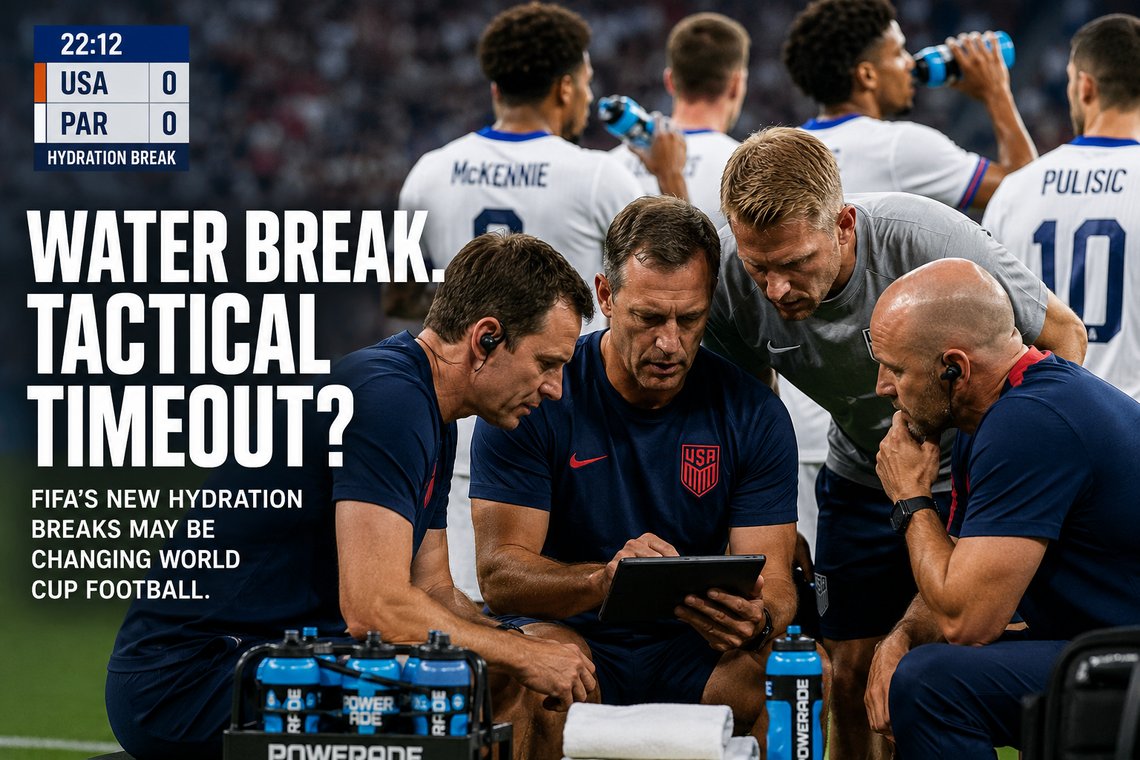
The referee signaled for the hydration break during the United States-Paraguay match and the American bench was already moving.
Not towards hydration or looking for water but towards a tablet.
During the United States-Paraguay broadcast, the American coaching staff could be seen gathering around a tablet during the break. TNT Sports has also noted a similar use of a laptop by Mauricio Pochettino during the United States’ friendly against Senegal.
By the time some of the players reached the touchline, members of the U.S. coaching staff were gathered around a screen. Players drifted over. Coaches pointed. The break had barely started.
Nobody looked surprised. That was the interesting part.
FIFA introduced mandatory three-minute hydration breaks for every match at the 2026 World Cup. The governing body says the measure is designed to protect players during a tournament spread across the North American summer.
Watching the American staff react, it was difficult to escape another conclusion. The coaches had prepared for this too.
Three minutes is enough time to tell a full-back to keep an eye on his man on the wing, tell the midfielders they have to press higher, or tell the strikers to press the keeper higher up.
It is not halftime, but it is no longer just shouting from the technical area either.
For most of football’s history, coaches had to wait. Halftime was the big opportunity. If something was going wrong after twenty minutes, players were often left to solve it themselves. A manager could shout. An assistant could wave his arms from the sideline. The match kept moving.
Now it stops, not for long, just long enough.
A defender who spent the previous ten minutes chasing runners can catch his breath. A midfielder can receive new instructions. Coaches can gather players together without waiting another twenty minutes for halftime.
The whistle blows and the game changes shape for a few minutes.
That is what makes these breaks interesting.
FIFA talks about hydration. Players talk about hydration. Water bottles appear. Towels appear. The official explanation is straightforward enough.
Yet the benches seem to see something else. The American staff certainly did.
Their reaction suggested the break was already part of the game plan. Not an interruption. Not an inconvenience. Another moment to manage and not everybody likes the idea.
Netherlands captain Virgil van Dijk questioned the need for mandatory breaks in matches where heat is not a serious issue, arguing that they interfere with the rhythm of the game. His complaint is easy to understand if you have watched enough football.
Momentum is a strange thing.
Sometimes a team spends fifteen minutes building pressure without scoring. Defenders get deeper. Clearances become rushed. Every attack feels a little more dangerous than the last. Then a whistle arrives and everybody walks to the sideline.
Maybe the stronger team loses something, the weaker team gains something or nothing changes at all.
That uncertainty is what makes the breaks worth watching.
The discussion around this rule has mostly focused on whether players need water. They probably do.
The more interesting question is what happens during those three minutes.
The tablet in the United States-Paraguay match offered one answer.
The players were drinking and the coaches were working.


