

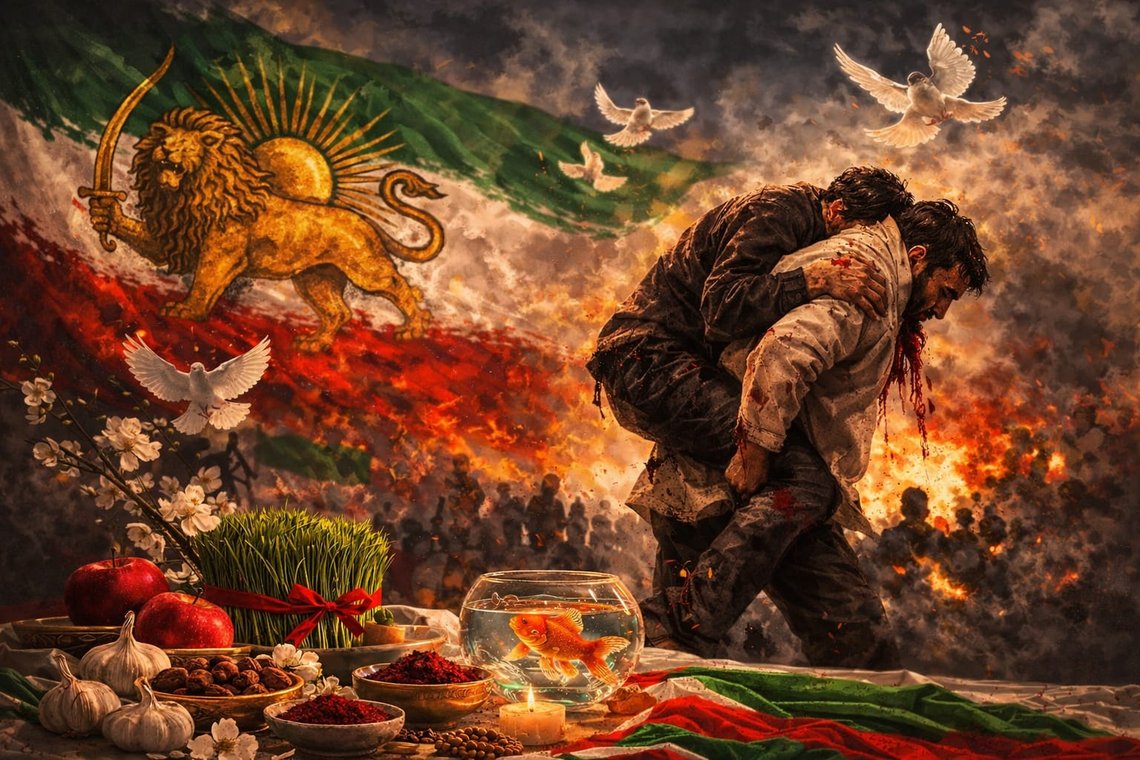
The Persian New Year is called Nowruz. And it means “a new day!”
A celebration that has lived through history.
It began long before religions and ideologies took hold.
At the vernal equinox, when the light returns and nature awakens.
For thousands of years, Iranians have gathered around this day.
Through empires, invasions, and shifting times.
It has survived everything.
It has grown stronger.
Nowruz is more than a celebration.
It is part of us.
A quiet resistance.
Against that which seeks to shape us.
Against that which seeks to erase us.
Against the darkness.
I have celebrated Nowruz in exile for several decades.
Year after year. The same table. The same rituals.
And yet – something was missing.
We were gathered, but a part of us was always somewhere else.
Another country.
Another life.
A place we never truly left, even though we departed.
It is often said that we are a divided people.
Perhaps we were.
There was a distance between those of us who lived outside and those who stood in the midst of it. A distance in reality.
Then came this year.
And something happened.
The distance disappeared.
What happened there lived here at the same time.
The same names.
The same images.
The same sleepless nights.
We were no longer merely following.
We were in it.
For the first time, Nowruz did not feel like something at a distance.
It was here.
Within us.
The Persian New Year approaches. When the earth on Friday 20 March completes yet another silent orbit around the sun and spring once again returns, millions will gather with their families to welcome the new year. But thousands of our bravest and most radiant minds will not be there to embrace their loved ones.
They were taken from us far too early – young lives, brave hearts, and beautiful souls who only dreamed of freedom.
As the new year begins and the fires are lit, we remember them. We speak their names – quietly, yet with hope. Their absence will be felt at every table, in every home, and in every heart that longs for a free Iran.
This Nowruz reminds us of who is missing – and why this year matters. At the same time, this day carries something more.
Nowruz itself is resistance.
Through generations, Iranians have preserved this day – not as a tradition one may choose to abandon, but as something that lives within us. Like a DNA. Through invasions, ideologies, and imposed truths, Nowruz has remained, quiet and alive.
It has always been greater than that which was placed upon us.
Perhaps this is also the most important Nowruz we will ever experience.
A Nowruz that will find its place in the history books. A Nowruz that future generations will write about, study, and discuss in universities. A Nowruz that will shine like a jewel in our long and valuable culture, our history, and our civilisation.
The year we rose.
The year we sacrificed.
The year we were once again reminded of what nation we are.
It was the year we danced at funerals.
We mourned. At the same time, we refused to let them see us broken.
Parents stood over their fallen – their most beautiful – and sang. A clear declaration of resistance. Never forget. Never forgive.
It was the year we turned grief into strength.
The year when a father walked among hundreds of dead young people and cried out his son’s name.
“Sepehr, my Sepehr,” where are you?
He knew there were only dead bodies there.
But for him, they were not dead until he found his own.
It was the year we paid the price.
For every bullet. For every life.
Families were made to pay for the bullets that took their own.
To have the body released.
The state kept accounts of death.
To grant a dignified burial.
To say goodbye.
It was the year when the regime brought in jihadists from neighbouring countries.
Armed them. Sent them against their own.
And it was the year something within us changed.
We shook off the fear.
We found one another.
It was also the year the distance disappeared.
Between those who stood in the streets in Iran
and those who followed everything from outside.
For the first time, the diaspora did not feel like something external.
What happened there lived here at the same time.
The same names were spoken.
The same images were shared.
The same silence descended afterwards.
In retrospect, it may be written that this was the moment when a people, scattered across the world, once again became one.
Not through organisations or slogans.
But through a shared experience.
A shared pain.
A shared understanding.
It was a year that turned logic on its head. A year that one day will sound like a myth when it is retold. A year when a people pleaded to be bombed in order to tear down what held them captive.
A year when a Jewish leader and a Christian leader struck against Islamist rulers – and millions of Iranians responded with gratitude.
A paradox.
But Iran has always lived through paradoxes.
We took a religion that came with conquerors – and made it our own, filled with our language, our poetry, and our philosophy. The Mongols came as occupiers, but ended by bowing to the civilisation they sought to crush.
So history has often been.
Empires have come with swords and dogmas – and departed changed by their encounter with Iran.
And now a new year begins.
Perhaps the year in which a nation not only frees itself from a regime, but also from ideologies and imposed truths.
For Iran is not merely an ancient nation.
It is something rarer still.
A civilisation that falls, rises again – and each time returns to the world with a deeper remembrance of what it truly is.
I know that this is a year our children and grandchildren will speak of.
They will read about it. Discuss it. Attempt to understand it.
And somewhere in those accounts, we too will be there.
Not as heroes.
But as people who stood in it.
A year in which we went against the current.
Against all odds.
And yet held fast.
For some of this is not borne only in memory.
It resides within us.
In the blood.
In every single cell.
Happy New Year.
A new year in which we – together – write history.
By: Afshin Bagherpour – Maximum Support For Iran


