

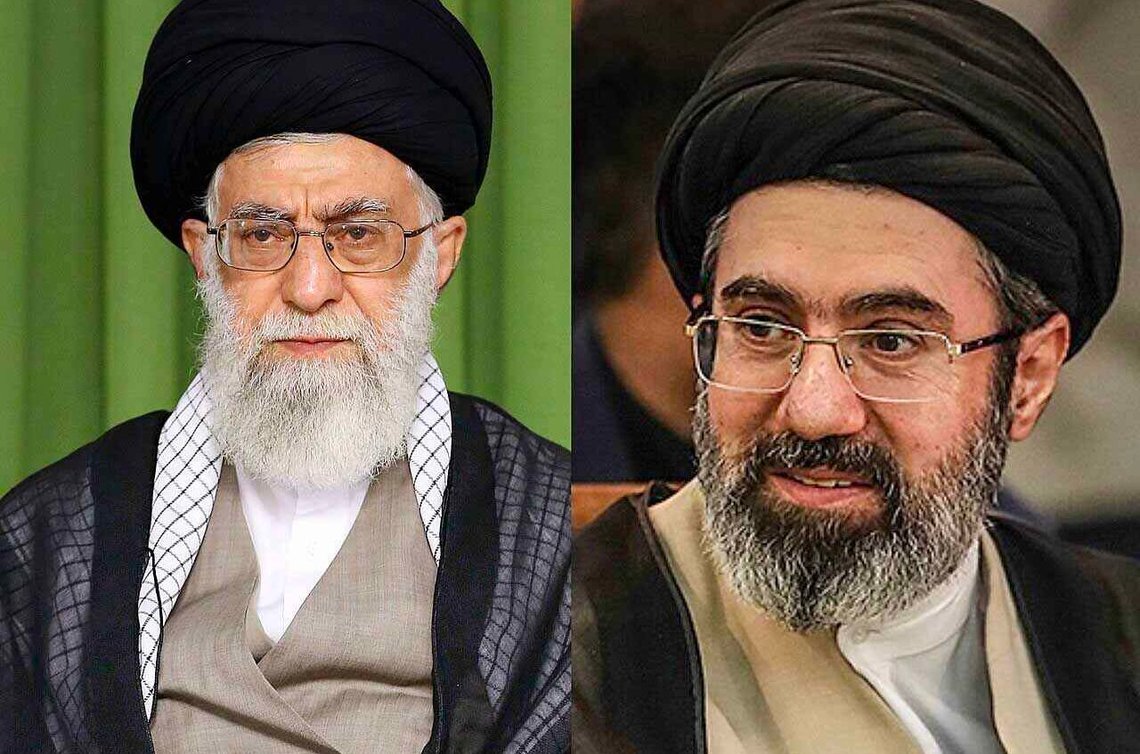


Mojtaba Khamenei’s assumption of power in Iran will not lead to a more moderate course, but rather to a sharpening of the security and power politics that have characterised the country over the past decades. His name is associated with the hard faction of Iran’s power elite, the circles within the Revolutionary Guard, IRGC, that supported the former commander Qasem Soleimani, the man who built up the IRGC’s network of militias and proxy forces in the Middle East and the wider world.
The appointment of Mojtaba Khamenei, 56, son of the slain Ali Khamenei, as Iran’s new Supreme Leader, is the first time since the 1979 Revolution that power has passed from father to son. It constitutes a break with the principle of non-hereditary leadership among the Shia clerics.
The Revolutionary Guard’s man
Mojtaba Khamenei is described as “Ali Khamenei on steroids” – even harder, with deep ties to the Revolutionary Guard and with minimal experience in diplomacy. He is expected to strengthen resistance to any concessions towards the West; he will rather accelerate the nuclear programme and increase support for the proxy groups. At the same time, the choice of him sends a message to the Trump administration: “We will not let you dictate our next leader”.
Mojtaba Khamenei has not been seen since the outbreak of the war and is presumably seriously injured. It is assumed that he was wounded in the legs during the attack that killed his father and parts of the family on 28 February, and that he is keeping in hiding for security reasons. The absence has also triggered rumours that he is dead or in a coma.
The absence undermines his authority. In wartime, visible leadership is critical for morale and propaganda. Trump has called him a lightweight and there is speculation that he will become Israel’s next target.
Extensive network-building
For several decades Mojtaba Khamenei has exercised considerable influence over Iran’s security apparatus. Even without a formal political role he has, in the shadow of his father, been a central figure in Iran’s power structure.
He was born in 1969 in Mashhad as the second eldest son of Ali Khamenei. Although he has rarely appeared in public, he is regarded as one of the most influential figures in Iran’s political system in recent decades. His power has largely been informal and linked to networks within the security apparatus, particularly within the Revolutionary Guard.
This network-building has its roots in the war between Iran and Iraq in the 1980s. As a young man Mojtaba Khamenei participated in the Revolutionary Guard. He served in the Habib Battalion, which was part of the 27th Mohammad Rasoulallah Division. In this unit he became acquainted with Esmail Kowsari, who later became a general in the Revolutionary Guard. The networks from the war years connected Mojtaba to a generation of IRGC veterans who later obtained important positions within the security apparatus, and this milieu formed the basis for his later political influence.
Iranernes forhold til islam er grunnleggende endret i løpet av 47 år med mullaher
A name that is often mentioned in connection with Mojtaba Khamenei’s network is Hossein Taeb. For many years he was regarded as one of Mojtaba’s most loyal allies in the Revolutionary Guard. Taeb had previously led the Basij militia and later became head of the Revolutionary Guard’s Intelligence Organisation, one of the most powerful security institutions in Iran. The appointment was interpreted as a result of Mojtaba Khamenei’s personal trust in him.
This organisation created a structural problem for the system because it operated in parallel with the Ministry of Intelligence, which formally lies under the government. The rivalry between these institutions illustrates how the Revolutionary Guard over time has built up its own power apparatus parallel to the state’s formal structures.
Eventually suspicions arose within parts of the power apparatus that Taeb might have been compromised in security matters, and after the death of President Ebrahim Raisi he was removed from the position. Nevertheless, it is claimed that contact between Taeb and Mojtaba Khamenei continued through informal channels outside public visibility – like most of Mojtaba’s other political activity.
Link between the Supreme Leader and the IRGC hardliners
Mojtaba Khamenei’s role in Iranian politics became clearer in the mid-1990s when he gradually developed into a central link between the office of the Supreme Leader and the hard core of the Revolutionary Guard. In periods of political unrest he is claimed to have played a coordinating role between the leadership and the security forces. Such claims have been made, among other things, in connection with the protests following the presidential election in 2009, during the demonstrations in 2017–2019 and later waves of protests such as Woman, Life, Freedom.
Unlike his father, Mojtaba is not known as a strong speaker. On the few occasions he has appeared in public he has been met with criticism for lacking the rhetorical and religious authority associated with Iran’s supreme leadership. Nor has he ever held a clearly defined public top position, something that has been part of the career path of persons who later became leaders of the Islamic Republic.
Representant for det iranske regime invitert til middag på Slottet igår kveld
Another factor that is highlighted is Mojtaba Khamenei’s religious rank. He is regarded as a “hojatoleslam”, a lower rank within Shia Islam, not as an ayatollah – which is expected of Iran’s Supreme Leader. This “handicap” is compensated for by his support from the Revolutionary Guard.
The protests of recent years have made Mojtaba’s name known in public. During demonstrations, slogans have been reported that expressed opposition to the leadership of the Islamic Republic being made hereditary. The slogans also showed that Mojtaba Khamenei’s name developed into a symbol of the power struggle within the country’s political system.
All power to the Revolutionary Guard’s military-economic complex
Mojtaba Khamenei’s role is not only about political leadership, but also about control over Iran’s economy. The Revolutionary Guard has developed extensive economic control over large parts of the country’s most important sectors – from oil and energy to construction, transport and telecommunications. With Mojtaba Khamenei as the country’s Supreme Leader, the Revolutionary Guard’s military-economic complex may concentrate military, political and economic power within one circle – unless the United States and Israel manage to put a stop to the whole process.
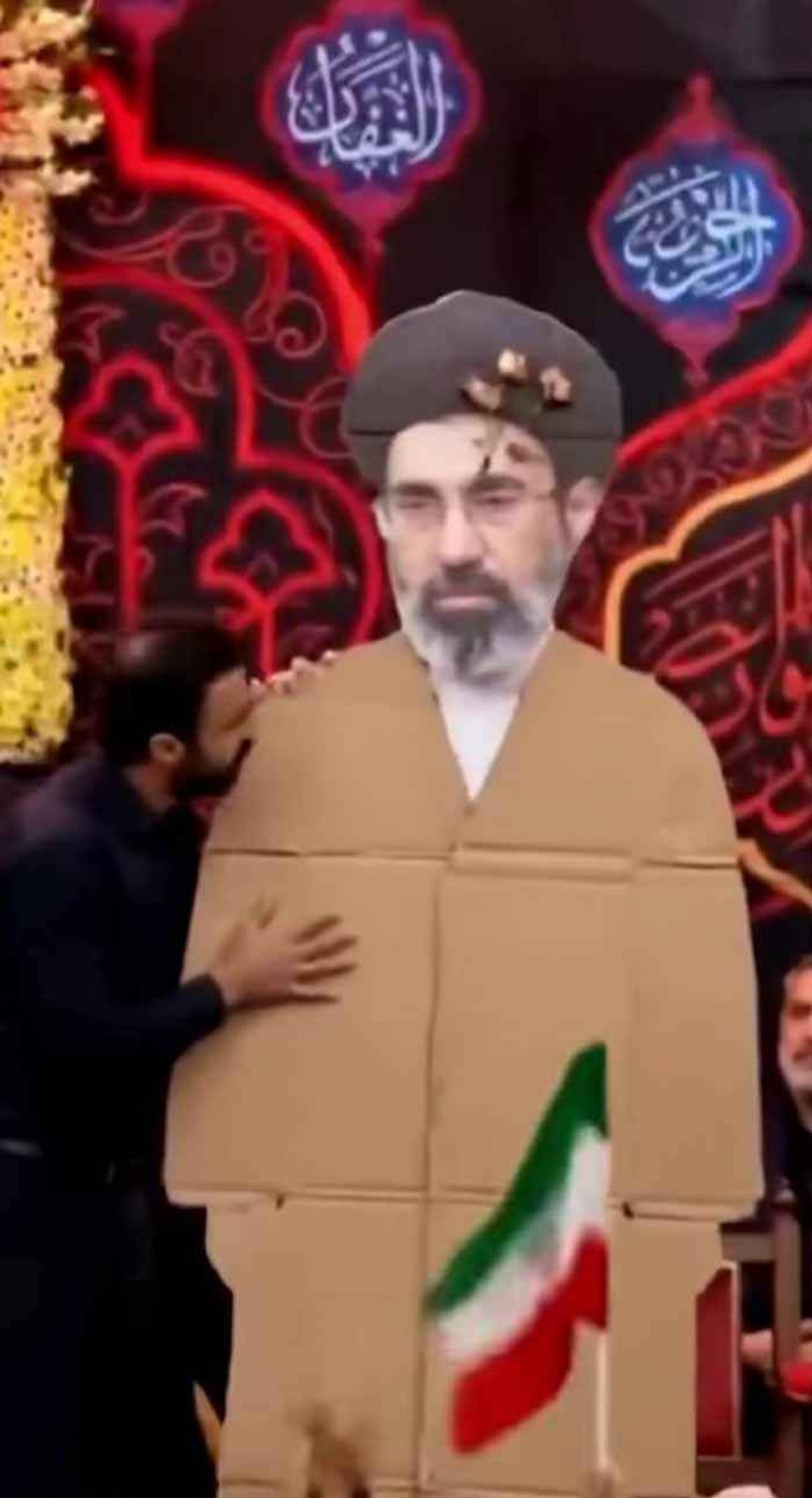 Mojtaba Khamenei has not appeared in public since he was chosen as Supreme Leader of the Islamic Republic – apart from an appearance in the form of a cardboard figure. Photo from social media
Mojtaba Khamenei’s absence from public view may be exploited by the Revolutionary Guard to consolidate control over both the conduct of the war, the economy and its own power structures, while at the same time attempts will be made to prevent the country from falling into a power vacuum. A country without a clear leader in a wartime situation can quickly be destabilised; therefore the silence may be a deliberate strategy if the rumours of death or coma should have substance.
Another and more troubling scenario is that Mojtaba is alive and returns if the war ends without the regime collapsing. In that case Iran may receive a leader who is even more uncompromising than his predecessor. Such a scenario may entail increased militarisation and a possible acceleration of the nuclear programme.
The hidden twelfth Imam?
That Mojtaba has been designated as leader without having appeared in public may appear unusual from a Western perspective, but in Shia Islam there exists a parallel in the notion of the hidden twelfth Imam, Imam Mahdi, whom the faithful await to return. In that perspective the absence will not necessarily be experienced as a break with the regime supporters’ conceptions of leadership.


