

On Wednesday 11 February it was 47 years since the Shah was overthrown and an Islamic dictatorship was introduced in Iran. Over 47 years of mullah rule, Iranians’ relationship with Islam has fundamentally changed – and the change is going in the opposite direction to what the mullahs envisaged: apostasy, distance, and active resistance to Islam are the result, not religious deepening.
What has happened in Iran is not a “normal” secularisation, but a delegitimisation of Islam as a whole. The reason is that Islam is more a political power system than a personal faith system.
– Islam is practised only under coercion and as a façade
When religion at one and the same time becomes both political ideology, state, law, and penal system, it also becomes held responsible for the violence, corruption, and oppression that follow from it. Therefore, most Iranians do not distinguish between “the regime” and “Islam”; it is experienced as what it is: one and the same project.
The information that two thirds of Iran’s approximately 75,000 mosques stand empty or are in practice closed comes from internal Iranian sources. The trend is undisputed: Religious participation is falling dramatically, especially among the young, urban, and educated. Islam is practised only under coercion and as a façade – and the tendency is increasing.
The Internet and social media have been decisive. They have broken the regime’s monopoly on history and knowledge. Many Iranians, especially Gen Z, have rediscovered their pre-Islamic identity, their language, and their history.
That the loss of political sovereignty in the Battle of Qadisiyyah and the Arabs’ conquest of the Sasanian Empire (the New Persian Empire) is still celebrated by the Arabs does not represent “liberation” in Iranians’ consciousness. Saudi Arabia and several other Arab countries have football teams named Qadesiyya. This conquest and celebration of the Persians’ defeat instead reinforces the distance between the Iranian people and Islam.
An identity anchor against Islamisation
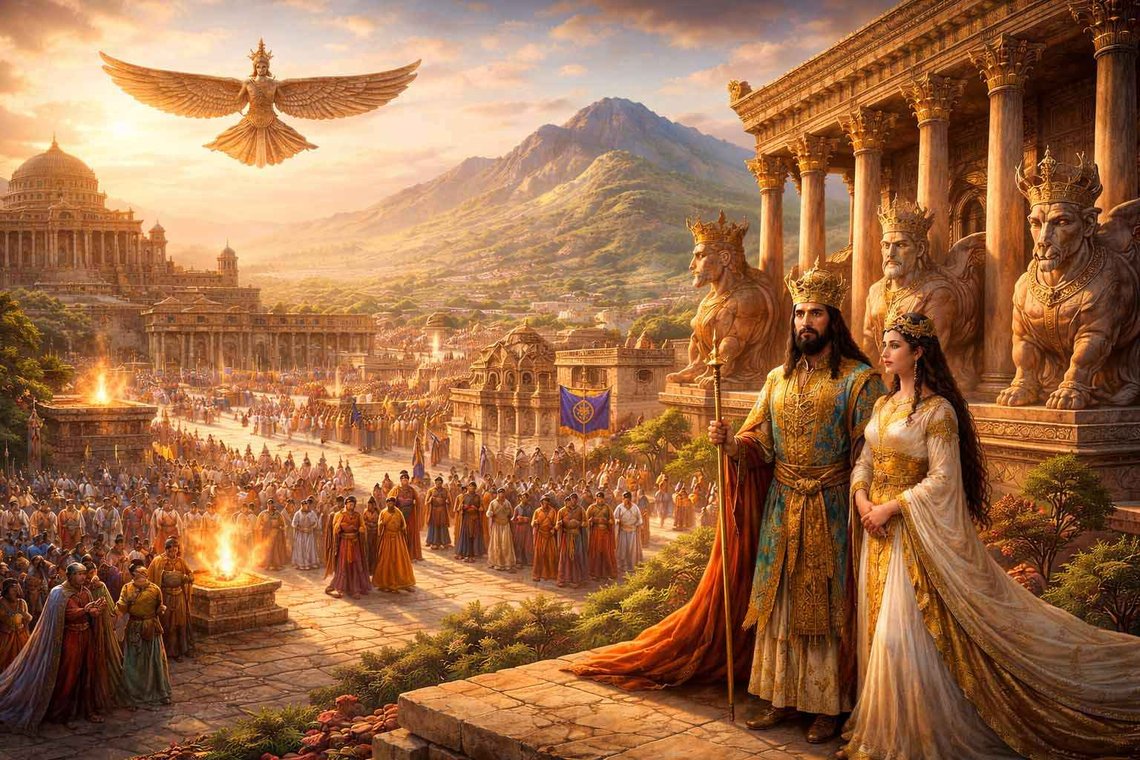
Here the Shâhnâme – “The Book of Kings” –, written by the Persian poet Ferdowsi around the year 1000 AD – plays a central role: This is Iran’s and the entire Persian-speaking world’s national epic. It has through centuries preserved the Persian language and historical self-understanding. Today it functions as an identity anchor against Islamisation. It is therefore not coincidental that many young people turn to national, cultural continuity rather than loyalty to the Arab conquerors’ oppressive religion.
This explains much of why the monarchy and “the Shah” have gained renewed symbolic appeal. It has less to do with nostalgia and more to do with secularism, state continuity, and a clear break with politicised Islam.
Tone-deaf António Guterres
When the UN Secretary-General António Guterres sent the Islamic Republic a warm, official congratulation on the 47th anniversary of the Islamic Revolution, he – together with the Norwegian royal house, which invites the regime’s representative to a gala dinner right in the middle of the slaughter of Iranian children, women, and men – is on a collision course with the future Iran and completely tone-deaf to the realities under which a tormented Iranian people live.
The legend of the king who literally devours his own people
The art video below is inspired by the legend of the blacksmith Kāveh Āhangar, which we find in the Shâhnâme (“The Book of Kings”) by Ferdowsi. It is made by the Iranian artist Bardia Sarshar and has not been published before.
Kāveh Āhangar
In the Persian national epic Shâhnâme stands the tale of Zahhak, a tyrant who in Persian mythology symbolises the king who literally lives off his own people.According to the myth, Zahhak entered into a pact with evil, snakes grew out of his shoulders, and he usurped power from the rightful heir, Fereydun. The snakes had to be fed daily with young men’s brains. The result was a brutal regime that every day killed young boys to keep the king alive.
Kāveh Āhangar was a simple blacksmith whom God had blessed with many sons, but Zahhak had killed 17 of them. When the king’s men came to take the last one, Kāveh had had enough.
He was called to the court to declare that Zahhak was a just ruler, but Kāveh refused, and raised his leather apron – the blacksmith’s work garment – as a banner of revolt.
The apron is later known as Derafsh Kaviani, the legendary Iranian freedom banner.
Kāveh gathered the people in support of the rightful heir, the hero Fereydun, and together they rebelled. Zahhak was defeated and chained to Mount Damavand, where according to the myth he still sits captive.
The story is about the people’s right to overthrow a tyrant and is regarded as one of the most politically charged episodes in the Book of Kings.
Bardia Sarshar was born in Tehran in 1986 and moved to Canada in 2023. He has drawn and painted since he was a child and would like to contribute to Document.


