



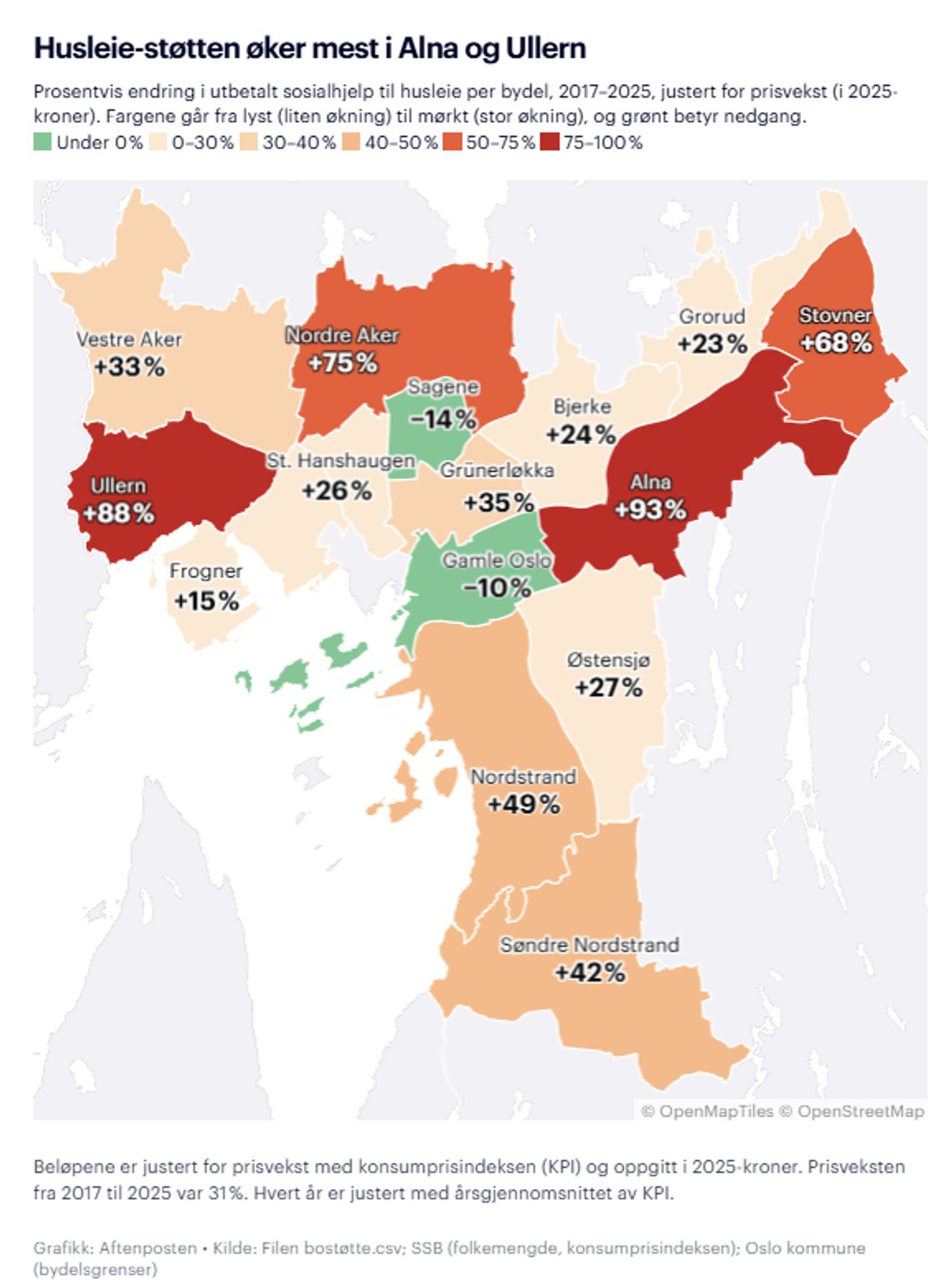
Oslo City Council’s payments to people who are unable to pay their rent have almost doubled. The districts of Stovner, Alna, Nordre Aker and Ullern have been hardest hit.
Oslo City Council’s payments to households struggling to pay their rent have risen from 643 million in 2022 to 1.13 billion in 2025. That is almost a doubling in four years, reports Aftenposten.
– People are worried and scared. They walk around with a knot in their stomachs, dreading the next rent increase, says Anne-Rita Andal, head of the Tenants’ Association.
Rents have risen significantly in recent years. Political decisions have made it less profitable to let out properties. New figures from the Norwegian Estate Agents’ Association show that 16,300 rental properties have disappeared from the Oslo market. One effect of this may be that more people are buying their own homes.
The result is that rents are skyrocketing, meaning that an increasing number of people cannot make ends meet without public support. Julianne Ferskaug (V), City Councillor for Social Services, is concerned.
“Many people find that housing costs are taking up an ever-increasing proportion of their income. For some, it comes down to difficult choices between basic everyday needs,” says Ferskaug.
Renting out property in Norway has become historically unprofitable
Many of the recipients have an income from work. Yet it is still not enough.
– High house prices and rents mean that many people on low incomes face challenges in finding and keeping suitable accommodation. For some, financial social assistance becomes necessary to secure a safe place to live.
The municipal branch of NAV pays for social assistance. Central government transfers do not increase simply because housing costs are skyrocketing in Oslo. Consequently, it is Oslo City Council that ends up footing the bill, which puts a strain on an already hard-pressed local economy.
Many young people on social assistance; immigration is a contributing factor
We are also seeing how certain areas in Eastern Norway are attracting large numbers of immigrants, leading to a sharp rise in local authority expenditure. This applies to areas such as Sarpsborg, Fredrikstad and Lørenskog, as well as Oslo.
- Last year, Oslo paid out 2.5 billion in all forms of financial social assistance. This was distributed amongst 26,304 households. One in four people receiving social assistance is under 30.
- From 2024 to 2025, as many as 11 out of 15 city districts saw an increase in the number of social assistance recipients in this group.
- People living alone without children are the largest single group among recipients.
- Six out of ten people receiving social assistance in Oslo have a foreign background.
– “The increase in social assistance for rent is largely due to market rents for housing,” says Hedda Aas, head of the analysis and research section at the Oslo Welfare Agency.
Among children and young people, the proportion of immigrants in Oslo is very high: One in three residents under the age of 25 in Oslo is either an immigrant or Norwegian-born to immigrant parents.
In some inner-city districts, benefit payments are actually falling, including in Sagene and Gamle Oslo. Demographic changes have meant that we now have a population with higher incomes and stronger links to the labour market in the city centre than before.
“This may have reduced the need for financial social assistance towards rent in several inner-city districts, whilst the need has increased or remained high in several outer districts,” says Ferskaug, who believes the most likely explanation for this is gentrification.
Over a million Norwegians rent a home. Rising rents hit those on low incomes particularly hard, as there is a clear link between income and whether you own or rent your home.
– What affects us most is the fear tenants have of being forced to move. Either because the landlord won’t renew their tenancy agreement, or because rent increases are effectively forcing them out. For many, this is worse than financial hardship and makes people feel very powerless, says Andal.


