

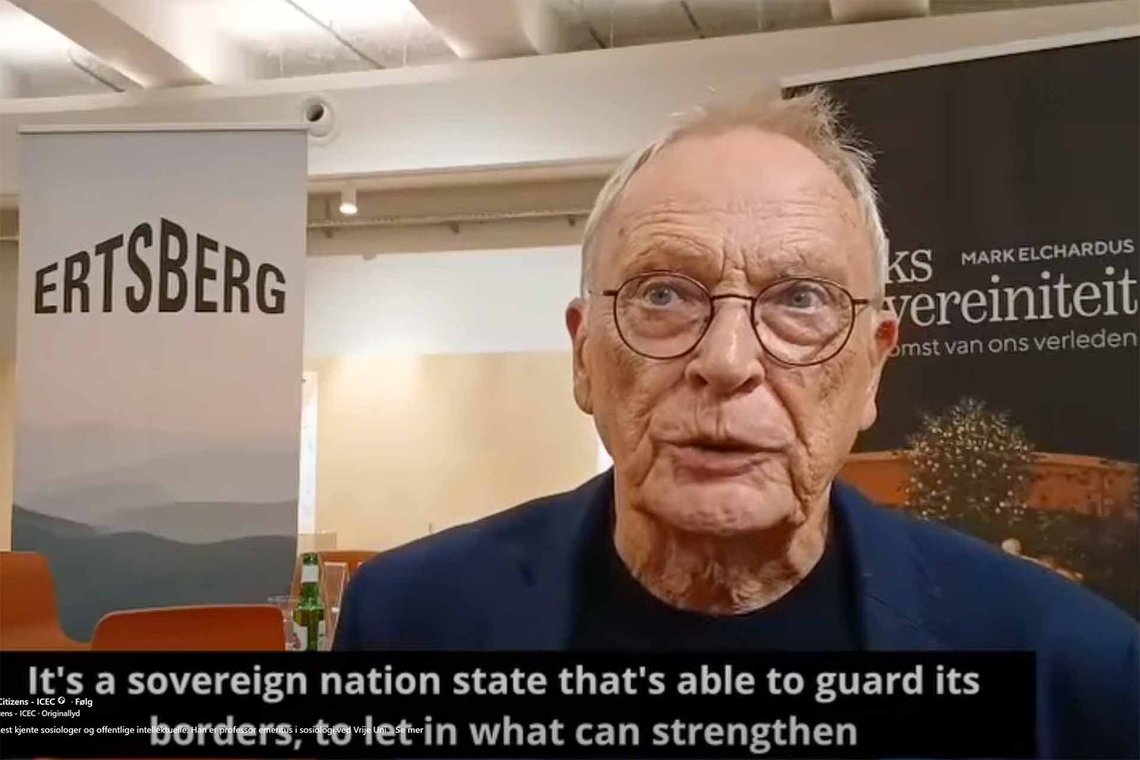


In the podcast *Onze Eeuw*, the Flemish sociologist Mark Elchardus highlights how power in European democracies has shifted from elected politicians to judges and the courts:
– Power has shifted from the people’s representatives to the judges, who today largely determine policy.
He points in particular to migration and climate policy and warns that this undermines voters’ trust in democracy:
– When political issues are increasingly decided in the courtrooms, voters lose the sense of having any real influence. The result may be political apathy or a desire for ‘strong leaders’ who promise to take back power.
The courts are expanding their influence through ‘evolutive interpretation’
Elchardus, professor emeritus at the Vrije Universiteit Brussel, believes that international treaties such as the European Convention on Human Rights (ECHR) grant the courts considerable freedom of interpretation. General formulations regarding ‘respect for life’ or the prohibition of torture are used to impose specific requirements on asylum centres or climate policy – decisions which he believes should be taken by parliaments. He cites a specific example from the Netherlands:
– An asylum seeker could not be returned to Italy under the Dublin Regulation because the court found there were insufficient guarantees of access to shelter, food and running water.
In Europe, both the European Court of Human Rights (ECHR) and the Court of Justice of the European Union (CJEU) have gained considerable influence over national migration policy. Critics argue that, through ‘evolutive interpretation’, the courts have extended their influence in a way that restricts the scope for action of nation states. Examples include rules on safe countries of origin, the return of asylum seekers and requirements regarding reception conditions. Several countries, including Denmark and Italy, have in recent years expressed frustration and sought to limit the ECHR’s influence.
– It is a disaster when judges end up taking precedence over the legislative power. That is effectively the case now, Elchardus begins in his conversation with Samuel Vandeputte and Marc Herman de Groot. – Judges determine immigration policy; judges determine climate policy. Matters that should be decided by parliament:
“Things go wrong when judges come to stand above the legislative power. That is, in fact, the case now”, Elchardus begins in conversation with Samuel Vandeputte and Marc Herman de Groot. “Judges determine immigration policy, judges determine climate policy. Matters that should be decided by parliament…
— Pieter Boudry (@BoudryPieter) 30 October 2026
Supporters of this legal development argue that the courts merely enforce existing human rights and prevent the arbitrary exercise of power. They point out that states still retain considerable sovereignty over immigration matters and that most complaints to the ECHR are dismissed. Nevertheless, many governments feel that their scope for action has been significantly curtailed.
‘Judicial activism’
In the US, the situation is different, but the debate is similar. Migration policy is, in principle, closely linked to the executive and legislative branches. The President and Congress have traditionally enjoyed considerable freedom to formulate rules governing entry, residence and deportation. Nevertheless, the Supreme Court has intervened on several occasions – both to limit and to uphold the President’s authority.
Under both Democratic and Republican administrations, federal courts have blocked or approved measures such as travel restrictions, the ‘Remain in Mexico’ programme, border closures and asylum rules.
From the right, liberal judges are accused of ‘judicial activism’, whilst from the left it is claimed that conservative judges are overly supportive of the President.
Unlike Europe, the US lacks a supranational legal system such as the ECHR, which provides greater political leeway – but also leads to a more polarised debate over the role of the courts.


