



Reply to Tove Elisabeth Rooney:
I refer to your email, which I received on Monday 2 November at 14.46, entitled ‘From Documents’ US correspondent: Misleading portrayal of food and petrol prices in the US in “Thomas Seltzer: – MAGA is over’”.
You call yourself a media critic, but you haven’t checked the most basic facts. Here are your errors:
1. Food prices: In the article, you write that I was in ‘the most expensive of all US states, both in terms of petrol and food’. That is incorrect. Hawaii and Alaska are more expensive, as shown by the map you yourself use (36 and 27 per cent above the average). Further down, you do specify ‘the contiguous US’, but it is the first claim that is used to label me a cherry-picker. According to the same map, California is 11 per cent above the national average and Florida 6 per cent. A five-percentage-point difference does not explain a tripling of the price of strawberries.
2. Strawberries: You yourself write that the strawberries you buy in Florida ‘are often from California’. Florida’s strawberry season has barely begun. California produces around 90 per cent of the US’s strawberries and dominates the market from April to November. So it is not Californian policy that explains the price difference. You are, in other words, boasting about cheap strawberries from the very state you are attacking. You are also comparing an offer at the discount chain Aldi with a standard supermarket, and admit yourself that Aldi is far cheaper than Publix, where you usually shop.
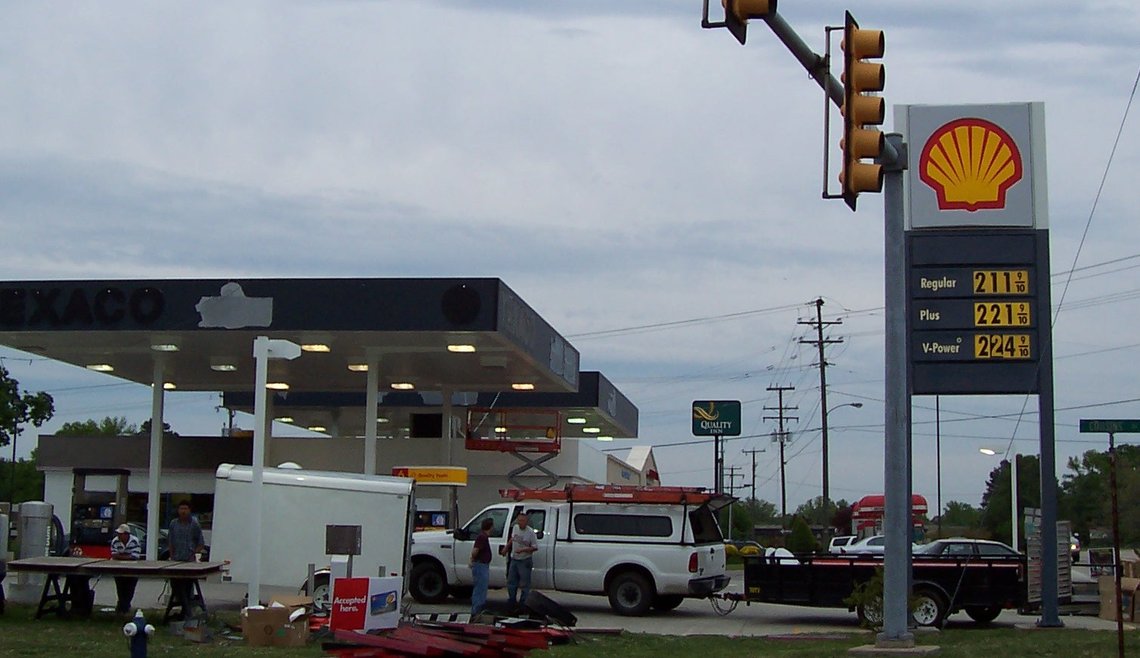
3. Petrol: The average price in California was $5.91 per gallon according to AAA on 2 November. ‘Around $6’ is correct, and you yourself quote the same figure. To put this into perspective, you single out North Carolina, the cheapest state in the whole country. The national average is around $4.20. Your article about me is called ‘cherry-picking’, but it is clearly you who are doing just that:
You blame petrol prices in California on Newsom and the Democrats. How, then, do you explain Idaho and Utah? Both are Republican strongholds, both have prices of $4.53 per gallon, and both are above the national average. The whole of the western US has higher petrol prices because the region is isolated from the major refineries on the Gulf of Mexico. You confirm this yourself when you write that California lacks pipelines from other states and is dependent on its own refineries and imports by ship. It’s geography, not Newsom.
4. Your entire article is based on the premise that it is not true that petrol and food have become expensive in the US. You call it ‘ridiculous’. In that case, it is not just me you disagree with. You disagree with the American people:
Almost four in five Americans say that inflation is a ‘very big’ concern for them personally (Reuters/Ipsos, February 2026). 82 per cent of likely voters say that inflation is very important to how they will vote in the mid-term elections (CBS News, September 2026). Only 17 per cent approve of Trump’s handling of the cost of living (AP-NORC, September 2026).
And the figures prove them right. Prices are higher now than when Biden left office. Price levels have risen by around 5 per cent since January 2025 (BLS). Inflation stood at 3.0 per cent when Trump took office. In September, it stood at 3.7 per cent. Petrol cost an average of $3.10 per gallon in January 2025 (AAA). Today it costs around $4.20, an increase of over a third. Yes, petrol was cheap in January this year. Then Trump started the war against Iran, and prices shot up. He promised to bring prices down. They have gone up.
You live in the US and call yourself a US correspondent. Nevertheless, after a brief visit to California, I must tell you what Americans themselves are saying loud and clear: life has become too expensive. It is not I who have lost touch with everyday American life.
That a US correspondent dismisses this by saying that the restaurants are full where she lives, we must chalk up to the Marie Antoinette account: Let them eat cake. Incidentally, it would have been amusing to see *Document*’s reaction if an NRK correspondent had written something similar.
Incidentally, you needn’t take my word for any of this. The day after the election, JD Vance himself wrote that the Republicans lost because of the war and the cost of living, and that many who voted for Trump/Vance in 2024 voted for the Democrats in 2026. ‘Focus on cost of living/inflation’ is number two on his own list of what is needed to win back voters. What you call ‘ridiculous’, the Vice-President calls a key reason why his party lost. So he agrees with me, and disagrees with you.
But perhaps it wasn’t the prices of petrol and strawberries that you were actually reacting to in Nettavisens interview with me. I reckon you were most provoked by the fact that I, backed by solid facts, pointed out that Trump and his cronies are historically unpopular. If that’s the case, I can live with it. Remember: facts don’t care about your feelings.
Trump’s approval ratings are at a record low. In a Reuters/Ipsos poll (2 November), only 32 per cent approve of the job he is doing. According to Silver Bulletin’s average of polls, only 21 per cent strongly support him, whilst nearly half strongly disapprove of him. According to NBC News (1 November), a third of Trump’s own voters say he has failed to deliver. The proportion of Republicans who identify as MAGA has fallen in poll after poll. The movement never had the support of a majority of Americans, and is losing more and more support within its own party.
The cost of living is a major factor. In the same AP-NORC poll, 65 per cent believe that Trump’s policies are more to blame for the high prices than factors beyond his control. In the Reuters/Ipsos poll in September, for the first time, more Republicans disapproved of his handling of the cost of living than approved of it: 51 per cent to 44 per cent. That is precisely why food and petrol prices were my point.
I could, of course, have mentioned other areas where Trump & co. have failed, according to the voters themselves. In the AP-NORC poll, only 28 per cent approve of his handling of Iran, 38 per cent of his trade policy and 39 per cent of his immigration policy. Only one in five Americans believe the war against Iran has been worth it (Reuters/Ipsos, August). Even on immigration, which was Trump’s strongest issue, he faces a majority of opposition.
Epstein: This was the second issue I highlighted in Nettavisen, and in several polls it has fared worse for Trump than any other. In the Economist/YouGov poll (January 2026), only 24 per cent approved of his handling of the Epstein case, whilst 57 per cent disapproved. 53 per cent believed he was trying to cover up Epstein’s crimes, and half believed he was involved in them. Among MAGA Republicans, only 5 per cent shared this view (February 2026). That says a lot about how isolated the core of the movement has become from the rest of the country.
If you believe this is incorrect, I advise you to take it up with the polling organisations. If they admit to errors or lies, I shall pass this on.
You have previously written that I ‘hate America’, based on my criticism of Trump. So you believe that criticising a president is treason. In the latest Reuters/Ipsos poll, 64 per cent of Americans disapprove of Trump’s performance – nearly two in three. Do they also hate the US?
The reality is that you have chosen to settle in a country where a clear majority of the population have had enough of the most corrupt, incompetent and oligarch-friendly president and vice-president in American history.
A word of advice, Tove Elisabeth: as an immigrant, you should start by respecting the citizens of the country that has been so generous as to let you live there, and integrate yourself in accordance with their values.
Finally, on the subject of press ethics. In your email, you wrote that you were ‘writing a comment’. You sent me neither a link to nor a copy of the article, just a few questions. Nor did you mention that it was due to be published seven minutes later. Your article, ‘Thomas Seltzer cherry-picking in California’, was published at 14.53. Seven minutes is not a realistic opportunity to respond, nor does it constitute a simultaneous rebuttal, cf. point 4.14 of the Code of Conduct for the Press.
Document is subject to the Press’s Professional Committee and has undertaken to comply with the Code of Conduct. Editor Hans Rustad is a member of the Norwegian Editors’ Association and is therefore personally bound by both the Code of Conduct and the Editors’ Code. I therefore expect the right of reply in accordance with section 4.15: my reply must be published in full, promptly and in a prominent position, not chopped up into quotes that suit you and Document. Your incorrect information must be corrected, cf. clause 4.13. If this does not happen, I will lodge a complaint with the PFU.
Thomas Seltzer
American patriot


