

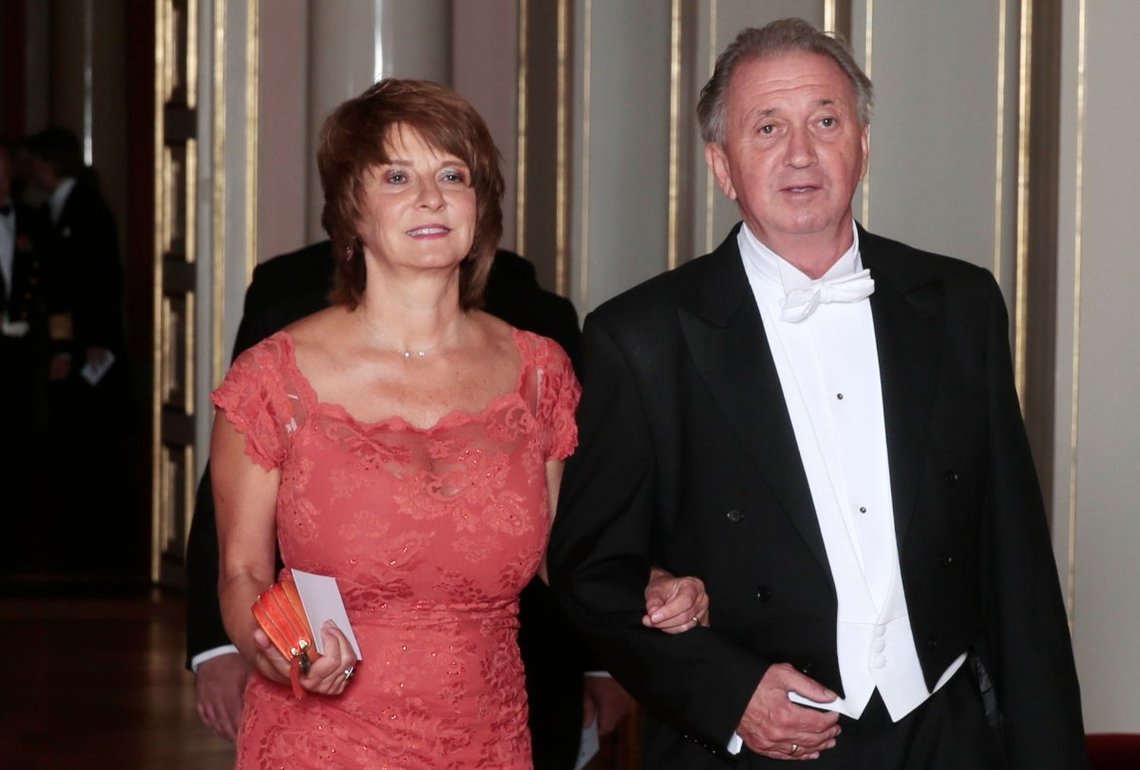
He was once one of Norway’s most influential diplomats. He moved among heads of state, billionaires and people of power. He was described as a rock star of international diplomacy. Today, Terje Rød-Larsen, 78 years old and seriously debilitated after two strokes, sits in his villa on the Greek island of Paxos. The images of him raise a question far greater than the Epstein case: What actually remains of a person’s life when the applause dies away?
NRK’s Brennpunkt documentary ‘The Diplomat Couple’ (‘Diplomatparet’) is, on the surface, a story about Mona Juul and Terje Rød-Larsen. About the Oslo Accords, diplomacy, power, networks – and the connection to Jeffrey Epstein. But perhaps the story is also about something far more fundamental. About what we humans choose to pursue. And about the price we sometimes pay. For the contrast is brutal.
Terje Rød-Larsen was the man who moved in the innermost circles. The man who knew the right people. The man with the telephone numbers, the contacts and the connections. Jeffrey Epstein was one of them. Rød-Larsen now explains why the connection was valuable: Epstein opened doors to wealthy people who could contribute financially to the International Peace Institute (IPI). There, perhaps, lies a key to the entire story. Doors. The entire world of power consists of doors. Who lets you in? Who introduces you? Who can finance your project? Who can lift you further? Who do you know who knows someone? But there is one question that is far more important than which doors are opened: What must you close your eyes to when you walk through them?
Rød-Larsen now says that he ‘deeply regrets’ his relationship with Epstein, and that he should have broken off the connection earlier. Those are strong words. But they also leave questions. What is it, really, that he regrets? Does he regret the connection because Epstein turned out to be the man he was? Does he regret that he did not ask more questions? Does he regret that the warning signs did not carry greater weight than the network, the money and the opportunities? Or does he primarily regret the consequences the connection later had? Only Terje Rød-Larsen himself knows that. And precisely for that reason, the question is interesting. For regret can mean different things. There is a difference between regretting an action and regretting that the action had consequences. The difference exists within the human being, and no documentary can film it.
Rød-Larsen says that Epstein rejected the allegations against him, and that he believed Epstein’s explanations, even though he had doubts. But it is precisely the words ‘had doubts’ that are difficult to get past. For what does a person do when doubt arises? Does one investigate? Does one withdraw? Or does one continue because the connection is too useful to lose?
A former IPI employee says in the documentary that in 2015 she was tasked with investigating whether there were media reports linking the Jeffrey Epstein Foundation to IPI’s Bahrain office. Rød-Larsen’s lawyer says that he does not remember the episode today. But if the story is true, it raises an important question: When does a person begin to understand that a connection may be problematic? And for how long can one continue telling oneself that everything is probably all right?
There is something of Greek tragedy about the story. The man who once stood at the centre of the international stage now sits on a Greek island. Gone are the flashbulbs. Gone are the summits. Gone is the feeling of being at the centre of history. What remains is an old, defeated man. And perhaps that is precisely why the image makes an impression. Not because we should take pleasure in another person’s fall, but because it reminds us of how transient power is. Prestige does not last. Titles do not last. Money does not last. Applause most certainly does not last. In the end comes silence. And in that silence there are questions that no adviser, fellow diplomat or billionaire can answer for you: Was it worth it?
And then there is a part of this story that means all polemics must fall silent. Mona Juul and Terje Rød-Larsen have lost their 25-year-old son to suicide. Their son was involuntarily drawn into the Epstein case and the intense public scrutiny surrounding the family. The tragedy thus also becomes a brutal reminder of something that people in positions of power perhaps think about far too rarely: Our choices do not always stop with us. They can have repercussions. They can affect spouses. Children. Families. People who never asked to become part of the story. That does not mean that parents can be held responsible for a child’s suicide, but it does mean that none of us lives an isolated life.
Epstein was not merely an acquaintance. Rød-Larsen has acknowledged borrowing money from him. The International Peace Institute received funding from him. Released documents have also shown that Rød-Larsen and Juul’s two children were intended to receive substantial sums in Epstein’s will. Rød-Larsen himself says that Epstein was a ‘very valuable contact’. But what does value actually mean? That is perhaps the most interesting question in the story. We measure value in money. Property. Career. Influence. Contacts. Titles. But life keeps a different set of accounts. There are entries that appear in no annual accounts: Integrity. Family. Conscience. Sleep. Self-respect. Peace. And love.
I do not know whether Terje Rød-Larsen is happy where he sits in the villa on Paxos. No outsider can know that. Perhaps he feels gratitude for a long and eventful life. Perhaps he feels sorrow. Perhaps regret. Perhaps anger. Perhaps peace. Perhaps all of it. But I wonder what he thinks when he looks back. What remains when one approaches the end of life and looks back at the entire balance sheet? Would he have chosen differently if he could live his life once again? Would he have traded some of the contacts, the money, the journeys and the positions for a simpler life? Only he can answer that.
It is easy to turn this into a story about ‘the others’. The elite. The diplomats. The people of power. But then we may miss the most important lesson. For on a smaller scale, we all face the same question. What is enough? How much are we willing to sacrifice to rise higher? How many compromises can we make before we no longer recognise the person in the mirror? How many warning signs can we ignore because the person on the other side of the table is useful? Rød-Larsen’s story should therefore, above all, prompt reflection. For life has a strange ability to strip us of everything we thought defined us. The position disappears. The telephone stops ringing. The invitations no longer arrive. The people who flocked around power find new people with power. In the end, we are left with ourselves. Then it matters little how many heads of state we have met. How many billionaires we knew. How large the villa is. Or how impressive the CV once was. Then perhaps only the simplest and most difficult question of all remains:
Did I live a life I can stand by?


