

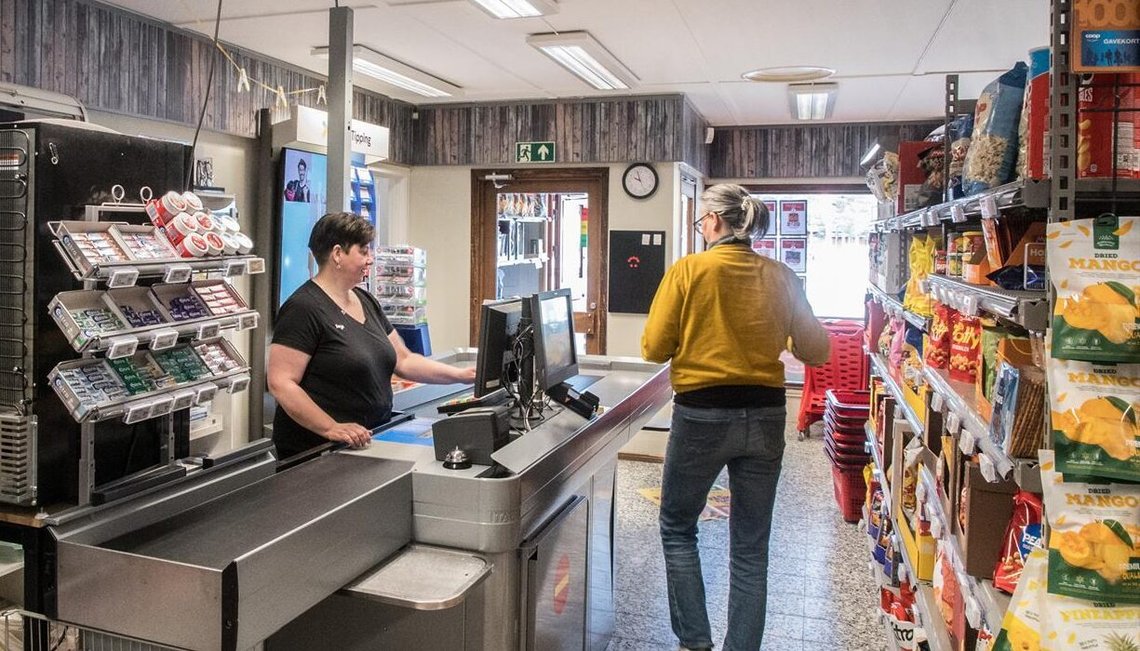


When politicians talk about business, they almost always talk about the large companies, the major players and the biggest turnovers. Policy is shaped accordingly. But it is not Equinor and Hydro that make up Norwegian business. Only 0.1 per cent of registered enterprises in Norway have more than 250 employees. Fully 90 per cent have fewer than six employees. Only 33 per cent of Norwegian businesses actually have employees.
Our business sector, then, is not the corporate giants politicians like to talk about. Norway depends on small and local businesses. It is grocery shops, clothing stores, shopping centres, plumbers, dentists and hairdressers that keep Norway running. Small businesses are the giant, and the giants are small – if we leave aside the oil sector.
Major survey on the conditions facing small businesses
Fiken is the accounting system used by 130,000 Norwegian businesses. It has now conducted a survey among Fiken customers who have used the accounting software for more than six months and operate either as sole proprietorships or limited companies with fewer than six employees. A total of 5,296 small business owners responded, of whom 2,871 operated sole proprietorships and 2,425 limited companies.
The figures show that as many as 49.9 per cent somewhat or completely agree that “there is too much bureaucracy in the public sector. It steals time, energy and resources from my business.” Meanwhile, 68.4 per cent somewhat or completely disagree with the statement that “politicians recognise how important small businesses like mine are to Norway and have a good understanding of what it is like to run a small business.”
When asked which political party best safeguards the interests of small businesses in Norway, 18.7 per cent believe the Progress Party (Fremskrittspartiet) is the answer, while 14.2 per cent believe the Conservative Party (Høyre) is the solution. The Liberal Party (Venstre) has favourable framework conditions for small businesses as one of its core issues, yet only 9.9 per cent agree that it is the best on this matter. Most interestingly, however, as many as 27.5 per cent answer “don’t know”. Because no party is really good at this.
No confidence in the government and the Labour Party
Confidence in the government is at rock bottom, with only 5.9 per cent somewhat or completely agreeing that “the current government will make it easier to run your own business in the years ahead”. A full 42.6 per cent completely disagree – and unfortunately they are right.
Fiken’s survey also reveals what small business owners believe makes everyday life most difficult: 26 per cent cite taxes and duties. Nineteen per cent point to laws and regulations. Uncertainty surrounding liquidity and new assignments also ranks highly, while bureaucracy and public reporting come fifth at 14 per cent.
When it comes to what politicians should prioritise in the future, as many as 73 per cent answer tax cuts and incentive schemes, together with simplification and a reduction in bureaucratic reporting requirements. That is not going to happen, because in 2025 the EU Taxonomy came fully into force. This is a major reason for the collapse among contractors, who now spend more time reporting climate measures and implementing extremely costly “climate measures” than actually building anything. It is taking a heavy toll on profitability.
Despite the authorities undermining business through meaningless EU regulation and destructive taxation, as many as 46 per cent say they would start their business all over again, even knowing everything they know today. But the conclusion is clear:
Much remains to be done to make it easy and worthwhile to run a small business in Norway.


