

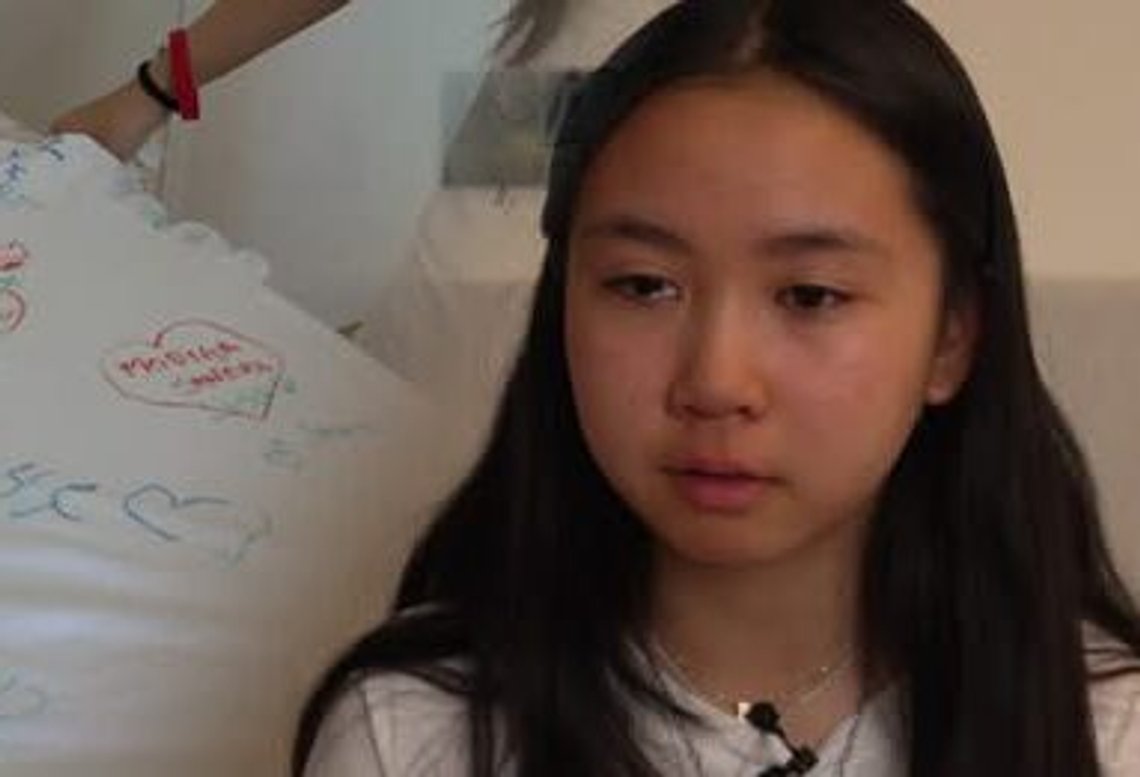
All of Sweden is crying for 13-year-old Sandra. But behind the headlines about a child being deported lies a story the media would rather not tell: 18 years of rejected applications, appeals, and ignored deportation orders. The question is not why Sandra must leave Sweden – the question is why her mother never did.
When TV4 and other media outlets tell the story of 13-year-old Sandra, readers are presented with a narrative that is difficult to resist. A girl who has grown up in Sweden is to be deported to a country she has never visited. The images are powerful, the interviews emotional, and the message clear: Swedish authorities are failing a child.
“A few days ago, it was the end of the school year. Sandra finished sixth grade at a school in the Stockholm area, but instead of excitement about the upcoming summer break, the occasion was marked by heavier emotions. She asked her classmates to write messages on a white T-shirt that she could bring with her on the first flight of her life.”
“Shame on you, Tidö Nazis!”
TV4 News suggests that Sandra’s deportation is the result of the Tidö government’s stricter residence permit requirements. Aftonbladet likewise argues that the case stems from higher income requirements and the fact that “particularly distressing circumstances” are no longer sufficient grounds for a residence permit, emphasizing the perceived inhumanity of the deportation: Sandra was born in Sweden, has attended school there, and “speaks very little Mongolian.”
“Sandra’s deportation, like that of many other affected children, is the result of several poorly conceived laws designed to force people to leave Sweden, and which, when combined, create a toxic mix,” writes Member of Parliament Martin Ådahl (Centre Party).
Unsurprisingly, the deportation of the 13-year-old has sparked massive protests on social media. “Damn today’s Sweden. It’s shameful,” “These inhumane and incomprehensible rules must end, I CANNOT BELIEVE this is happening in Sweden in 2026!!!!,” “Absolutely disgusting!! Poor child!,” “Shame on you, Tidö Nazis!”
 Photo: Screenshot from Facebook / Vi står inte ut men vi slutar aldrig kämpa (“We can’t take it any more, but we never stop fighting”)
The comments continue in that vein, with strong reactions from people across the political spectrum – and that is entirely understandable. For a 13-year-old girl to leave her home, school, and friends for a country she has never visited and whose language she does not speak is a tragedy for her.
Sandra – a pawn in the political game
And with a parliamentary election only three months away, Sandra has become an obvious pawn in the political game.
– When a child is born and raised in Sweden, that child must have the right to their home, their private life, to continue their education, and to continue living with their friends. That must carry significant weight. The child must be allowed to stay, says Annika Hirvonen of the Green Party.
– We have all reacted to the unreasonable deportations we have seen. I believe we will need to undertake a complete review of migration legislation, says Social Democratic migration spokesperson Ida Karkiainen.
“We must all, regardless of political affiliation, reflect on what has happened to our country, and how we can, as soon as possible, make things right for Sandra and others in her situation”, Martin Ådahl concludes in his opinion piece in Aftonbladet.
Implicitly, Hirvonen, Karkiainen, and Ådahl argue that anyone who cares about Sandra and other children in similar situations should vote for the left-wing bloc in the upcoming election, because a left-wing government would not act as heartlessly as the current one.
But that is exactly what their preferred governments have done. Several times, in fact.
Constant rejections for 18 years
There is a crucial part of the story that readers – for some reason – are not being told.
Sandra is not the subject of a sudden or unexpected government decision. Her family’s case has been reviewed by Swedish authorities for nearly two decades. Asylum applications have been rejected, appeals have been rejected, and deportation orders have been issued by both authorities and courts under governments of different political colors – including during the left-wing era of “Open Doors” migration policies.
The Sandra case stretches back 18 years, before Sandra was even born.
Sandra’s mother, Sarnai, came to Sweden from Mongolia and first applied for asylum in 2008. Her application was rejected after less than four months. Sarnai appealed, but the appeal was rejected six months later.
In August 2009, Sarnai filed what is known as an impediment-to-enforcement claim, arguing that it was too dangerous for her to return to her home country. This claim was also rejected after just over a week. Nevertheless, Sarnai did not return to Mongolia despite the rulings. Instead, she chose to remain in Sweden illegally – and it was during this period that Sandra was born.
At the time, Sweden was governed by a coalition consisting of the Moderate Party, the Centre Party, the Liberal Party, and the Christian Democrats.
Let us pause and summarize: A woman with multiple deportation orders chooses to remain in Sweden illegally. During this period, she receives housing and financial support paid for by Swedish taxpayers, and she also gives birth to her child in a Swedish hospital.
Continued rejections despite “open hearts”…
In 2013, another asylum application was submitted – this time including her daughter. These applications were also rejected. The following year, in 2014, the case was handed over to the police for deportation enforcement, yet both Sarnai and Sandra remained in the country.
One notable detail is that the center-right coalition won the 2010 parliamentary election, but because Swedish voters had also elected the Sweden Democrats to Parliament, then-Prime Minister Fredrik Reinfeldt chose to open Sweden’s doors wider than ever.
Had Swedish voters elected a party advocating reduced immigration? Then they would be punished by receiving even more of it. Yet despite this, Sarnai and her daughter were denied asylum, and the case was referred to the police the same year Reinfeldt delivered his famous speech urging Swedes to “open their hearts.”
…and under Social Democratic governments
Another asylum application was submitted in 2018 and was also rejected – despite then-Prime Minister Stefan Löfven having declared three years earlier that “my Europe builds no walls.” In 2019, however, a temporary residence permit was granted through the so-called “track change” system, which allowed certain rejected asylum seekers to remain in Sweden based on work or studies.
The track-change system was introduced when the Social Democrats governed together with the Green Party. Its purpose was to allow people without asylum grounds to remain in Sweden.
The temporary residence permit remained valid until 2022, when Sarnai applied for an extension for herself and her daughter. At that time Sweden was still governed by the Social Democrats under Prime Minister Magdalena Andersson. Sweden’s doors remained open, but it made no difference. The application was rejected.
Let us summarize once more: By that point, the mother had been living illegally in Sweden for 14 years. During that period, Sweden had shifted from a center-right government to a left-wing coalition and then to a Social Democratic government, with the Social Democrats and the Green Party pursuing a consciously ultra-liberal immigration policy between 2014 and 2022.
Despite this, Sarnai was repeatedly denied asylum. Yet despite her highly uncertain situation, she chose to have a child, who, despite the rejected asylum applications and deportation orders, enjoyed full access to Swedish childcare and schooling.
The media’s focus ignores the cause
Then came the day that arguably should have arrived 18 years earlier, when Sarnai boarded a plane back to Mongolia together with her daughter, since children and parents are obviously not separated.
Yet Sweden appears united in outrage and compassion – and the reason is simple: when the media focus exclusively on the final chapter of a story that has unfolded over nearly two decades, they create the impression that authorities have suddenly pulled the rug out from under an innocent teenager. But Sandra’s situation did not arise overnight. It is the result of a long series of decisions, in which her mother was repeatedly informed that she had no legal right to remain in Sweden.
– Highlights how damaging migration policy has been
The reality that the media choose to omit is that the family’s applications have been reviewed time and again, always with the same result, and that every rejection carries an obligation to leave the country. If that obligation is ignored, consequences will eventually follow. And when parents make poorly considered decisions, their children are affected as well.
That is tragic, but it does not change who made the decisions along the way and who bears responsibility for the consequences.
– This highlights just how damaging Sweden’s previous migration policy has been. People could remain in our country for ten, fifteen, even twenty years without having the right to be here, Migration Minister Johan Forssell told TV4.
– There is nothing humane, in my view, about the old policy under which people with rejected applications were allowed to remain year after year. Going home does not become easier simply because the process is stretched out for many years. In fact, it often becomes much harder.
Sandra’s tears and despair over having to travel to Mongolia are not Sweden’s fault. It is Sandra’s mother – not the Swedish state and not the current government – who ignored the decisions. Therefore, it is Sandra’s mother who bears full responsibility for her daughter’s situation.
The point at which Sweden actually failed
There is, however, one respect in which Sweden genuinely failed: Swedish legislation and Swedish authorities made it possible for Sarnai to remain illegally in the country for 18 years. And who can blame her? She was able to live in Sweden for nearly two decades, with housing, a registered address, access to healthcare, and financial support. Her daughter had access to Swedish child healthcare services, preschool, and school.
Why would she leave?
The uncomfortable question is therefore not why the state is now enforcing a decision. The uncomfortable question is why an adult chose to remain year after year despite repeated rejections, while a child grew up amid that uncertainty – and why successive governments made it possible for them to stay.


