Samira Nawa of the party Radikale Venstre is the first Muslim to be appointed a minister in Denmark. Her parents are Afghan asylum seekers, and Afghans and other Muslims are now celebrating that one of their “own” has attained such an important position in the Nordic region. In Denmark, opinions are divided. There has previously been considerable media attention surrounding Nawa, including in a recent discussion about what ethnicity is.
Originates from Afghanistan
Samira Nawa was born in Denmark in 1988 and grew up in Roskilde. Her parents came there from Afghanistan, via Pakistan, and were granted asylum not long before Samira was born. Samira Nawa is married to Naweed Amini, who reportedly also has an Afghan background. Samira Nawa has now become a minister in Mette Frederiksen’s new government, which is regarded as being more left-leaning than the previous one.
Minister for Climate and Energy
Samira Nawa became head of an umbrella organisation for youth organisations at the age of 22, and from there her political career began, alongside studies in economics. Among other things, she was a candidate for the European Parliament in 2014 on behalf of Radikale Venstre. That did not succeed at the time, but a few days ago she was appointed Minister for Climate, Energy and Utilities, Denmark’s very first Muslim minister.
Dispute over who is Danish
When Nawa entered national politics in 2019, she did not wish to be the politician who always spoke about integration and identity. Nevertheless, that is perhaps what she has become best known for. So much so that this spring she became involved in a heated discussion about ethnicity and nationality. The discussion arose from a post on X by Folketing politician Nadja Natalie Isaksen, who dared to say that there is a difference between ethnicity and citizenship, and that a cat does not become a horse because it is born in a stable.
Nawa was born in Denmark to Afghan parents who sought asylum a couple of years before she was born.
Forsvarer politiker som skiller dansk etnisitet fra dansk statsborgerskap
Praised as an Afghan by her own
It became a tremendous uproar, for weeks. The matter virtually divided the country in two. But if one is to believe many of the congratulations now echoing across social media, particularly from those with an Afghan background, but also from other Muslims, Samira Nawa is regarded as Afghan by very many of her “own”.
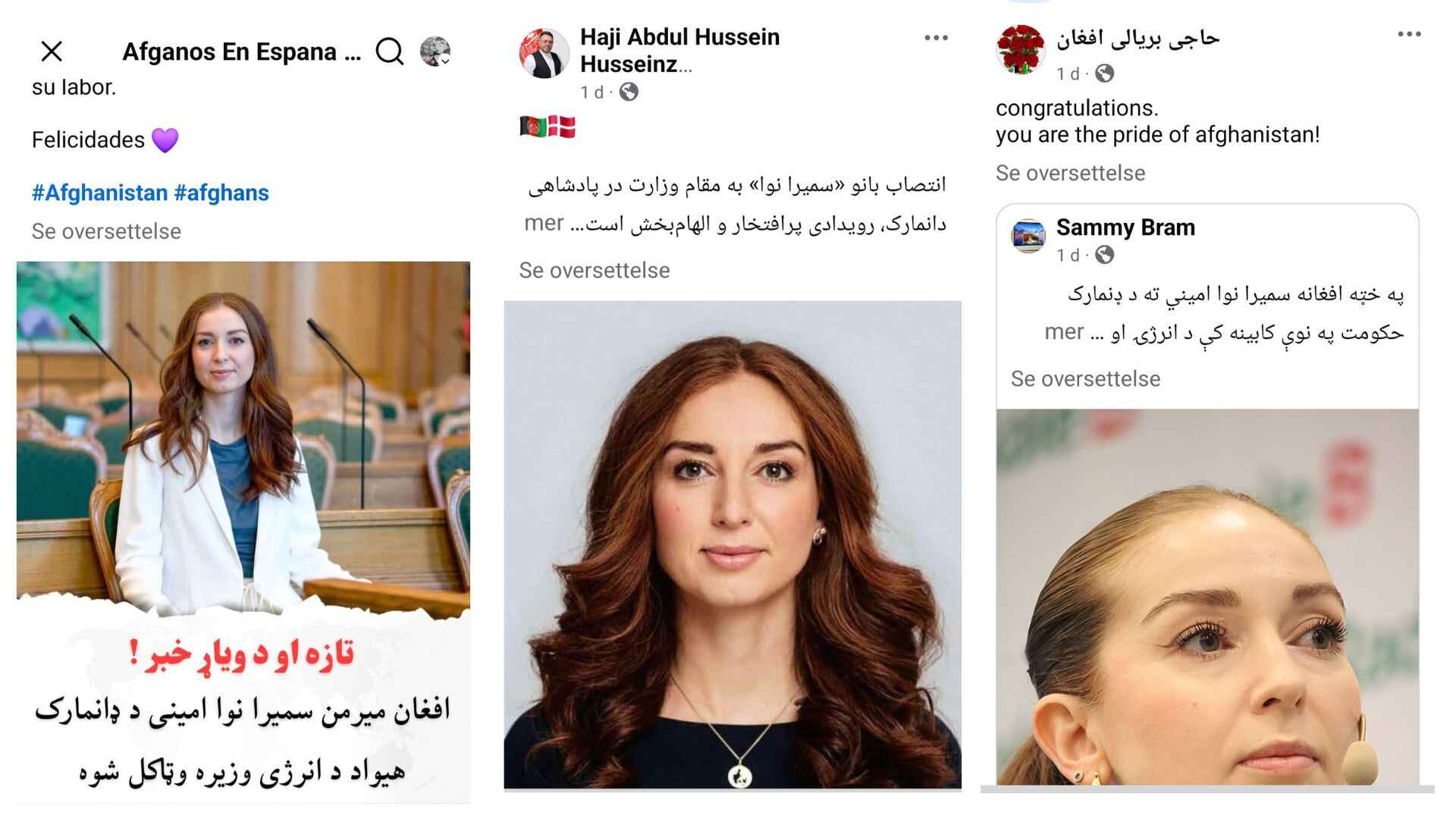
Many Afghans living in various countries are praising Samira Nawa as an Afghan after she was appointed a minister in Denmark. Photo: Social media.
“Mrs Samira is the pride of Afghans and foreigners in Denmark. I congratulate her and all Afghans,” writes Abdul in a thread where an Afghan shared the announcement of Samira Nawa’s appointment.
“This is a great honour for the Afghan people,” writes Taher.
“Long live the homeland’s daughter abroad,” writes Afifa.
“As an Afghan woman, I wish success and health to our sister. It is our honour,” writes Mahshazi, while Ahmad writes in the same thread that “regardless of who it is, it is Afghanistan’s pride. Whether they are in the German parliament, the Australian one, the English one, etc.” (automatic translation)
Afghanistan’s daughter
In another thread, Atta writes that the appointment of Samira Nawa is a triumph:
“If a daughter of Afghanistan can help lead a nation’s energy policy when she is given the opportunity, then think what millions could accomplish if their rights were restored,” writes Atta, with a clear reference to women in Afghanistan.
“As an Afghan citizen residing in Denmark, I follow this historic achievement with a profound sense of pride, and regard it as a source of pride not only for the immigrant community but for all Afghans who believe in women’s potential,” writes Haji. (Translated)
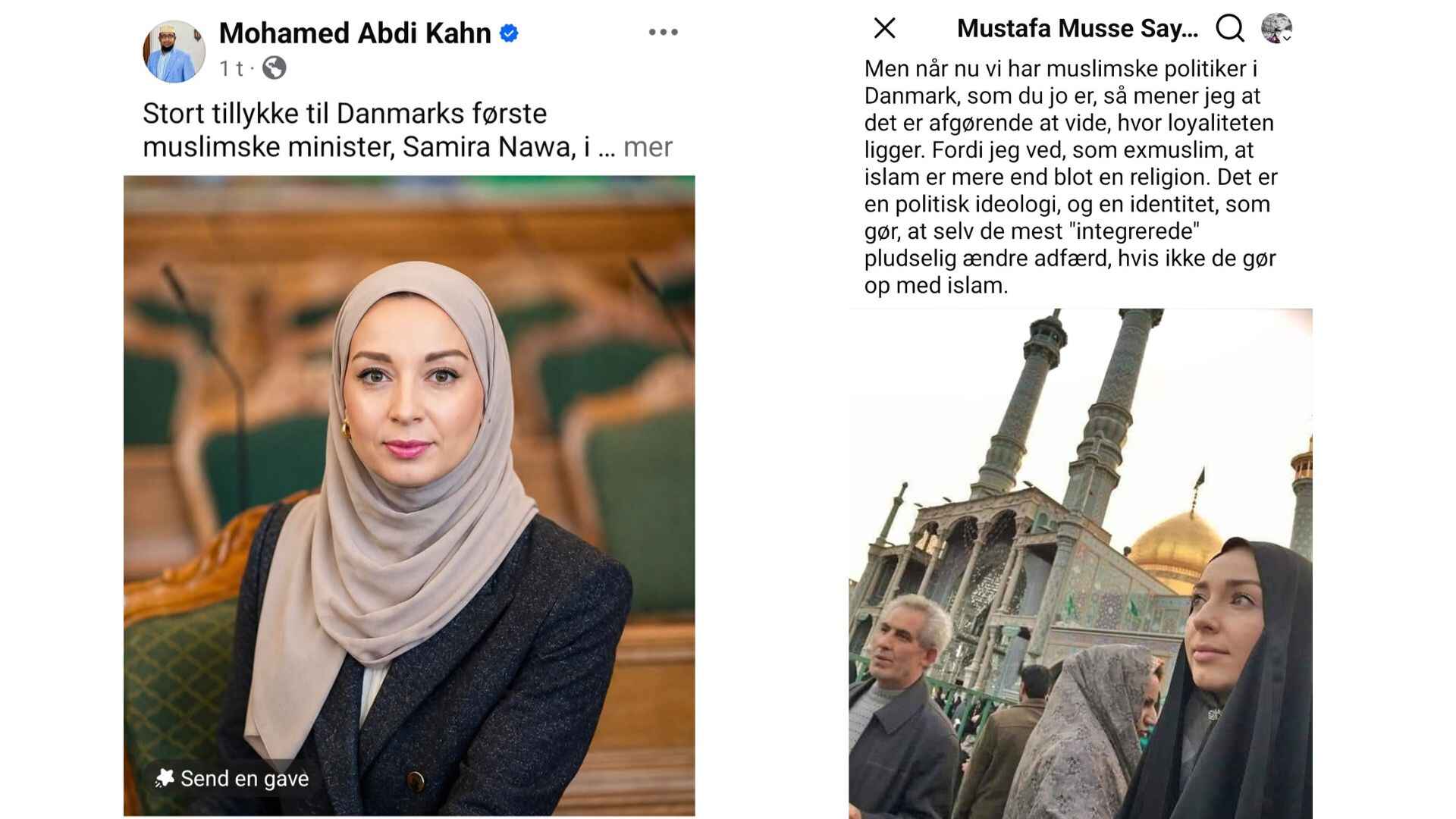
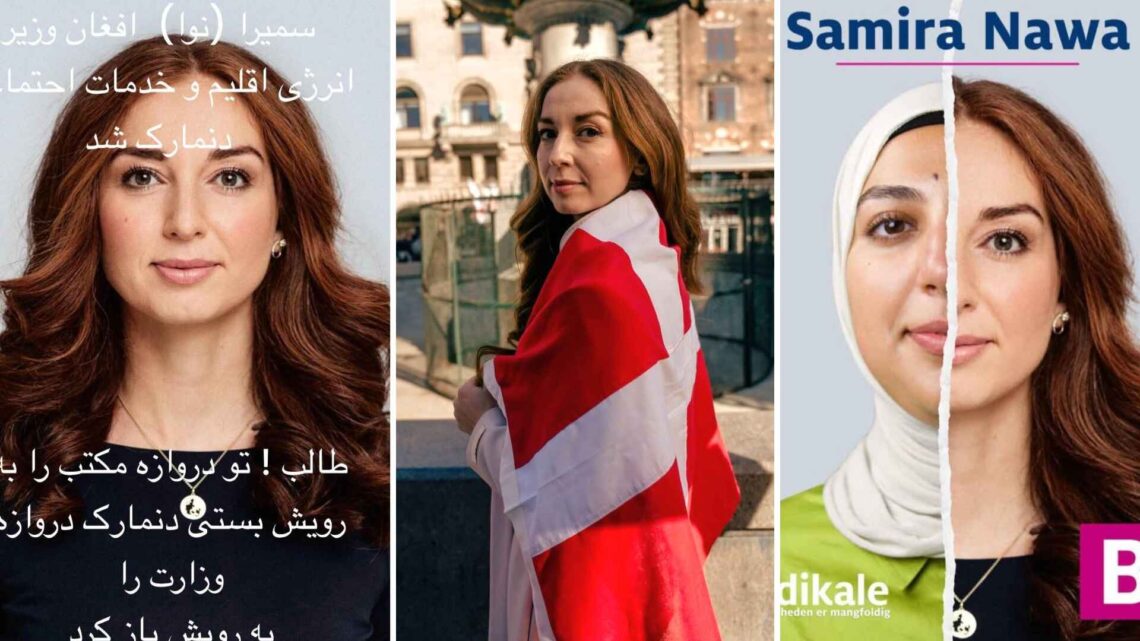
Samira Nawa does not wear a hijab in everyday life, but has worn one for political purposes and while visiting Iran. Mohamed Abdi Khan and Mustafa “Musse” Sayegh use a photograph of her wearing a hijab from their respective perspectives. Khan is from Somalia and strongly pro-Islam, while Sayegh leads the group Frafallen, for ex-Muslims. Nawa is said to have posted the hijab photograph from a visit to Iran in 2018, where, according to Sayegh, she wrote: “It is a wild experience to reach all the way into the mausoleum, where praying women for a time set aside everything worldly and find themselves in an admirable religious immersion. It is the third time I have visited Qom (Iran).” Sayegh’s post is from September 2025. Photo: Social media.
Both non-Afghan Muslims and non-Muslims have commented on Samira Nawa’s appointment.
Wants a Muslim Prime Minister in Denmark
The Somali Mohamed Abdi Khan is among the enthusiastic supporters.
“Jeg forventer, at Samira vil tale højt om det had og den systematiske diskrimination, som muslimske borgere i Danmark udsættes for, ligesom hun tidligere har gjort. Danmark skal nok på et tidspunkt få en muslimsk statsminister”, he wrote on the same day that Nawa was appointed. The following day he wrote about Rasmus Stoklund and Frederik Vad, who until recently were respectively Minister for Immigration and responsible for immigration policy in Mette Frederiksen’s party, Socialdemokratiet:
“Disse to politikere er hverken socialister eller demokratiske. Hvad laver de så i et socialdemokratisk parti? Godt, at Enhedslisten sammen med de øvrige venstrefløjspartier klart sagde til Mette, at de ikke kan acceptere Rasmus Stoklund som minister. Ud med dem.”
Enhedslisten roughly corresponds to Rødt in Norway and is assumed to have influence over the new government.
Khan is otherwise not especially enthusiastic about Denmark as we know it. On 2 June he wrote on Facebook:
“Jeg vil dø for islam og for at beskytte uskyldige mennesker – især de muslimer, der bliver udsat for krig, undertrykkelse og uretfærdighed. Jeg vil ikke dø for Danmark eller for noget andet land eller nogen anden sag. Hvis Danmark en dag stod på de uskyldiges side og blev angrebet for at forsvare retfærdighed, så kunne jeg måske forsvare det. Men så længe Danmark står skulder ved skulder med zionisme, islamofobi og diskriminerende politikker mod muslimer og flygtninge, er mit svar nej tak. Jeg vil ikke ofre mit liv for det Danmark.”
Hizb ut-Tahrir not enthusiastic about Nawa
So are all Muslims in Denmark enthusiastic about Samira Nawa? Not at all. An example of the less enthusiastic is Taimullah Abu-Laban, son of a controversial Arab from Jaffa in Israel who was granted asylum in 1984. That is, one of those who set the Middle East ablaze following the Muhammad cartoons. Taimullah has also become somewhat controversial himself, as he has called for the killing of Jews, and is involved with the notorious Hizb ut-Tahrir, which supports stoning as a punishment and seeks to replace democracy with sharia.
Accordingly, Samira Nawa as a minister in Denmark is not to his liking either. In a post on Facebook, he mocks a Muslim organisation said to have celebrated that Denmark has allegedly gained a new Muslim minister, and that this supposedly sends an important signal to many people with minority backgrounds:
“On one level they are right. There are no limits to how far you can go. As long as you submit to child-killers such as Mette Frederiksen and Lars Løkke Rasmussen.
As long as you promote shamelessness without hesitation, participate in Christmas church services, celebrate Christmas and allow your children to sing in church.
As long as your Muslim identity has been reduced to an exotic name on a business card. Yes, then there are no limits to how far you can go. People like Naser Khader have demonstrated this for a long time.
To regard this as a victory worthy of celebration is an expression of an inferiority complex of such enormous dimensions that I genuinely feel pity for those who suffer from it.
When even the most conditional acceptance is celebrated as a triumph, that says something about how poorly you regard yourself.
To long for recognition from a system that embraces you only once you have rid yourself of everything that made you different is not a victory. It is the opposite,” writes Abu-Laban, pouring wormwood into the cup.
Norway has had many Muslim ministers
There are others who have a different type of criticism or scepticism towards a Muslim being appointed a minister in a Christian and secular country such as Denmark. They may take comfort from the fact that Norway has already had three Muslim Ministers of Culture, all with backgrounds from Pakistan, and we also have a President of the Storting, ranking second only to the King, who was born in Iran. To mention a few Muslims in positions of authority.