

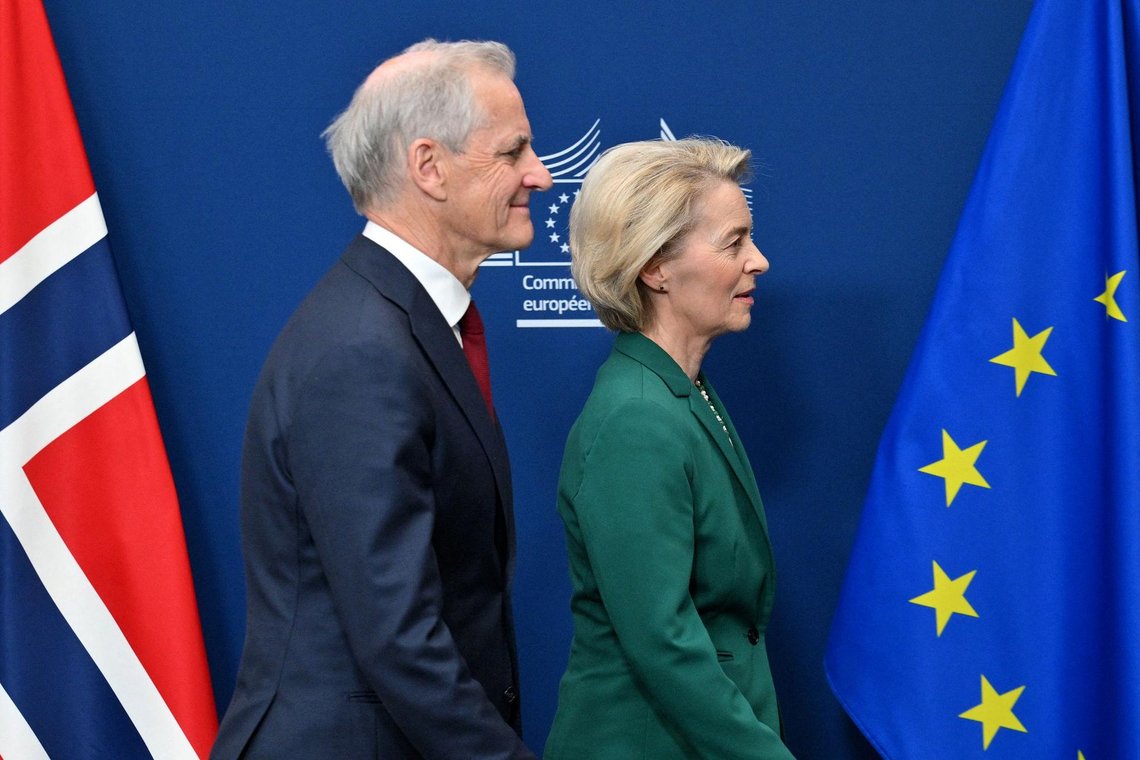
Prime Minister Jonas Gahr Støre (Labour) has just returned from one of his many trips to Brussels, “the whited sepulchre”, which brings death to mind—quoting Joseph Conrad, Heart of Darkness (1899). Conrad used the “city of tombs” as a metaphor for the bloodstained colonial policy in the Congo.
Not much has changed 127 years later, except largely on the surface. Brussels is the capital of a top-down, centrally governed union where consideration for smaller, subordinate states is generally minimal and often absent.
Against Its Own Interests
Støre’s trip this time was primarily an attempt to persuade the European Commission to depart from its position of “not permitting” oil and gas industries in Arctic waters. Norway’s largest reserves—and thus its future—are located precisely there.
Without any geographical jurisdiction, the EU has centrally decreed this, naturally over the heads of Norway and other oil- and gas-producing nations with interests in the Arctic, whose oil and gas Belgium, Germany and the rest of the EU are entirely dependent upon. Besides having been adopted undemocratically by the Commission and against the interests of most EU countries, and being prescriptive for countries that are not members (such as Norway), a categorical rejection of oil and gas activity in Arctic regions appears rather poorly thought through.
Coming to Its Senses
Støre therefore had good reason to travel to Brussels this time, although he is unlikely to have achieved much, as no reports of progress for Norway’s position have emerged so far, as far as I can see.
Now, it may be that the EU eventually comes to its senses when the Commission realises, in due course, that such a policy risks depriving it of its heating, its fuel and its entire industrial base. Then perhaps the devil in the white city of tombs will swallow this fly as well—we shall see. But it will probably take some time.
What Will the EU Demand?
And what, then, will the EU want in return for reopening the door to (Norwegian) oil and gas activity in Arctic waters?
One can only imagine. Perhaps future membership?
Or that we slavishly implement the new building directives that will impoverish our homeowners and, naturally, our already hard-pressed construction industry. Or new demands regarding fishing quotas. Or Energy Package Four—in full? Etc. As I said, one can only speculate. And strictly speaking, I do not know. But I do know that Brussels gives nothing away gratis, “for free”.
It will probably take some time before the European Commission realises that the Union is not served by a unilateral ban on oil and gas activities in Arctic waters. Europe is far from ready to be heated and electrified solely by wind turbines, solar panels and similar technologies from beginning to end. It will, of course, require fuel and gas for industry, transport and heating for the foreseeable future. And more than before, as demands for living standards and total consumption continue to rise steadily.
And then they have few others to ask besides Norway (apart from the United Kingdom, which is also outside the EU), which they currently seek to throttle—and thereby commit something resembling collective suicide. Unless Germany and the white city of tombs decide to dust off and continue their hypocritical trade in oil and gas with Russia.
The latter is perhaps most in keeping with the EU’s original spirit (read Spinelli), which was to a considerable extent a communist project and which remains heavily infected by the collectivist and profoundly anti-human top-down idea in which the individual person and individual nations matter very little.


