



What does it entail that queer theory should be normative for society? Many people have been concerned with religious freedom and the interests of children. But few have considered the traditional homosexual experience of this revolution.
In 2006 there was disagreement within the then National Association for Lesbian and Gay Liberation (LLH) as to whether it should “become queer” or not, that is, whether it should base its work on queer theory. Kim Friele warned against this, and in an interview with Klassekampen she pointed out that queer theory was dangerous for the women’s movement insofar as it abolished sex as a biological reality.
It was those who wanted queer theory, or radical gender theory, who won this battle of ideas, but the interesting thing is that no one was concerned with the situation of lesbian women. For what becomes the result for a lesbian woman when society says that gender identity must take the place of biology, and sexual orientation replaces sexual disposition? What kind of culture do we get with queer theory?
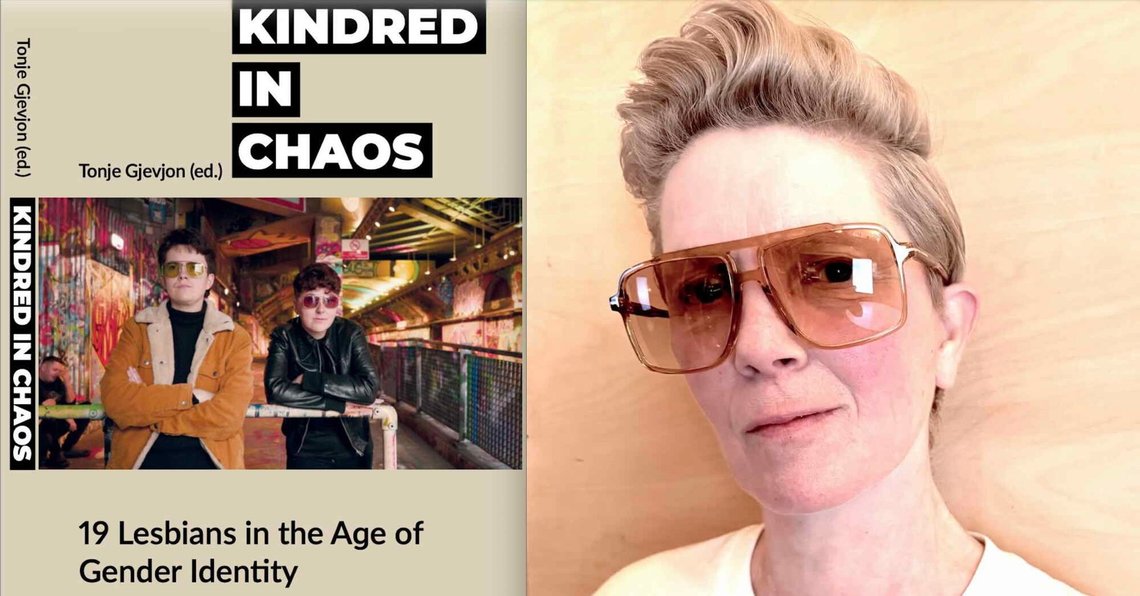
This question has almost been a taboo area. Neither the media nor politicians wish to touch this issue. But now there is a small book, “Kindred in Chaos. 19 Lesbians in the Age of Gender Identity”, in which the editor, the Norwegian artist Tonje Gjevjon, allows 19 lesbians to tell their story.
These stories ought to be a wake-up call for those who claim that they are fighting for homosexual rights while at the same time supporting the organisation FRI and today’s legislation built on radical gender theory. The 19 contributors represent different parts of the world, but all share the same experience, namely that the queer revolution works against them as lesbian women.
All confirm the message that followed in the wake of the queer milieus that emerged with the queer revolution: Sex is a social construct, homosexuality does not exist, it is transphobic not to have sex with transgender persons, one must use preferred pronouns and accept all transgender identities. Lesbians who do not accept these premises are labelled “TERFs” (trans-exclusionary radical feminists) and risk being cancelled, doxxed, losing their jobs and being ostracised from society.
Several also speak of how masculine lesbian women experience pressure to undergo gender reassignment. Society tells them that they must have been born in the wrong body, but that the body can be changed.
Elisabeth from Sweden describes what happened when her girlfriend posted a text on Instagram in which she spoke about the pressure she experienced from the queer milieu to identify as something other than a woman. There was a storm of hateful messages. She then tells of another girlfriend who allowed herself to be swept along and underwent surgery with the aim of becoming a man. Of the grief she felt over a healthy woman who was destroyed because of an ideological theory. She lost friends and stopped visiting places where she had previously felt safe. The word lesbian was ruined; she stopped using it, since someone might feel excluded. She does not use the term woman either, and writes: “There are women with an asterisk now. Women with a footnote. A word with exceptions. No one felt the need to change the word ‘man’.”
Kim from China tells of the mother who asked whether gender reassignment could not be a solution. A straight trans son would in fact be more acceptable than a lesbian daughter who did not live up to society’s expectations concerning gender and sexuality.
Alison from the United Kingdom writes about her encounter with academia. As a student she searched for meeting places for lesbians, but found none. When she finally found some lesbians, it turned out that they both identified as men. The lecturers placed students who identified as transgender persons on a pedestal and granted them every advantage. She describes how many lesbians have been brainwashed into believing that they are really men.
The lesbian woman is no longer relevant as an identity, something Alexandra from Sweden confirms. She tells of an everyday reality in which homosexuality, defined as a sexual attraction between persons of the same sex, was regarded as hateful, hurtful and exclusionary. But also wrong. She was told to become better informed.
It must surely be a paradox for the liberal West that one of the contributors found a refuge in Poland. The country has not yet been destroyed by the queer movement. In the West, a sex-fixated queer milieu does not set boundaries for boundary-transgressing behaviour.
Both legislation and culture linked to gender identity make it difficult for girls in general and young lesbians in particular to safeguard themselves and their boundaries. The tragedy is that there is scarcely anyone who speaks on their behalf.
The book “Kindred in Chaos” is a disturbing account of the unknown consequences of the queer revolution and ought to be read by everyone who works with the subject.
Tonje Gjevjon (ed.)
“Kindred in Chaos”
Published in 2006
Matriarken Forlag
104 pages


