



On Thursday we could read in Document that Hamse Ali’s head injury was too minor to produce “false memories”. The prosecution argued that neuropsychologist Knut Dalen had provided unlawful assessments of the evidence in court and demanded 45 days’ imprisonment for Ali.
Hamse Ali’s defence counsel, Anette Askevold, requested acquittal or exemption from punishment. She believes that Ali would suffer serious reputational damage if he withdrew his account of the assault in Nygårdsparken, grounding the argument in a section of the Penal Code concerning false testimony.
How do we put madness into words?
One tries to find words for the insanity unfolding in Norway, especially on the racism front, and sometimes one simply becomes speechless and loses faith in humanity altogether. But after a while one realises that the only thing that helps is to crawl out of the foetal position, wipe away the tears, pick up the pen and attempt to put the madness into words.
Hamse Ali’s reputation is at stake?
The same man who falsely accused six men from Bergen of racist violence, and transformed Bergen and the rest of the country into one vast circus of performative virtue. An “at last we have our own Smollett and Floyd moment”, where zealous anti-racists emptied their piggy banks in order to wash away white guilt.
And while they marched in rose parades singing “no racists in our streets”, it was their own chosen victim who plunged the otherwise idyllic city between the seven mountains into full panic. A city where people lived in fear behind closed doors, terrified of the six men from Bergen hiding in the city’s many alleyways, ready to strike at any moment.
No one felt safe. Except the whites, of course.
But it is apparently Hamse Ali’s reputation that we should truly be worried about.
Nothing new under the midnight sun
From the very beginning, the story sounded absurd. My immediate reaction was that there was no chance whatsoever that six adult men from Bergen would have joined forces for something like this, not even while drunk. In fact, you have better odds of encountering a gang of enraged trolls in the forest area around Fløyen.
It could theoretically have happened that the Nordic Resistance Movement had acquired three new members and suddenly thought: “Now we are six, and now we are damned well going to man up and attack a black man on an electric scooter.”
But even that is completely beyond all reason. We are simply not wired that way. How many Norwegians have committed the kind of coordinated, brutal racist violence that Hamse Ali allegedly suffered? I can think of one case, although I do not know the full story. And that particular case we are to be reminded of for all eternity.
But if we are going to speak about reputational damage: whose reputation has actually been destroyed in the Hamse Ali case? It is the white Norwegian man, as always in such cases, in this instance men from Bergen.
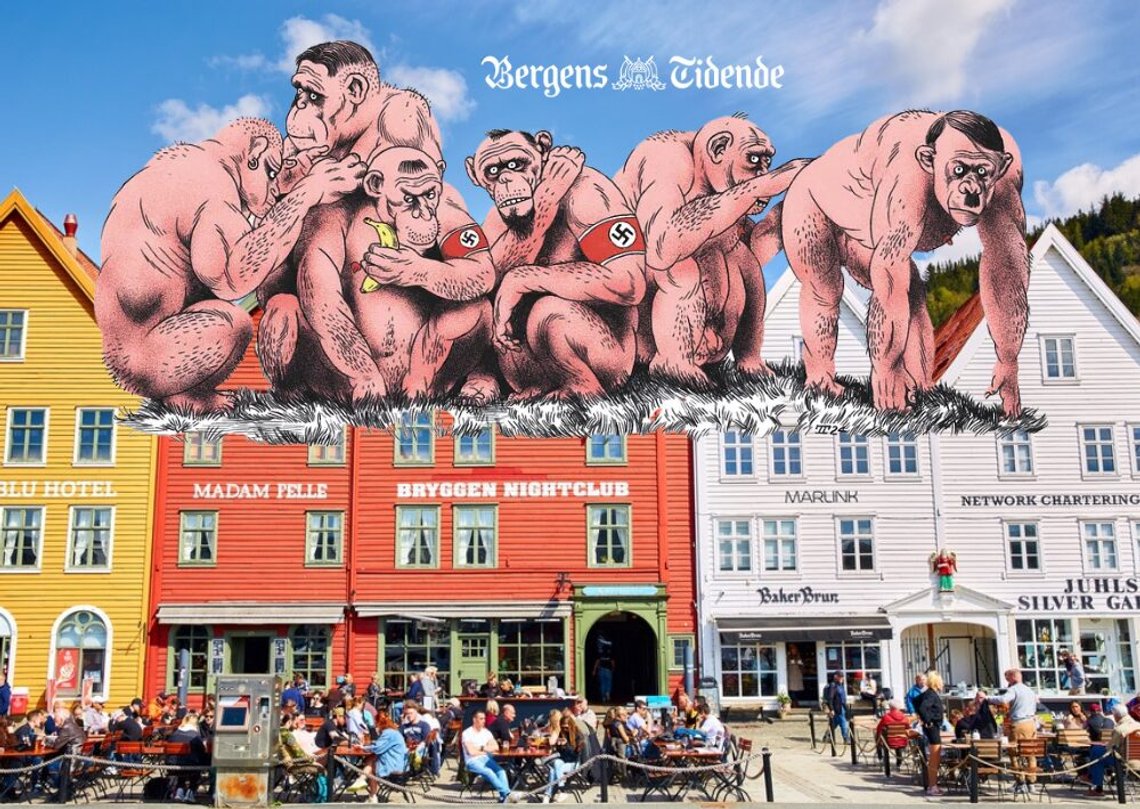
And nothing illustrates this better than the way Bergens Tidende portrayed these six men. As primitive, violent, ape-like Nazis hunting immigrants. Not only is the illustration completely dehumanising and degrading, it was published at a time when no one knew who the “suspects” were.
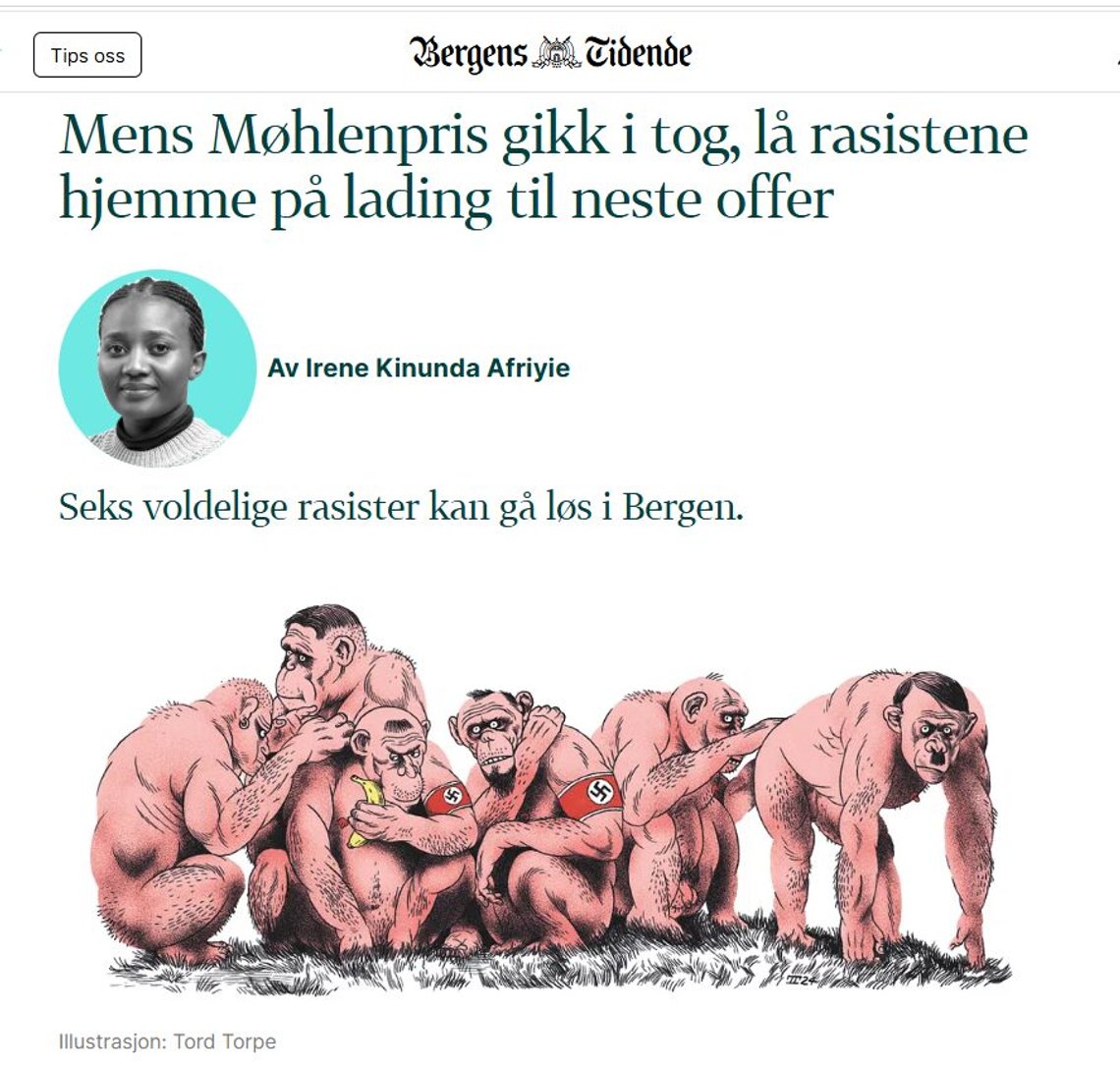 Facsimile from Bergens Tidende, 12 October 2024.
But there is nothing new under the midnight sun in Norway. We have seen such cases before, where Norwegian men are publicly pilloried and bullied as punishment for imagined racism. Not merely as individuals, but as an entire group.
Who does not remember the case of the Somali man Ali Farah? Two white ambulance workers were turned into the country’s greatest racists and had their lives and careers destroyed by the merciless mob, with the media leading the way in a competition to see who could behave most shamelessly.
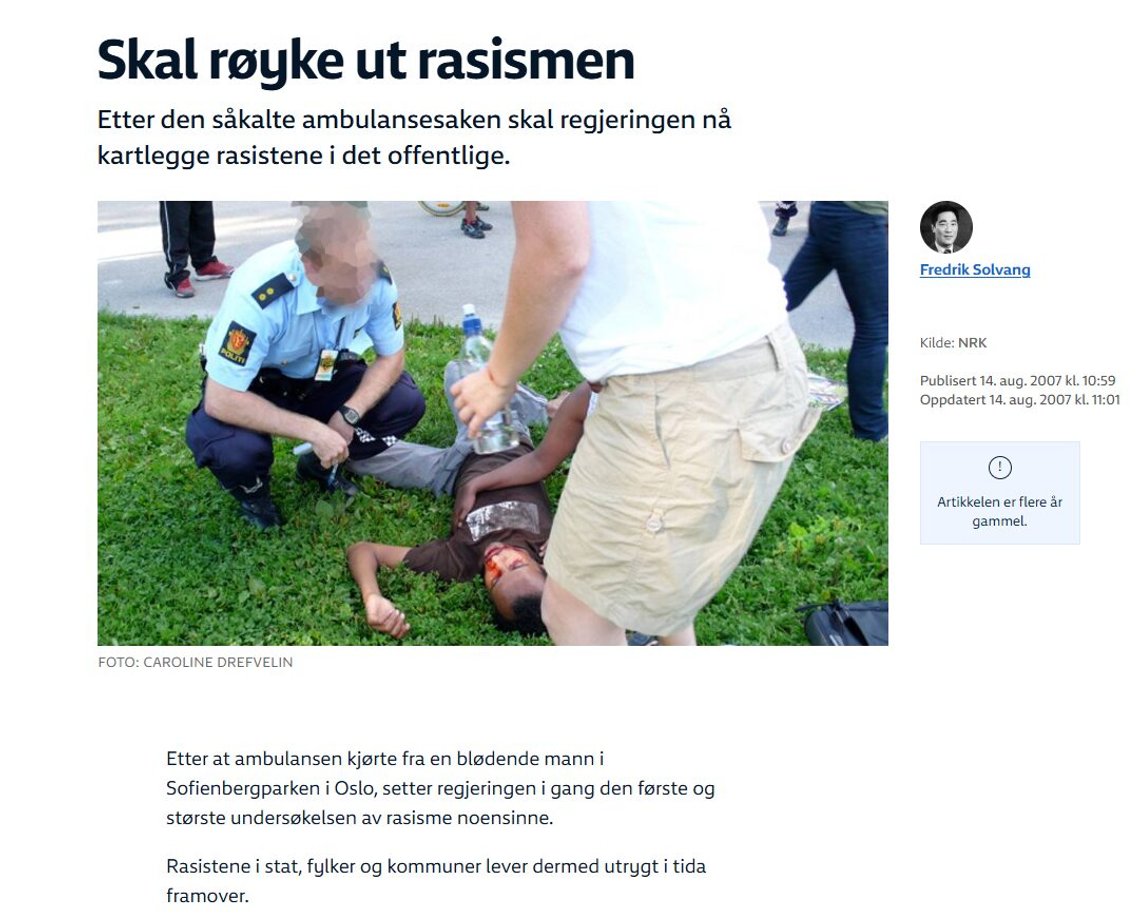 Screenshot from NRK.
Racism everywhere in the world’s least racist country
We may place the blame on guest columnist Irene Kinunda Afriyie or illustrator Tord Torpe. The artist could have chosen an entirely different illustration, or Bergens Tidende could have kept its speculation to itself until the racists had actually been apprehended.
I know nothing about Tord Torpe, but judging from the name I assume he is ethnically Norwegian. Is it possible to hate one’s own race that much? To depict one’s own people as racist pink apes wearing Nazi armbands?
Kinunda Afriyie is from Congo, and like so many immigrants she is given a platform by white saviours in Norway to speak about widespread racism “in the world’s least racist country”. She could have chosen not to go down that path, but why should she? Some people enjoy living in a world where one can play the eternal victim.
And just look at the opportunities it opens up in Norway: media appearances, book sales, lectures, you name it. And the crowning glory: a job at NRK, should one desire it. A win-win for everyone. Except the rest of us.
But in the end it is the editors at Bergens Tidende who decide what is printed. And nothing brightens the day more for media houses around the country, where 70 per cent (or is it 90?) belong to the Left, than being able to accuse their own people of racism.
Jørgen Thormøhlen turns in his grave
Kinunda Afriyie describes the massive turnout in Bergen. She found it truly impressive to see how a neighbourhood named after Norway’s most famous slave trader takes a strong stand against racism. “Jørgen Thormøhlen must have turned in his grave,” she writes.
If I came from Congo, I might perhaps have been somewhat more cautious about lecturing Norway on racism and the slave trade. In her home country, massacres, widespread sexual violence, kidnappings, forced recruitment of child soldiers and systematic attacks on civilians still rage.
Not to mention the hundreds of thousands who are victims of modern slavery in Congo, including children as young as four working in the cobalt mines that probably help power her telephone and iPad. But no. That would be far too uncomfortable a truth.
Incidentally, Thormøhlen was born in the Duchy of Holstein in 1460, and according to several sources his name was Jürgen Thor Möhlen. But just as with Hamse Ali, they must invent racists in Norway. A German fellow from 566 years ago serves perfectly well.
She even received column space in BA to write about Jørgen Thormøhlen, educate us about black history in Norway and demand that we introduce a “Black History Month”.
The racism narrative must live on
Kinunda Afriyie says that after seeing the picture of Hamse Ali, she has walked faster than usual when getting off the bus late at night. She looks over her shoulder more often, because she knows that “even after such a successful demonstration against racism, there may still be six violent racists at large in Bergen.”
Irene Kinunda Afriyie is not alone. She has with her the entire self-righteous mob in Norway which for years has been engaged in a merciless crusade against racists in the ethnic Norwegian population. From the ambulance workers to Atle Antonsen to six racist men from Bergen to Hårek Hansen and many others.
And there will be more. For the racism narrative must live on. In their worldview, the six fictional racists from Bergen will always roam free in Nygårdsparken — or anywhere else in the country, for that matter.
The reputation of white Norwegian men was destroyed long ago, and those who deliberately destroyed it could not care less.
Ny sakkyndig: Alis hodeskade var for liten til å gi «falske minner»


