

The most important reason why we are not already today standing in the midst of the final and perhaps decisive EU battle, the closest we come politically to civil war in this country, is that the Ap elite does not dare take the risk. The already badly declining, politically scalped party is deathly afraid of being split down the middle.
It is a fact that everyone who wants to advance within Ap places themselves on the yes side in the EU question. They do so first and foremost for career reasons, many solely out of sheer social-climbing mentality. With some honourable exceptions, it must be said, such as Trond Giske.
Political civil war in Ap
But from approximately the middle ranks and downwards in the party there is considerable scepticism towards Norwegian EU membership, which since the last referendum in 1994 has shown an approximately plus-minus 50–50 ratio internally in Ap. This situation fosters fear of a new EU battle, a new political civil war, particularly within Ap.
Here lies the main reason why Ap did not want the EU issue in the election campaign, and succeeded only moderately in that regard. After one of the worst elections of all time, the party managed to scrape together what is politically the narrowest (weakest?) government Norway has ever had.
The EU spectre
But if there is one issue that does not disappear, it is the EU question. It has ridden Norway like a nightmare since the late 1960s, via the first referendum in 1972 and up to the present day.
Now Høyre and Venstre want a new EU debate, as they put it. What they really want is to raise the issue so high that one presses the nation into the EU’s clutches, as Erna Solberg said not long ago: “preferably without a referendum”.
It is reasonably inconceivable to force Norway into the EU without a decisive referendum first (so-called advisory, but in reality decisive), and not as in the EEA matter, where Gro Harlem Brundtland and shoe-shiner/bag-carrier Jonas Gahr Støre smuggled the agreement, which now threatens to choke ever more of Norway’s control over its own country and its own policy, in through the back door, practically in the dead of night. Gro duly forced it down over the heads of the Norwegian people and the country’s free enterprise. “Enough, and keep quiet”, sounded from the scolding mouth.
The EU are today’s modern neo-colonialists, and they conduct their colonialism in an authoritarian manner. Just look at the penalties imposed on those countries that have opposed through referendums, especially Viktor Orbán’s Hungary, to whom we no-people have much to thank.
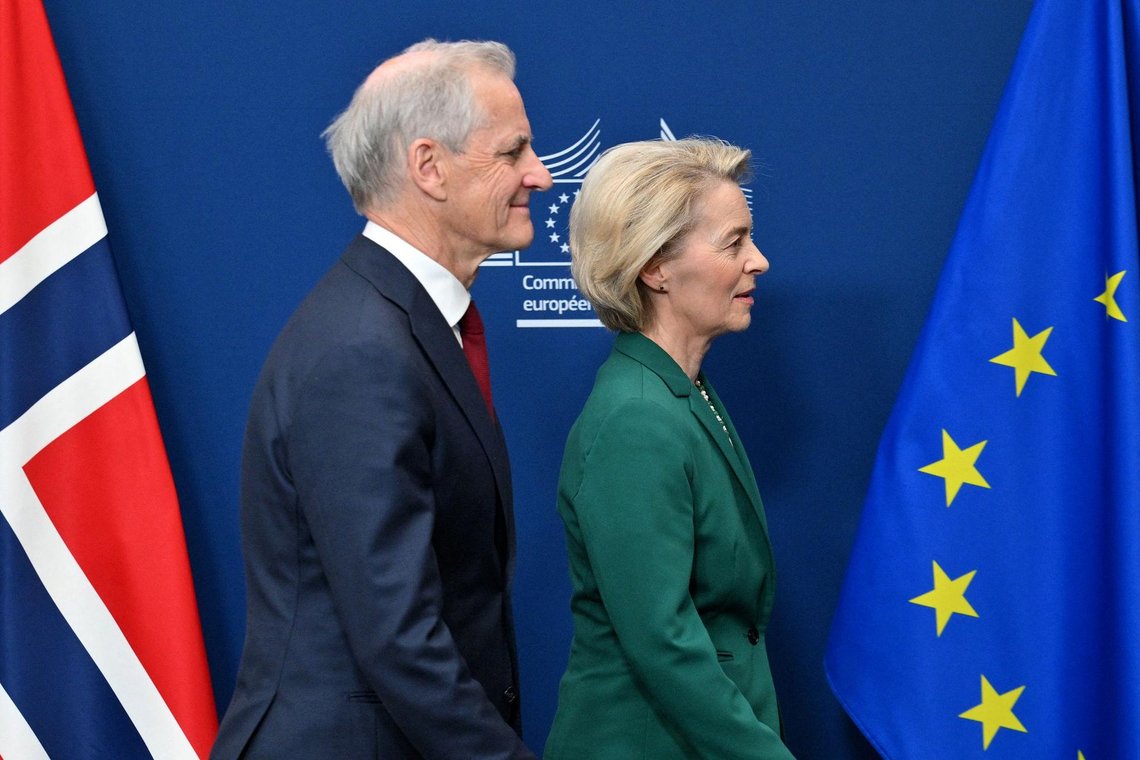
And we see that the clamour from the EU side is now directed towards Norway, both from the undemocratic and centrally governed EU Commission, where Norway would scarcely have had any power whatsoever either as a member or as an EEA country, and from the EU Parliament.
Earlier this week, a Finnish parliamentarian proposed that Norway should give a significant share of the large oil and gas revenues the state has, thanks to the Iran war, and give them to Ukraine. Similar proposals will come. Next time, perhaps the wording will be to give billions in additional revenues from our oil and gas industry directly to the EU, as a contribution to the “common good”. Just wait: It will come, mark my words!
Coming within three years
In other words: The pressure is only tightening and becoming harder and harder. I dare predict that at the end of this parliamentary term – in the spring of 2029 or earlier – we will have the EU question on the table.
And we know the situation: The Ap power/leadership, together with Høyre and Venstre, will in all likelihood fight against Sp, SV, Rødt and not least FrP, which at present is a reasonably clarified no-party. KrF also leans towards no.
Hundreds of thousands on the fence
But, and this must not be forgotten: We have thousands of people who have grown tired of political parties and long ago stopped voting. This at least half a million of eligible voters usually turn out when there is an EU referendum; we must assume that also this time. That was the case in 1972 and 1994.
Let us, by the Lord, hope that it goes that way this time as well, that this group largely turns out and saves us, hopefully once and for all. For should it instead be yes this time, then we know what will be lost forever: Then goes what little remains of control over hydropower and clean water in general, then goes our sovereign control over our gigantic oil and gas industry, and then goes control over our rich fisheries. The whole shall be shared and taken over by the EU, at the very least the governance of it all.
As at the turn of the century between the 1800s and the 1900s, we will then be left sitting with our cap in hand, politely begging for alms.


