

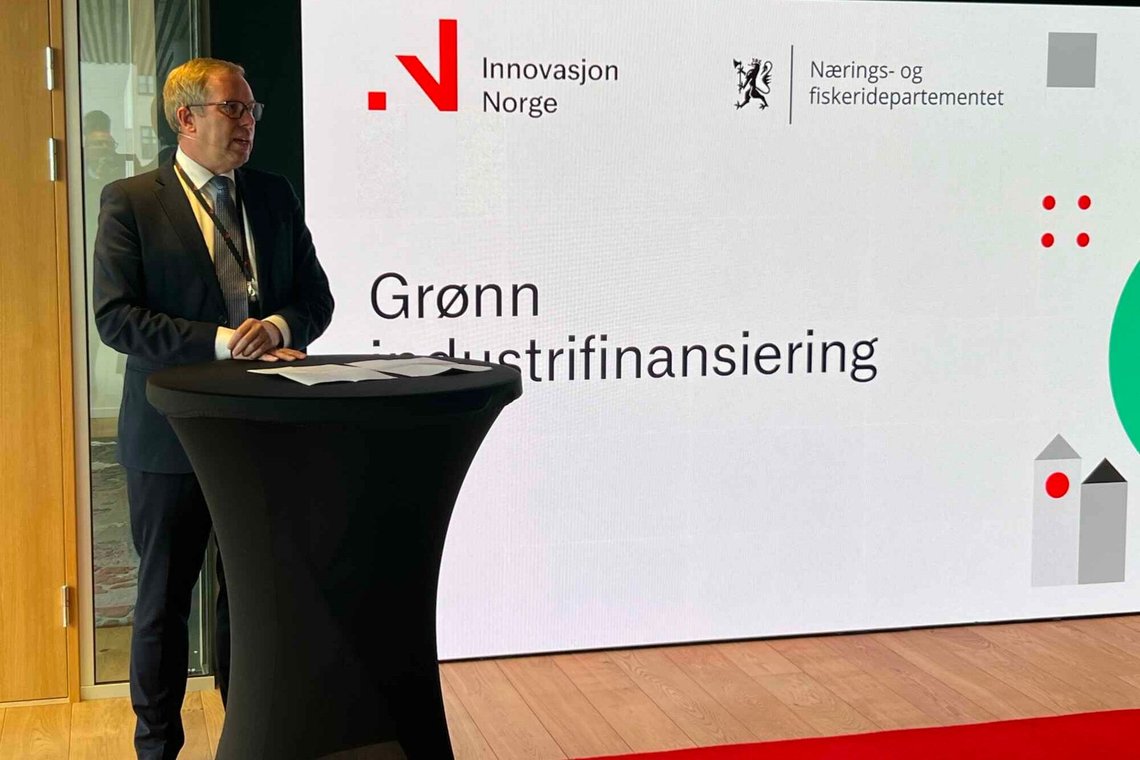
 Chief Executive Officer of the state-owned company Innovasjon Norge, Håkon Haugli, during the launch of the billion-kroner project “Green Industrial Financing” on 2 September 2024. Photo: Innovasjon Norge.
Many may perhaps have noticed that the Storting has now decided to scrap the climate targets for 2030. In light of this, new challenges arise in connection with the climate targets for 2035, which were adopted on 1 June 2025. These are even more ambitious than the 2030 target, which now appears likely to be discarded. Some logical thinking around this seems to be absent among Norwegian politicians.
It may appear that the politicians are pushing the climate targets forward in time in order to buy themselves time, in the hope that people forget what has previously been promised. It is mathematically impossible for Norway to reach the climate targets. Those who still believe that this is possible should go and take a bun (bolle).
There are many reasons why it is extremely difficult for Norway to reach the climate targets. Firstly, we have so far seen no clear signs that climate measures in Norway are actually profitable. Secondly: if we are to take the United Nations Sustainable Development Goals (FNs bærekraftsmål) seriously, new challenges arise. It is not possible to eradicate poverty – Sustainable Development Goal number one – without the use of fossil energy. Many of the sustainability goals therefore collide directly with the climate targets.
Norwegian emissions are scarcely measurable in a global context. Nor is there anyone who in a satisfactory manner can account for the consequences and costs of Norwegian climate measures. What will the green transition (det grønne skiftet) cost? This is a pertinent question to which no one can give a clear answer. The authorities merely assume that we must implement climate measures, because climate change is regarded as so serious that we cannot afford to refrain from doing so. At the same time, it appears strange that the politicians consider it entirely acceptable to refrain from investigating the costs of these measures.
We also see that many of the climate measures are extremely demanding to implement. Measures such as battery factories, hydrogen production, solar panels and wind power are strongly contested. Large-scale encroachments on nature and loss of natural resources are decisive factors for many of these projects. It is difficult to defend wind power as renewable energy if we take into account destruction of nature, enormous development costs and relatively low electricity production. The only ones who still defend wind power are lobbyists and power producers with clear economic interests.
Norwegian climate policy is long overdue for a new direction, with a focus on more sensible measures, such as landslide protection (rassikring), preparedness (beredskap), investment in infrastructure and preservation of natural resources. Unfortunately, the opposite has happened. The money of ordinary people is channelled directly to the state, which uses the climate crisis as an instrument for tax increases. The green transition is paid for by Norwegian households and businesses, because Norwegian politicians are so preoccupied with climate change and international recognition that they forget to take actual costs and consequences into account.
In recent years Norwegian companies have increasingly been concerned with appearing green and sustainable, without necessarily reflecting on how the authorities actually handle the situation. Climate policy functions poorly for you and me, but for those who have found an economically viable career path within the green transition, climate has become more important than anything else.
The green transition is not primarily about climate, but about money, power and prestige. Many wonder why everything has become so difficult and expensive in Norway. The answer is that climate policy now permeates all other policy. When climate policy becomes so dominant, other political considerations must give way, and the result is a series of new problems as a consequence of poorly conceived climate policy. Can it become worse than this?
Norway has hydropower that largely covers our energy needs. Thus all additional climate measures become extremely costly, since emission reductions must be taken in other sectors, such as agriculture, transport or through electrification of the continental shelf (sokkelen). In other words, we have very limited potential for further emission reductions compared with countries that are still dependent on fossil- or coal-fired power.
It is therefore entirely absurd that a country such as Norway should spend such large resources on a green prestige project in which the rest of the world to a limited extent wishes to participate. The United States and China quite obviously have other interests than cutting emissions, while we in Norway are to be the best in the world in the fight against climate change – whatever the cost. As long as it becomes expensive enough, it will apparently pay off.
The time for costly climate measures will sooner or later be overtaken by reality. Unfortunately, our climate-policy spokesmen have made our country into a bureaucratic nightmare for ordinary people, who pay the price for the politicians’ green dreams – dreams that may perhaps look fine on paper, but which in practice have serious consequences.
Out of sight, out of mind.
Thorstein Opsahl is a municipal council representative (kommunestyrerepresentant) for the Progress Party (FrP) in Lier.


