

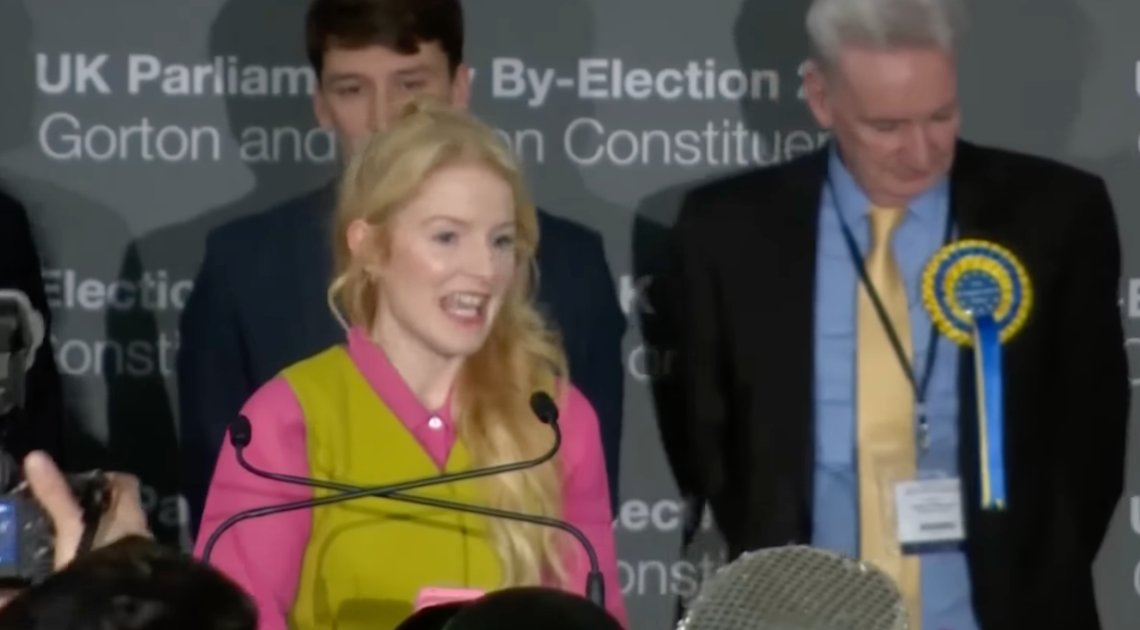
Hannah Spencer, the newly crowned queen of The Green Party, won the election in Gorton and Denton in Manchester by a landslide. Labour’s defeat is described as seismic. If Labour can be crushed here, it can be crushed everywhere. Yet despite its name, Britain’s Green Party is concerned less with climate and the environment, and far more with Gaza and Islam – all in order to curry favour with the growing electorate of new “Britons”.
Thus we see that the dividing lines in politics will revolve less around right versus left, and far more around the original population and the newcomers, accompanied by young “progressive” radicals of the left. The lines of conflict are being drawn, and the outlook appears bleak for a united kingdom in a future that will be marked by ethnic divisions.
Labour has lost its grip in Britain. Much indicates that Keir Starmer’s days are soon numbered, but the next election is still far away. Angela Rayner, who stands to the left of Starmer, will probably take over the baton in what may be Britain’s least popular government ever. But there will be a time after this one, and if the result in the Manchester local election is representative, we may experience many more elections like Gorton and Denton in the years to come.
The Green Party is experiencing tremendous growth, and it is radical leftists, disillusioned youth, and the Islam-left who are flocking to Zack Polanski, the party’s leader. Polanski is a charismatic and popular leader – a kind of Jeremy Corbyn for a new generation. On his team he has Hannah Kathrine Spencer, a young, blonde plumber who, in addition to presenting well in photographs, holds political views far to the left of Labour.
Some see her in this way:
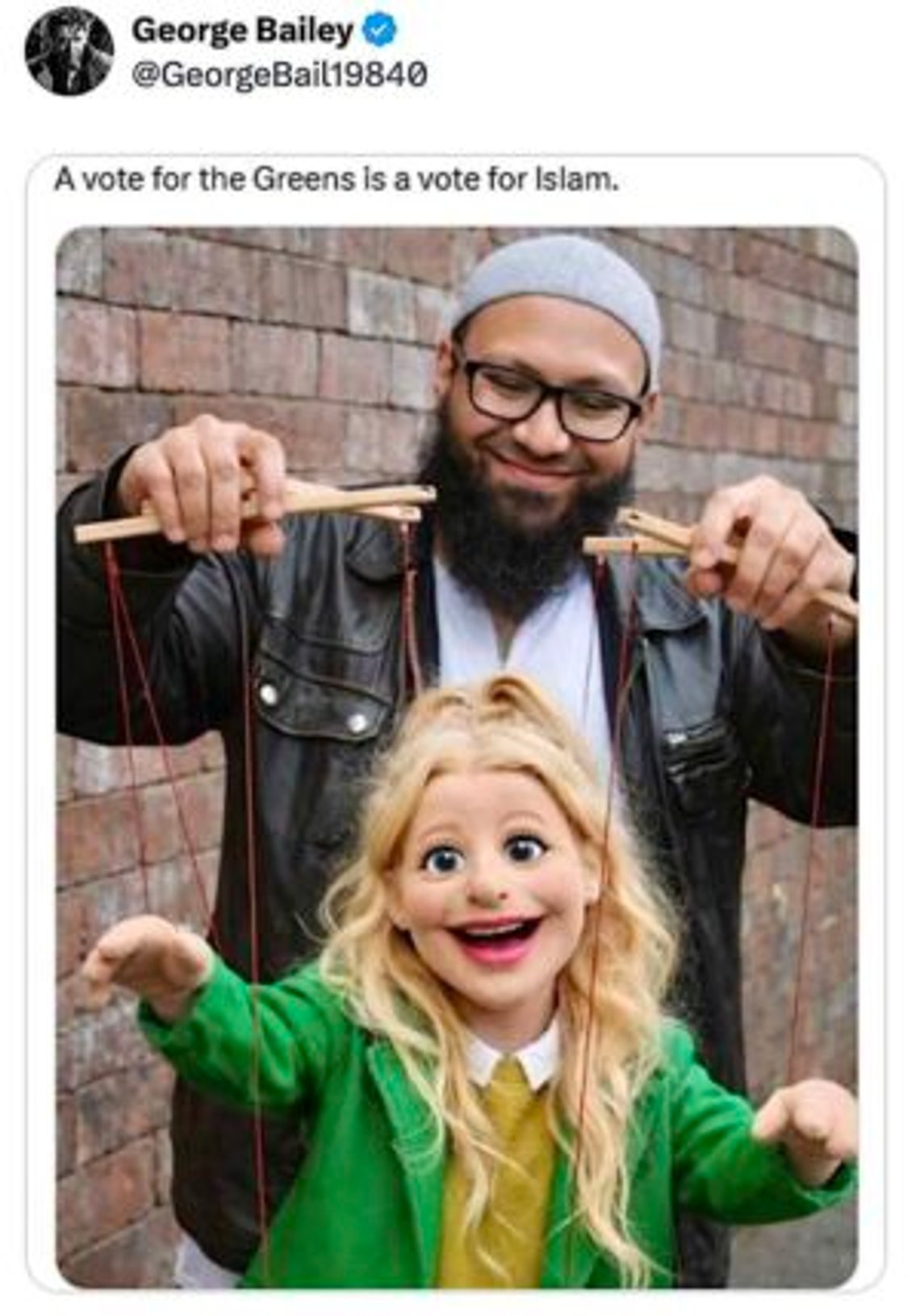
Among other things, Spencer wishes to grant amnesty to all illegal immigrants, and not only that; they are also to receive income (without working for it) and free housing, and they may also use the National Health Service without restrictions. “Immigration is not a criminal act under any circumstances,” the manifesto of The Green Party states. Labour, The Conservative Party, and Reform UK all regard the Greens’ policy as irresponsible.
In addition, the Greens used Urdu in one of their videos:
While supporters of the party considered this a clever move, it is difficult to avoid the conclusion that this points towards a future that is ever less British, and in which there will no longer be one dominant culture and common frame of reference, nor a single common language. The concept of “the Muslim vote” is already well established. We see the same in Norway. The website “Muslimer stemmer” (“Muslims vote”) encourages Muslims to “give your vote to those who protect your freedom of religion and distance themselves from Islamophobic laws!” Naturally they refer to parties on the left – the alliance between Islam and the left (islamo-left) has a long history, going back to the revolution in Iran in 1979.
Family voting
The authoritarian tendency that is evident both in Islam and on the left manifests itself in several ways. It is therefore not surprising that the phenomenon known as “family voting” raises concerns about whether the democratic rules of the game are being followed. In the by-election in Gorton and Denton, the Electoral Commission, the body that oversees elections in Britain, has raised the problem, and it is now being investigated by Greater Manchester Police. “Family voting” means, for example, that a man instructs his wife which party she is to vote for. This is illegal under British law.
“We do not usually report on the evening of an election, but the data we have collected today concerning family voting are extremely high compared with other recent by-elections,” the Electoral Commission said in a press release.
Election observers have been ordered to exercise “cultural sensitivity” in addressing the problem – yet another example of how the fear of being called racist sets the parameters for politics in Starmer’s divided Britain. There are approximately 20 per cent Muslims in the Gorton and Denton constituency, according to the Henry Jackson Society.
“We are losing our country,” writes Reform UK’s candidate in Gorton and Denton, Matt Goodwin, also known as a political commentator and former professor at the University of Kent.
“A dangerous Muslim sectarianism has emerged. We have only a couple of parliamentary elections left to save Britain. Vote Reform at every opportunity. I will continue the fight. I will always fight for you. I will stand at the parliamentary election. Matt.”
Restore or Reform?
Reform UK is not the only actor that has entered the struggle to preserve Britain. Rupert Lowe’s Restore Britain already has 100,000 members. Restore Britain is positioned to the right of Reform, and has already influenced Reform to adopt bolder positions on issues such as immigration. While many applaud Restore Britain and Rupert Lowe, who was expelled from Reform under mysterious circumstances, it is argued that with the British electoral system of first-past-the-post in single-member constituencies, a split on the right will benefit the left.
Tom Slater of Spiked summarises the situation in which Labour and Britain now find themselves:
“This is a shocking victory for the Greens. No one can take that away from them. But the way they won is ominous, not only for Labour, but also for our divided nation. Spencer effectively marched to victory on Britain’s integration crisis – by campaigning on Gaza, making TikTok videos in Urdu and relying on the Islamic sectarianism that has spread since 7 October. It proved to be a potent combination in inner-city districts, where as much as 40 per cent of the inhabitants are Muslims. Instead of appealing to voters on the basis of shared interests and social identity, the Greens did not even take for granted that their voters spoke the same language. The Muslim vote gave them its support. (…) In the future we can expect that more and more elections will be decided by this dispiriting demographic tally.”


