

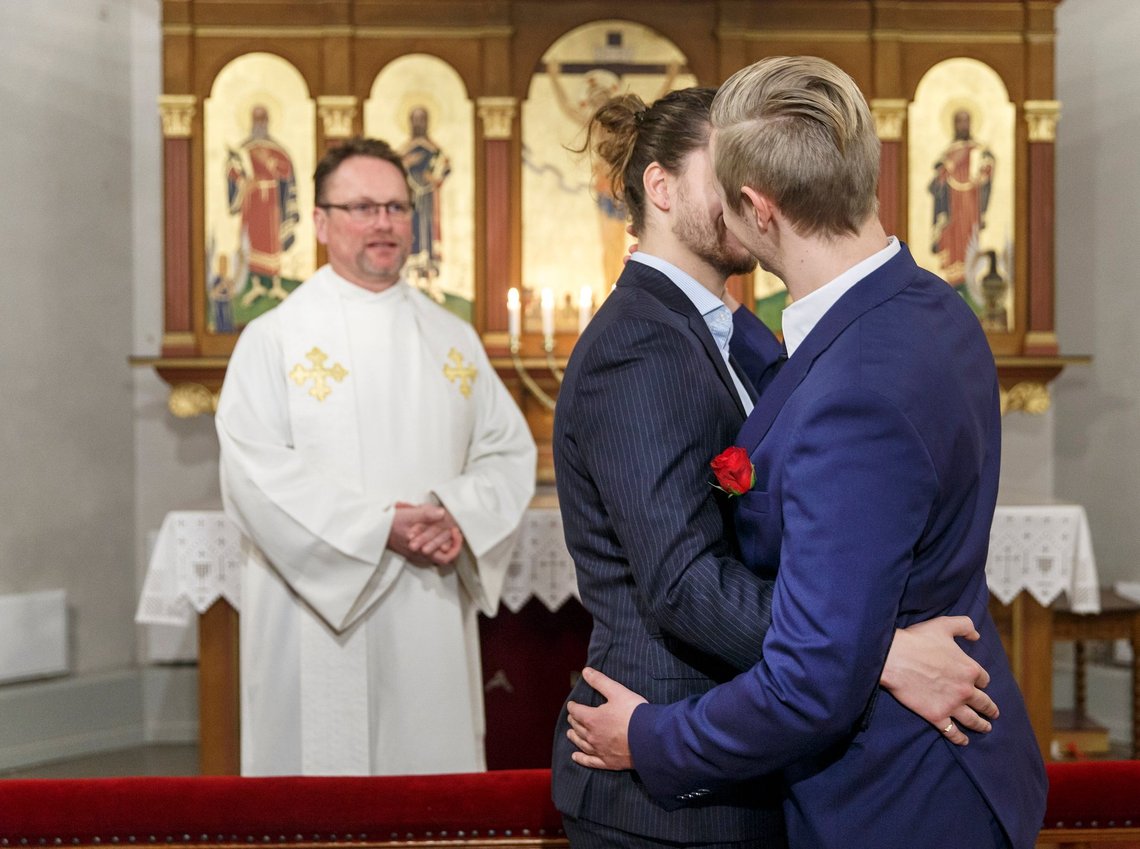


As the election campaign ramps up, left-leaning public service media once again bring forward that issue which refuses to die: priests who do not want to officiate same-sex marriages. Now it is reported, with sorrow in the voice, that there are still bishops who do not sweep away those who hold the wrong views.
A survey conducted by Swedish public service has shown that nine out of thirteen bishops in the Church of Sweden “do not automatically exclude” prospective priests who say no to same-sex weddings.
The outrage is, as always, total and carefully orchestrated.
The small detail that the Church of Sweden opened up to same-sex marriages back in 2009 and that not a single same-sex couple is denied a church wedding is accidentally forgotten to mention.
Instead, we are told how people “are saddened” and how this “is about love”. And who would want to be against love? It is an effective rhetorical device: if the issue is reduced to emotions, any objection automatically becomes cold, harsh, and suspect.
But what is happening has very little to do with emotions – and much more to do with power.
Tolerance – but only for the right kind of thinking
The facts of the matter are actually quite unremarkable: a majority of bishops in the Church of Sweden still allow priests to hold a classical Christian view of marriage. That is, the view the Church itself taught for two thousand years, and which is still shared by large parts of the global Church.
This is not some fringe minority. It is rather the remnants of what was, until recently, the norm.
And yet it is presented as a problem that must be solved.
Why?
Because tolerance in today’s church debate turns out to be conditional. It applies – but only in one direction. You are free to be inclusive, as long as you include in the right way. You are free to speak about love, as long as you arrive at the right conclusion.
And what is defined as “right” in Church of Sweden matters is, as so often, aligned with the party program of the Social Democrats. That may, of course, be a coincidence.
“A matter of hygiene” – when people become something to be cleaned away
When the bishop in Diocese of Karlstad, Sören Dalevi, describes it as “a matter of hygiene” to exclude priests with a traditional view of marriage, the picture becomes clearer.
Hygiene.
A word that belongs in contexts where something is to be cleaned, disinfected – removed.
Has the bishop perhaps embraced the idea of human vermin?
In any case, it is a remarkable choice of words in a church that claims to uphold the dignity of every human being. But perhaps that is precisely where the problem lies: dignity applies – but not to those who hold the wrong views.
“It’s about love” – and about exclusion
“It’s about love,” we are told.
Yes, evidently. The love for one’s own value system appears to be so strong that it requires other viewpoints to disappear.
Because while inclusion is preached, the Social Democrats have long pushed the line that no one should be ordained as a priest unless they are willing to officiate same-sex marriages. It is not enough to accept the arrangement, or to coexist within a church that holds differing views. One must actively affirm it.
Otherwise, you are not welcome.
It is a curious form of diversity.
A church in urgent need – of fewer priests?
At the same time, there is a shortage of priests. Not least in the Diocese of Karlstad.
In most organizations, that would lead to a degree of humility in recruitment. Perhaps a willingness to include more people rather than fewer.
But not here.
Here, the discussion instead concerns how to close the door even further – this time to people holding a theological conviction that the Church itself upheld for centuries.
It is hard not to admire the consistency.
From national church to opinion filter
What was once a broad national church is becoming something else: an opinion filter.
Where the decisive question is no longer faith, calling, or competence – but whether you arrive at the correct conclusions on contemporary value issues.
And of course, you are free to think whatever you like. As long as you think the right thing.
Or accept the consequences of thinking the wrong thing.
The uncomfortable question
One question remains – one that few are willing to ask out loud: How open is a church that only admits those who share the right opinions? And how tolerant is an organization that describes its dissenters as a hygiene problem?
Perhaps, after all, it is not only about love – it is also about who gets to belong.
And who must go.


