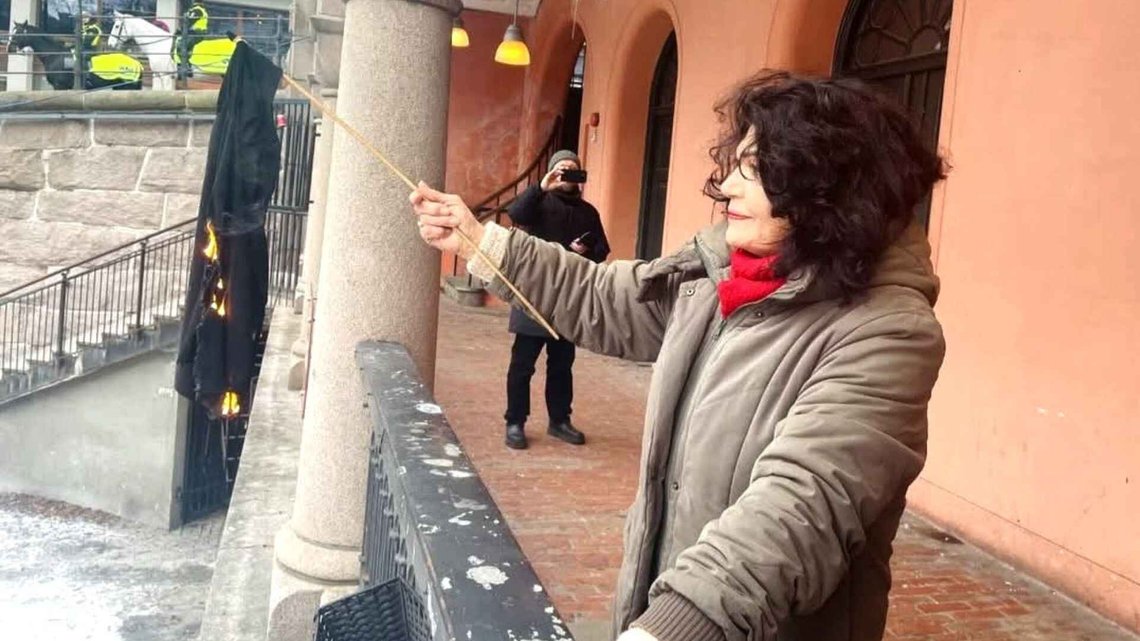
Lily Bandehy’s hijab action this time is not just against an ideology she strongly opposes. It is also an expression of sympathy with the Iranian people and the country she once fled from, decades ago. A country that is currently on fire, after large parts of the population have demonstrated against the Islamist regime in recent weeks. A country that has paid the price with thousands of protesters killed.
Compares hijab to swastika
I burn the hijab in solidarity with 36,500 families who have lost loved ones, with over 10,000 who have lost their sight, and with hundreds of thousands of wounded, disappeared and arrested Iranians inside Iran. The hijab, as we know it today, became a political symbol before Khomeini came to power in 1979. A regime based on religious fascism was established, and the hijab became a symbol of power, just as the swastika was the symbol of Nazism under Hitler.
Writes Lily Bandehy. She believes that today we see the same pattern across the Middle East: The women of Hezbollah, Hamas, Islamic Jihad, al-Hashd al-Shaabi and other militias subservient to the Iranian regime are all marked with the hijab.
The hijab serves as a visual sign of ideological loyalty to a system that seeks power, control and domination, a system that openly preaches the annihilation of Jews and rejects universal human rights. At the same time, we know that many girls and women, including children, are forced to wear the hijab, either by the state or by their families, under the guise of “modesty”. These women are victims.
– Hijab normalises Islamic fascism
Lily Bandehy is among those who believe that whatever the motives of those who wear the hijab, it serves as a symbol to normalise and reinforce oppression.
“Whatever the intention, the hijab as a symbol helps to normalise and reinforce Islamo-fascism,” Bandehy writes in the post.
Many do not wear it voluntarily, and there are countless examples of women who have either had their faces disfigured by acid or have been killed because they have refused to wear the hijab. There are plenty of examples in the West too, as Islamism’s adherents are also found in large numbers among immigrants, without this causing anti-Western and oppressive attitudes to subside.
https://www.document.no/2023/02/01/lily-bandehy-shall-burn-a-hijab-in-oslo/embed/#?secret=wINoK6J14r#?secret=d8LKF1GawW
Hijab women silent about the massacres in Iran
Since 8 January this year, the world has witnessed a systematic and nationwide massacre of peaceful protesters in Iran, people demanding bread, freedom and dignity. In just two days, 8-9 January, at least 36,500 people were killed in over 400 towns and villages. These are just the ones that have been documented. Many are buried in mass graves, without names.
Yet: Out of 57 Muslim countries, none have reacted. No one has condemned the massacre. In Norway, we have the Islamic Council of Norway, the Islamic Dialogue Centre, the Rabita Mosque and a number of other mosques. None of them have condemned the killing of innocent Iranians – not even when the victims are small children.
The silence is total. Not one imam.
Not one hijab-wearing woman in Norway.
Not one organised Muslim institution.
Why? Because the loyalty lies with the ummah, not with human rights. That is why it is necessary to burn the hijab. Not out of hatred for people, but in support of those who fight for democracy, equality and freedom. The hijab consciously or unconsciously represents an ideology that is in direct conflict with women’s rights and universal freedoms.
That’s why I burn the hijab on 1 February every year. I do it for the women of Iran. For the children who were killed. For those who can no longer shout,” writes Bandehy.Ahmadiyya women celebrate hijab day
Bandehy has chosen the date 1 February because this is the annual International Hijab Day. In Norway, Ahmadiyya Muslims in particular have been behind this day. Many people believe that these Muslims, who are not recognised as Muslims by Sunni Muslims, are moderate. But they want hijab, gender segregation and their own version of a caliphate. Including those who have moved to Norway and established the largest mosque in the Nordic region as one of the first things they did when they arrived in Oslo. That is,
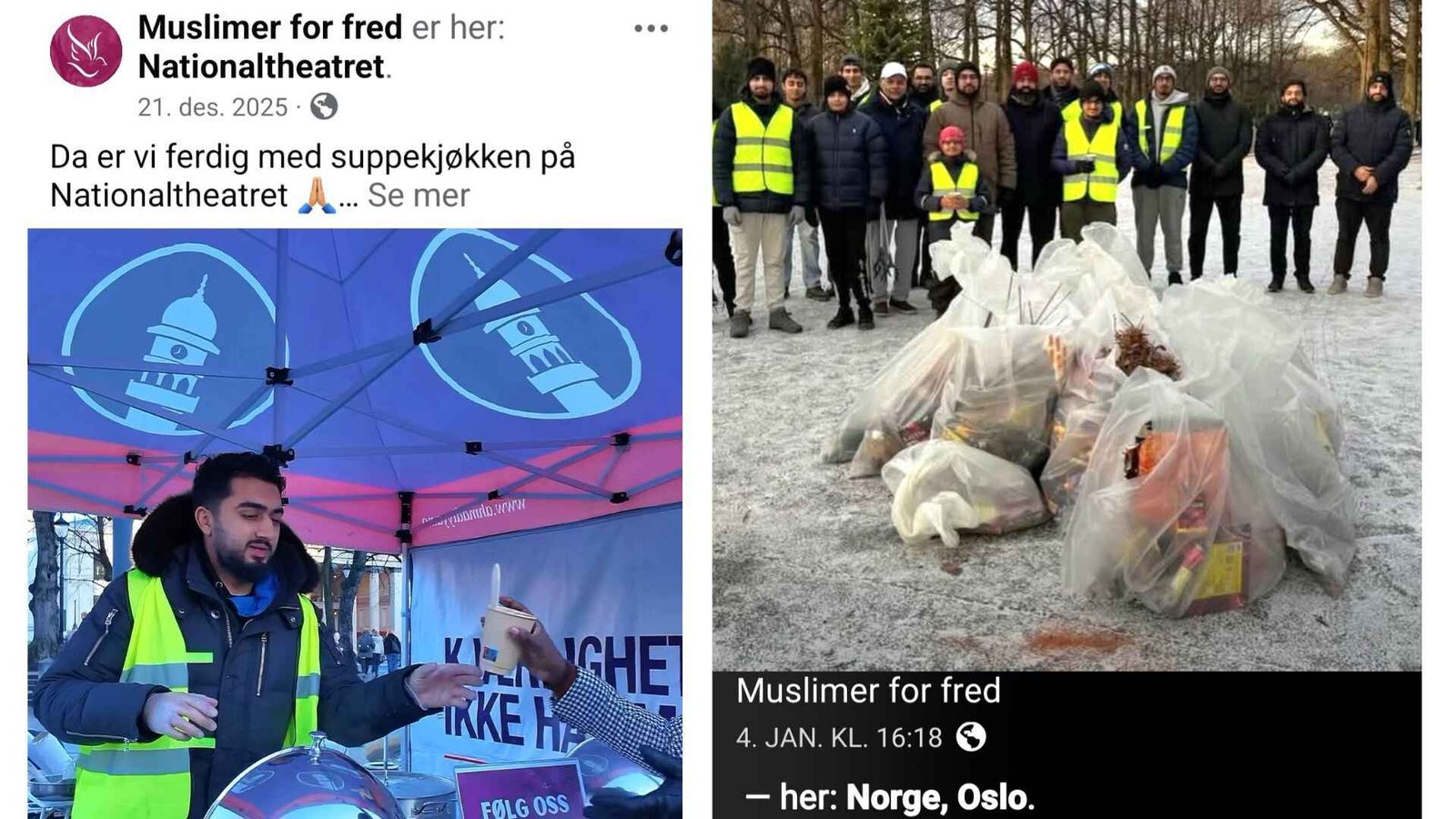
Ahmadiyya Muslims have the same practices throughout the Nordic region: Soup kitchens in Advent, tidying up on New Year’s Day, and on 1 February the ladies celebrate Hijab Day, without posting pictures. Photo: Facebook.
The Ahmadiyya Muslims make a name for themselves every New Year’s Day, when they clean up after unbelievers who have celebrated the New Year, not only in Oslo, but in many Norwegian cities, and also in other cities throughout the Nordic region. Like here in Malmö. They also have a common strategy for spreading their version of Islam, such as organising soup kitchens during Advent.
Ahmadiyya women celebrate hijab day
By and large, men are visibly present at most Ahmadiyya activities against infidels, with one exception. The ladies are celebrating hijab day, and they have also clashed with Lily Bandehy and her supporters in various newspaper columns. Like Nabila Anwar, who is fighting for the right to wear the hijab in Norway.
I have never been forced to wear the hijab. For me, the hijab does not represent oppression, but rather a personal and religious freedom.
While it is a fact that some Muslim countries and groups force women to wear the hijab, and even if they do not want to, this practice should not be generalised. The oppression of women in such cases has nothing to do with the religion itself, as Islam clearly emphasises that there is no compulsion in the religion,” Anwar wrote in Nettavisen in 2024.She, who works as a doctor in Hadeland, wants to be recognised as a hijab feminist. The women’s association of the Ahmadiyya Muslim faith community, Lajna Imai’llah Norge, has for several years organised stands around Norway to celebrate Hijab Day. In 2025, they had stands in 12 locations around Norway, Utrop wrote last year, mentioning two in Oslo city centre plus Holmlia and Lambertseter, Stavanger city centre, Kristiansand, Byhallen in Fredrikstad, USN Campus Drammen, Mosenteret in Nittedal, Ski train station, Lillestrom torg and Nes library in Ullensaker. They also quoted Nabila Anwar, who said that, among other things, they had talked about the importance of covering up on Hijab Day.
https://www.document.no/2026/01/12/doc-tv-lily-bandehys-hjerte-blor-for-iran/embed/#?secret=Oz3PMzisZs#?secret=30mO2VBTsL