



By the killjoy and rationalist Yan Calmeyer Friis
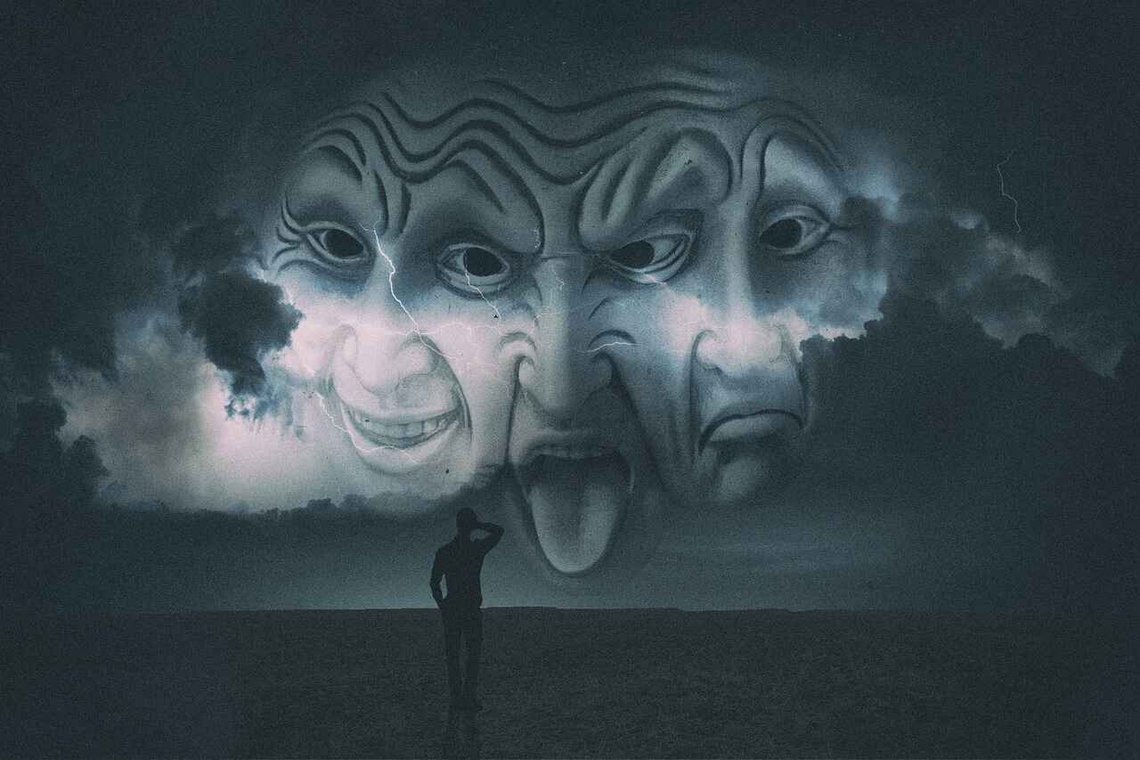
The lie walks freely among us. No one raises an eyebrow. He is an accepted gentleman. Dressed in black and supple, with a cunning smile upon his lips. The same lips that kissed Christ.
When we were children, we discovered the lie. Not in our own mouths, even though the adults all too readily accused us of lying when we merely invented something and allowed imagination to carry us where imagination carries a child’s mind. That is called tall tales, perhaps, but never a lie. No, we discovered the lie in those same adults who could promise something, and just as easily go back on their promises.
It was the things we did not receive. It was everything that nevertheless was not done. It was the fairy tale that was never read. It was the journey that never came to pass. It was the evening they nevertheless did not have time.
And when hope was almost shattered, the adults gave us the straw to cling to: Perhaps another day. “Perhaps another day” is the most cowardly no and the greatest lie of them all. In the child’s ears it becomes a hope to which he clings, yet never truly believes. For it is the sum of childhood’s lesson: Another day never comes.
As adults, we have learnt to deal with the lie as though it were the most natural thing in the world. The lie is the magical fairy dust sprinkled over all promises in public life and in the thousand homes.
 Pinocchio. Photo: AP/Felipe Dana/NTB
Daily we hear adults from every shelf of society accuse one another of lying. They lied about the Gardermotunnelen as well. And afterwards everyone ran in all directions to escape responsibility.
It has become popular to “swallow camels”. During election campaigns they promise themselves yellow and blue. Afterwards they abandon their promises by blaming all the others. Or they deny that they made the promises, even though the TV 2 news has it on record. The struggle for power and influence carries a personal gain that is irresistible. The means is an endless series of compromises, an infernal race conducted at the expense of one’s own opinions, laced with suitable doses of lies and betrayal.
Take our Prime Minister, who says one thing before the election and something entirely different afterwards, and denies every lie in which he is caught, without noticing that his nose grows longer and longer. He even believes that, if he is caught in a lie, he can ask for another chance, a new recording with an adjusted answer.
 Would you buy a used car from this man? Photo: Amanda Pedersen Giske / NTB.
A good politician’s diet thus consists of daily doses of camels. If one fails to realise the promises one gave, one swallows a camel, and gets on with it, as they say abroad.
The party leaders’ debate before the election is highly revealing. Here the country’s most prominent political figures accuse one another of lying and swindling and cheating in prime time, live to the thousand homes. The accusations come in such overheated quantities that one gains the impression that these people are in fact competing to be the one who has lied the most. Shoplifting a pair of sunglasses becomes, in this context, a mitigating circumstance.
The litmus test here is to watch the Storting debate between Ine Eriksen Søreide and Bjørn Moxnes on “elite diplomacy” in 2021. You are in no doubt which of them you feel you can trust. Hint: The person in question does not have a Beatles haircut.
When we were children, accusations of lying resulted in a beating and at least a nosebleed. For adult human beings there are no such consequences. For them the lie is as natural as the air they breathe. Both they and we take it for granted. Just think of all the lies that rained from politicians’ mouths before the last EU referendum. None of them bleed from the nose today. These are our role models and our guardians.
Since the Epstein revelations emerged, if not the whole, then at least half the house of cards has collapsed. Norwegian network-builders in the super-class – right into the Royal House and the Government – have ensured that Norway is overrepresented as a nation in the Epsteinian spider’s web. Imagine, little, honest, aid-generous Norway, suddenly world-famous for corruption, greed and fraud. We reign at the top of the disqualification charts – and there our performers are equally well represented on both the left and right sides of the political spectrum. We have become the country where one cannot trust anyone.
From the Palace to the Storting. From the corridors of the Ministry of Foreign Affairs (UD) to the boardrooms of the international peace institutions. We hear about ethics and openness. About sustainability and responsibility. About trust.
 Økokrim searches the residence of Thorbjørn Jagland in Risør on 12 February 2026. Photo: Tor Erik Schrøder / NTB.
At the same time, connections between humanitarian aid environments and financial networks that should never have been anywhere near one another are being unravelled. Dinners. Donations. Board positions. Correspondence. Property transactions. All within the framework of what is formally permitted, yet nevertheless with an aftertaste of something else.
To this are added systematised abuses of little girls.
When think tanks financed by Norwegian aid funds are revealed to have had close ties to an internationally compromised financier, it is explained as dialogue. When senior leaders participate in contexts that in hindsight appear more than unwise, it is called meeting activity. When questions are asked, one responds with an external-internal commission of inquiry populated by disqualified participants at mate level. When the inquiry is requested, one asks for calm.
And under pressure everything sinks down to the lie’s final desperate whimper: I exercised poor judgement. I am sorry. I should have googled him.
Who has paid for this circus of lies? The money comes from us. It comes from what was supposed to be humanitarian aid, development and peace work. It comes from trust.
No one raises their voice. No one bleeds from the nose. Some need a little more time before they respond – with justifications such as that they are slightly ill, very sorry and all that. One moves on to the next conference, the next summit, the next speech on moral leadership. And our own mendacious Prime Minister boasts of the high morality of the Ministry of Foreign Affairs. It is scarcely credible.
Yes. Thus the lie continues to walk freely among us. Not necessarily in the grand words, but in the spaces between. In what is not said. In what is explained away.
Another day everything shall be put in order. Another day all the cards shall be laid on the table. That is roughly what they attempt to say. Thus they return to the mother of all lies: Another day. And swallow a camel. Double standards are the natural consequence of the lie’s deep yet uncomplicated inner life.
I shall in no way pretend that I am aggrieved. Our parents did a good job with us children. From them we received the most important maxim in life: Honesty does not pay.
Will it be better another day? What an idiotic question. Another day never comes.
 First thing I remember, was asking papa “Why?”
For there were many things I didn’t know
And Daddy always smiled, took me by the hand
Saying, “Someday you’ll understand”
Well
First thing I remember, was asking papa “Why?”
For there were many things I didn’t know
And Daddy always smiled, took me by the hand
Saying, “Someday you’ll understand”
Well


