
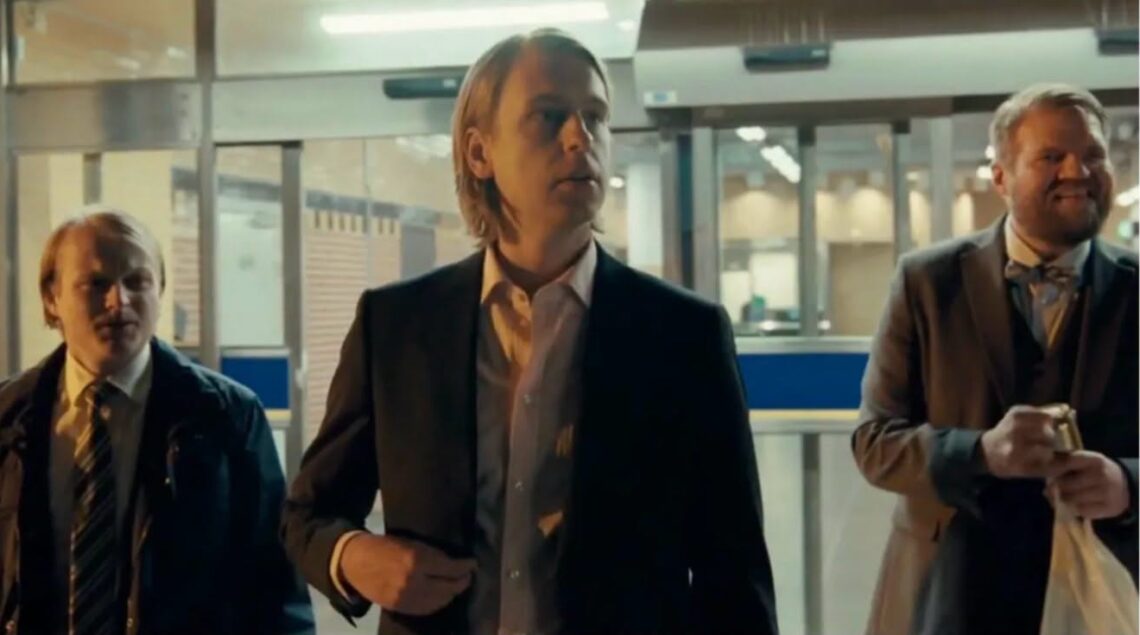
A new Swedish feature film with a clear satirical edge aimed at the Sweden Democrats will premiere in cinemas just over two weeks before the general election. Among those behind the production are SVT and the Swedish Film Institute, raising questions about the impartiality of public service and state-funded cultural institutions.
The film Flaggan (“The Flag”) is marketed as an “offbeat comedy” in which the story revolves around stereotypical portrayals of Sweden Democrat voters and the nationalist right. In the marketing material, the characters are depicted as ridiculous and politically uneducated. The film is described as a satire of the Swedish right, and the plot is summarized as follows by MovieZine:
“Flaggan takes place on election night in 2010. Two young Sweden Democrats (Noel Flike and Arvid Swedrup) are assigned to hang a giant Swedish flag in Rinkeby Square, but are drawn into a chaotic night filled with bizarre encounters. Drug dealers, activists and Finnish bikers stand in their way.”
The theatrical premiere is scheduled for August 28, meaning the film will reach cinemas just as the Swedish election campaign enters its most intense phase, when the parties are making their final push and the large number of undecided voters are making their decisions ahead of Election Day.
“Who wants to vote for fools?”
Political satire has a long tradition in Swedish culture, but because Flaggan premieres only two weeks before Election Day, the film has already become part of the debate about public service, cultural policy and the boundary between artistic freedom and political influence.
“Scheduling it for two weeks before the election is, of course, carefully planned: enough time for it to shape public opinion, become a talking point and directly influence the election result. Who wants to cast their vote for a party whose representatives have been portrayed on screen as fools? At the same time, it is a short enough period that any possible legal consequences will not have time to take effect,” writes Tina von Schinkel in Samtiden.
New accusations of political bias
Among those behind the production are SVT and the Swedish Film Institute, something that, unsurprisingly, has once again raised questions about how public service and other state-funded institutions should act during an election year.
The fact that a political satire targeting a single parliamentary party is being released during the election campaign is seen as yet another political statement from institutions that have long been accused of having a left-wing political bias.
As recently as last Saturday, journalist and former SVT profile Anna Hedenmo acknowledged in an interview with P1 that news stories that could benefit the Sweden Democrats were downplayed when the party first entered Parliament.
– I know, because I have seen and heard it with my own eyes and ears, that news which could benefit the Sweden Democrats was held back, she said, referring to information about how many inmates in Swedish prisons had a foreign background. Hedenmo later repeated the statement in an interview with Kvartal.
Supposed to remain independent of party politics
According to their mandates, both SVT and the Swedish Film Institute are supposed to remain independent of party politics. SVT’s broadcasting licence, for example, requires accuracy and impartiality in its operations, while the public broadcaster repeatedly emphasizes the importance of political neutrality.
In its description of the public service mission, SVT states:
“Our operations shall be independent and autonomous in relation to both the state and various economic, political and other interests and spheres of power in society.”
SVT also has a dedicated page on impartiality, where it describes being impartial as one of its “most important responsibilities.”
Funded through taxes
SVT and the Swedish Film Institute are financed primarily through taxes or government appropriations.
SVT’s revenue amounted to approximately SEK 5.7 billion in 2025, around 95 percent of which came from the mandatory public service fee collected through the tax system. The Swedish Film Institute’s government appropriation for 2026 amounts to approximately SEK 550 million.
The film is scheduled to premiere in cinemas on August 28, while the Swedish people go to the polls on September 13. Watch the official trailer below.