




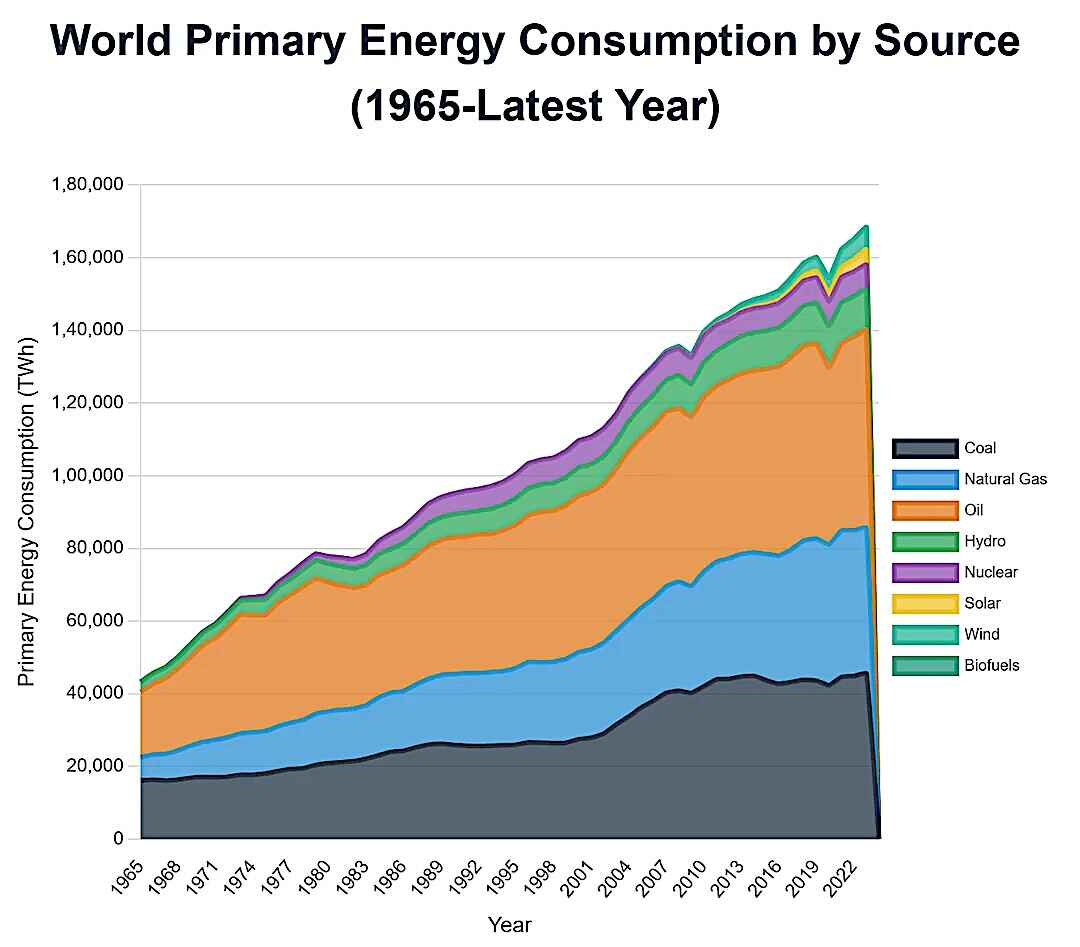
Global energy consumption increased in 2025 by 1.7 per cent compared with 2024 to a new record level of 600.3 exajoules (EJ). In the same period global CO2 emissions increased by 1.1 per cent to 41 billion tonnes, also a new record.
This is how the long-term upward trend in the world’s energy demand continues, according to The Energy Institute’s Statistical Review of World Energy for 2026, which was published in the past week.
According to the report, fossil energy sources covered 86 per cent of global energy demand last year. The corresponding share the year before was 87 per cent.
But even though the share of fossil energy has fallen by one percentage point, fossil energy production still increased in absolute terms by approximately 8.1 EJ.
Production of renewable energy increased the most in percentage terms, but all energy sources increased in absolute terms in 2025, which once again shows that renewable energy sources do not replace others but are added to them.
The historical trend is that energy consumption increases steadily and that coal, oil and gas remain indispensable, vital energy sources.
Forbes writes:
In 2025 oil was still the world’s largest energy source with 201.0 exajoules. Natural gas increased to 150.7 exajoules, while coal rose to 166.0 exajoules. Together these three fossil fuels accounted for approximately 518 exajoules of the global energy supply.
This means that fossil fuels still accounted for approximately 86 % of total global energy supply in 2025. Renewable energy accounted for, despite rapid growth, approximately 5.9 %. Nuclear power accounted for approximately 5.2 %, and hydropower accounted for approximately 2.7 %.
The American business magazine does not expect the 86 per cent share to fall quickly, and notes that North America accounted for half of the global increase in CO2 emissions in 2025.
An increase of 13 % in US coal-fired power production contributed significantly to this increase. At the same time demand for electricity in the USA rose by 3 %, which was largely in line with the global average. The USA also accounted for 40 % of global electricity consumption in data centres, underscoring the rising energy consumption linked to artificial intelligence, cloud services and digital infrastructure.
The USA benefits from its energy abundance, while Europe is vulnerable, Forbes concludes.


