

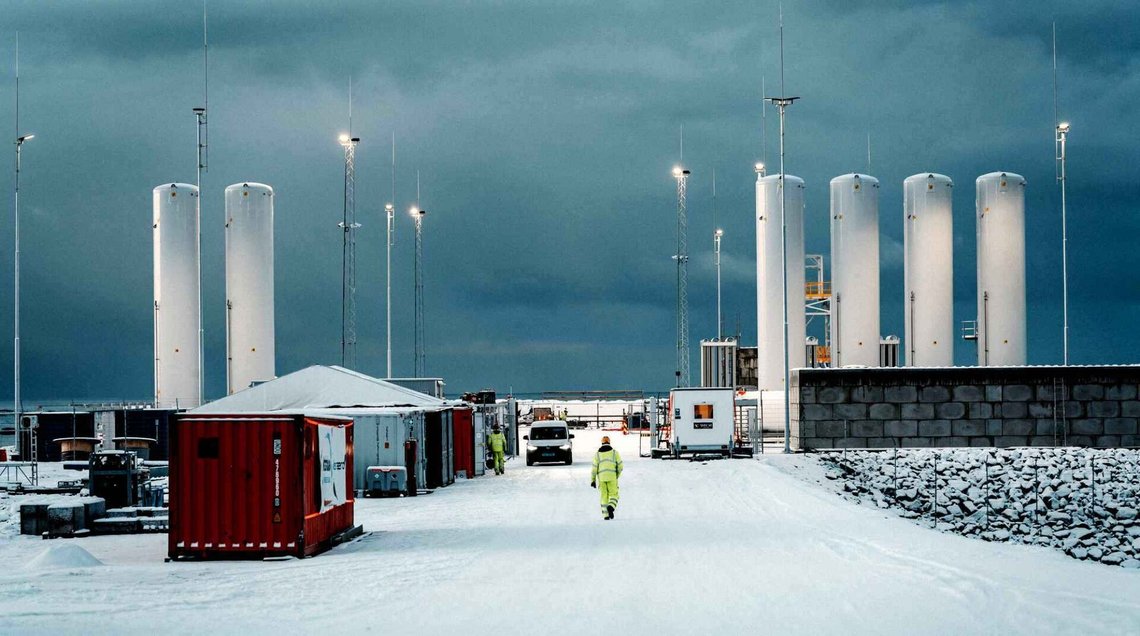
The Norwegian Directorate for Civil Protection (DSB) has conducted a classified inspection of Andøya Spaceport, which may have been the target of one or more Chinese intelligence operations.
The Directorate notified Andøya Spaceport AS of the inspection on 21 April this year. This was only four days after the Norwegian Police Security Service (PST) had seized a 22-tonne satellite receiver at Oslo Port, which it believes individuals linked to Chinese intelligence were planning to deploy on Andøya.
The antenna may have been intended for use in intercepting data from the NATO-funded rocket “Spectrum”, which is tested regularly from Andøya Spaceport.
The 29-year-old Chinese woman who was arrested by PST on 7 May was still communicating with the freight company in an attempt to get the antenna through customs after it had been seized.
The exact date on which DSB conducted the inspection is not known. Judging by the document log, it may have taken place at the beginning of May.
– DSB denies access to the case documents on national security grounds, it states in a written response from DSB to Document’s request for access:
The documents for which access is requested concern the submission of documentation in connection with an inspection at Andøya Spaceport in the spring of 2026.
The request for access is denied pursuant to Sections 21 and 24, third paragraph, of the Freedom of Information Act (offentleglova), as the documents contain information that must be protected in order to safeguard national security interests, as well as information that could facilitate the commission of criminal acts if disclosed.
Additional access pursuant to Section 11 of the Freedom of Information Act (offentleglova) has been considered, but DSB finds that it cannot grant access because the need for exemption outweighs the consideration of public access in this case.
The case history shows that Andøya Spaceport AS had to submit additional documentation to DSB on two occasions following the inspection, both times after PST’s arrest and operation against a detached house on Andøya.
Andøya Spaceport is owned by Andøya Space AS, which in turn is jointly owned by the Ministry of Trade, Industry and Fisheries and Kongsberg Defence & Aerospace AS.
Jørgen Bratting, Director of Quality, Safety and Security at Andøya Space, has previously rejected claims that the company is involved in the espionage case.
 The case history relating to the inspection of Andøya Spaceport shows that it was carried out at short notice and probably took place at the beginning of May. (Screenshot from einnsyn.no)
The inspection was carried out by DSB, which itself may potentially have been exposed to Chinese intelligence through its contract with Frequentis AG, supplier of support, maintenance and equipment to the control centres of the Emergency Network (Nødnett).
Frequentis AG has a Chinese employee in a key position in Norway, who was recruited directly from a position with one of the accused Chinese nationals in the Andøya case.
DSB has previously stated that it maintains close dialogue with its suppliers, including Frequentis AG, regarding the issue:
– In light of this case, they have informed us that they are conducting further investigations and assessing whether measures are required, commented Bjørn Morten Skudsveen, Head of Emergency and Preparedness Communications.
Andøya Spaceport is the launch base for the NATO-funded launch vehicle “Spectrum”. The German manufacturer Isar Aerospace makes no secret of the rocket’s “dual-use” capability, meaning both civilian and military use.
Isar has a contract with Andøya Spaceport for the regular use of the launch pad on Andøya. Frequentis AG supplies the communications platform used during the launches.
Andøya Spaceport has held governmental approval for a second test launch of “Spectrum” from 11 June onwards. On Monday a week ago, the first attempt was cancelled and the launch was postponed indefinitely.


