
 Erling Marthinsen
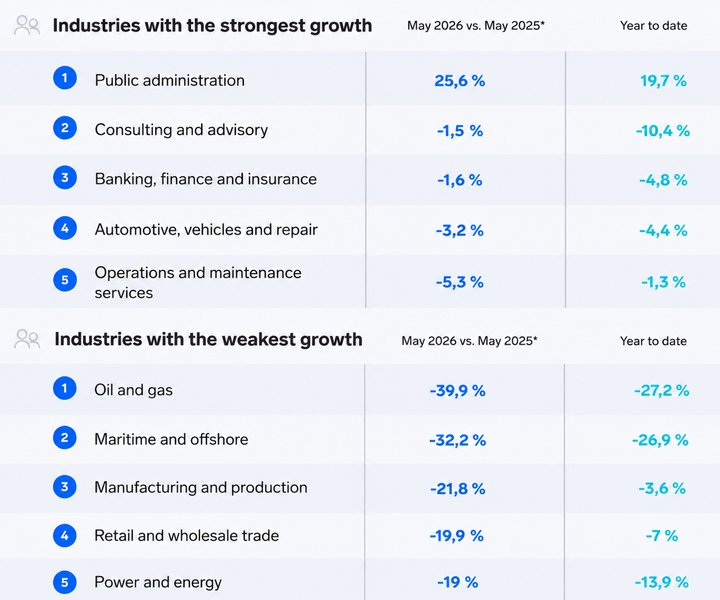
The job market is in free fall when it comes to private enterprise. But public administration is delivering more than 25 per cent new positions.
Several of our most important industries are being affected, writes editor Steinar Grini in Dagens Næringsliv.
Oil and gas is down 40 per cent over the past year, maritime and offshore is down 32 per cent, industry is down 22 per cent, and retail and wholesale trade is down 20 per cent. Power and energy is also showing weak development, with a 19 per cent decline in the number of positions.
At the same time as the number of vacancies is falling, the number of jobseekers is growing sharply.
“We are now seeing an intensification of the trend we have observed for some time, namely that fewer positions are being advertised while significantly more candidates are actively looking for new opportunities. This means we have a weak labour market where competition for each individual position is increasing,” says job analyst and head of FINN Jobs, Christopher Ringvold.
This is a warning for the future of those somewhat older workers who are approaching retirement age. But it is worst for young people who are currently attending upper secondary school or university.
According to the overview, the sectors that appear to be faring best are “consulting and advisory services”, which one must assume are financed to a large extent by the public sector. They are followed by “banking, finance and insurance”, which also serve municipalities, counties and the state.
The only sector showing solid growth is public administration.
Sectors Showing the Strongest Growth
This undeniably suggests that we live in a country that survives solely because of the oil industry. But even there, the future does not look bright, according to Ringvold.
“There are major differences between sectors in the May figures, and the most striking change is found within the country’s heavier industries. The oil and gas sector is experiencing a dramatic decline of as much as 39.9 per cent in the number of advertised positions compared with May last year. At the same time, the maritime and offshore sector is also falling heavily, with a decline of 32.2 per cent.
“Industries such as oil, gas and maritime activities have been in a negative spiral regarding recruitment for a considerable period, and what we are seeing now is a clear cooling-off. Employers in these sectors have applied the brakes hard compared with the aggressive hiring levels we saw only a few years ago.”
The maritime and offshore sector is closely linked to the oil industry.
Ringvold finds some comfort in the fact that certain industries which essentially produce nothing other than services are experiencing only a slight decline.
“The fact that the finance and consulting sectors are now stabilising so close to last year’s level is a positive sign. It may be interpreted as meaning that demand in these sectors is beginning to find a new normal level.”


