

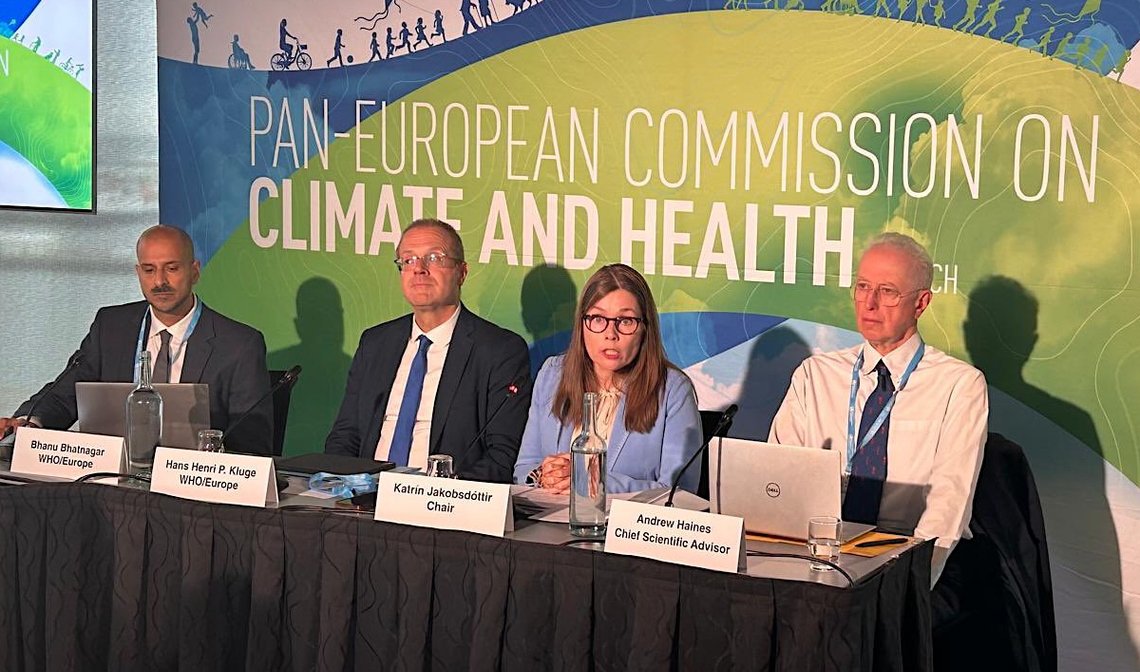


“The climate crisis” should be declared a global public health emergency, proclaims a “pan-European” commission on climate and health established by the World Health Organization (WHO). The commission is also calling for measures to combat “disinformation”.
It is in a document published on 17 May that the Pan-European Commission on Climate and Health (PECCH) urges the WHO to treat the “climate crisis” in the same manner as public health emergencies of international concern such as pandemics. In this way, an international effort can be coordinated with the aim of preventing the loss of millions of human lives, the document concludes.
PECCH is chaired by Iceland’s former Prime Minister Katrín Jakobsdóttir, and among the commission’s thirteen members are the EU’s former Climate Commissioner Connie Hedegaard and Germany’s former Health Minister Karl Lauterbach. The latter led the Covid response in Germany, and it is precisely such a level of preparedness that the commission seeks for the “climate crisis”.
In an interview with The Guardian on Saturday, Jakobsdóttir says:
“The climate crisis may not be a pandemic, but it is nonetheless a public health crisis threatening the very health and survival of humanity. And if we do not act faster and more comprehensively, many millions more people may die or suffer life-altering illnesses.”
To the English newspaper, the commission’s chief scientific adviser Andrew Haines says:
“If we continue emitting at current levels, this will intensify health risks for both present and future generations, including more people suffering and dying from extreme heat, flooding and infectious diseases, air pollution from wildfires, more premature births, and increased food insecurity.”
PECCH urges the world’s governments to stop subsidising fossil energy sources, which the commission believes cause 600,000 premature deaths in Europe each year. What consequences energy shortages have for public health does not appear to concern her.
Jakobsdóttir proposes an information strategy:
“The way to combat climate scepticism and misinformation is simple: make it personal. Climate change is not happening somewhere else, to someone else, in the future. It is shortening lives in European cities right now. It is filling hospitals. It is causing anxiety, stress, and other mental health problems. And the measures that will solve the problem – clean air, active transport, insulated homes, sustainable food – are precisely the measures that make people healthier and happier today.
“When the health argument and the climate argument are one and the same argument, it becomes very difficult to oppose it.”
– Climate change concerns security, health, and the economy all at once, comments WHO Regional Director for Europe Hans Kluge. Therefore, there is a moral duty to act now, he believes.


