

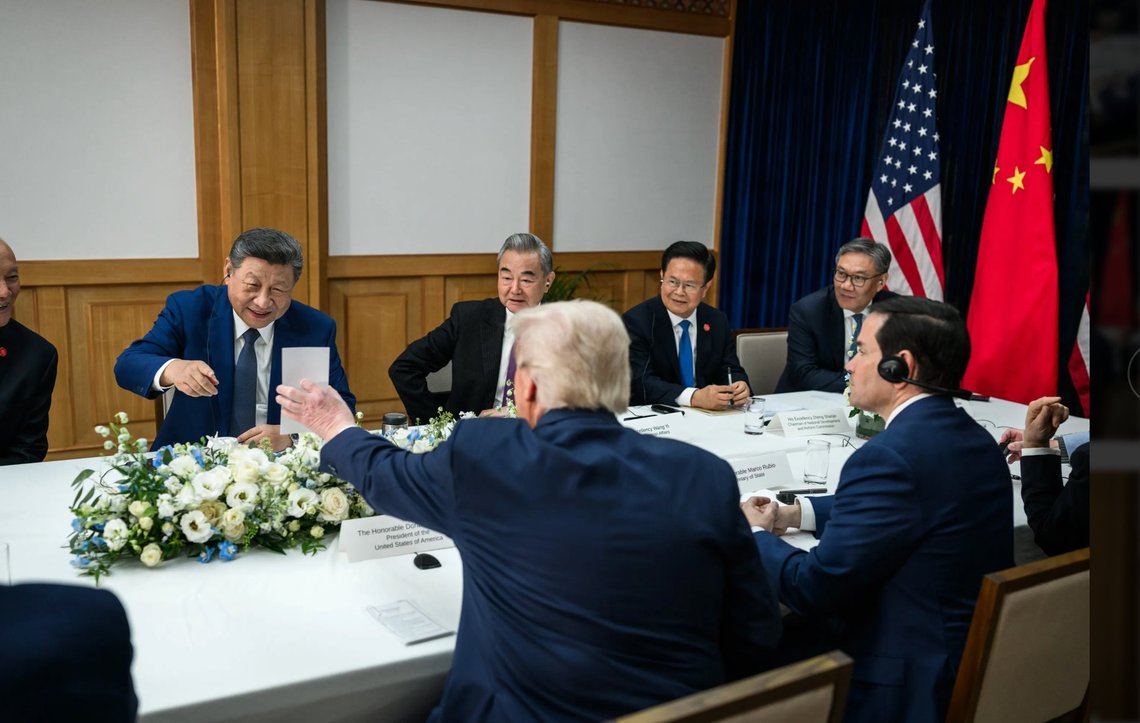


The American delegation met the Chinese one in Peking on Friday. Trump praised Xi Jinping as a great leader and said it was deserved. Everyone around the table knows that Trump said something entirely different during the pandemic. He called Covid-19 the China virus and believed China ought to pay compensation amounting to staggering sums. Now the tone was entirely different. The United States is on its way up, and China is in a weakened position.
The raid against Venezuela deprived China of one of the country’s important crude oil suppliers. The United States seized several tankers, and now the oil is going to the United States. That was a major blow to China.
Iran was the other major supplier, and now that source too has been cut off. China is left only with Russia, and it is doubtful whether Russia has the capacity to cover China’s needs.
The Strait of Hormuz is closed.
Trump will ask Xi to help bring the war to an end, but on America’s terms: Iran must abandon the dream of acquiring nuclear weapons.
China is dependent on exports for economic growth, and this has diminished after Trump introduced tariff duties.
Trump therefore now holds all the cards: energy and tariffs.
For China, Taiwan and reunification are inextricably linked to Xi’s future. He has wagered that reunification will succeed, but not at the price of war with the United States.
Trump represents a 180-degree reversal in China policy.
Republican George H.W. Bush was the one who opened the door to economic cooperation with China.
Even after the massacre at Tiananmen Square, it did not take long before National Security Adviser Brent Scowcroft was in place and had restored relations.
That was the beginning of a process in which American production was moved to China. It led to the deindustrialisation of the United States: America could provide the smart technology, and China would take care of the dirty work.
Washington underestimated China’s ability to learn how to copy. Japan had done the same towards the end of the nineteenth century and defeated Russia in 1905.
Just as the American Establishment failed to understand that the Arab countries were poorly suited to American democracy and squandered men and capital on an overly ambitious enterprise, the United States failed to understand that the Chinese are adept at copying and stealing. They turned a blind eye to America being drained for one single reason: Those who deindustrialised the United States became fabulously rich.
That is what is called managed decline.
It escalated when Clinton admitted China into the WTO in 2001. China knew how to exploit market access in order to acquire market dominance in one sector after another.
Trump and his people have learned. They are retaliating with tariffs.
But Europe has learned nothing: Germany wants to let Chinese electric cars in. It is like signing its own death warrant.


