

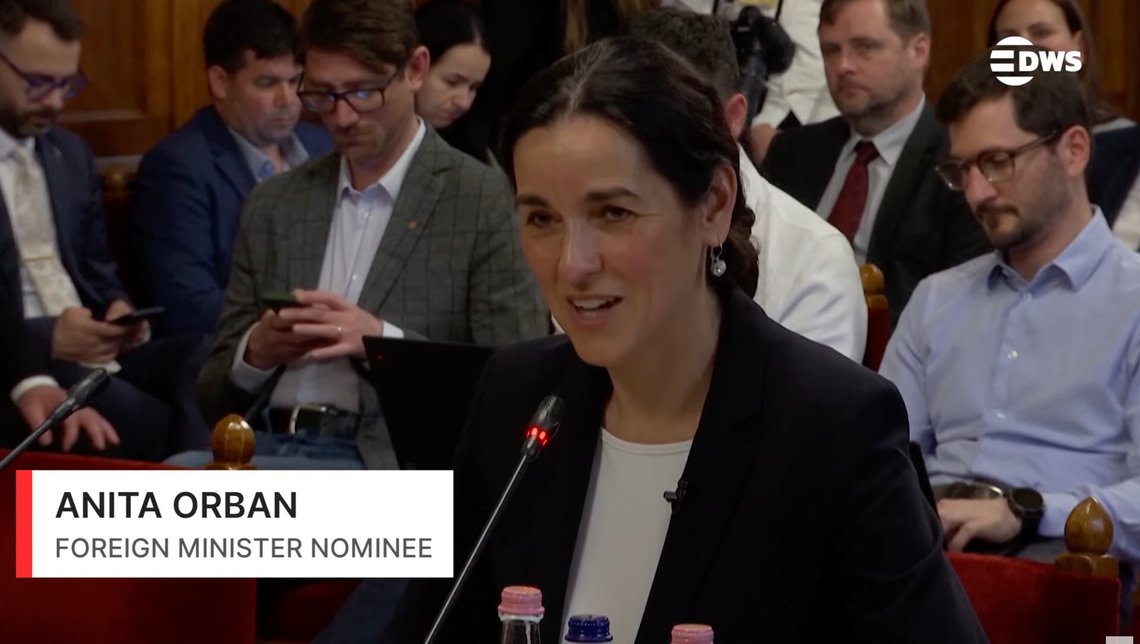
Anita Orbán announces a major shift in Hungary’s foreign policy, and opens the door to migration and Hungarian troops in Ukraine in order to satisfy demands from Brussels.
Anita Orbán is not related to Viktor. She has been appointed foreign minister and deputy prime minister of the Tisza Party, and, just like Hungary’s new prime minister Péter Magyar, has a background in the Fidesz party.
Hungary’s most important foreign-policy priority will be to restore trust and strengthen the country’s position both in the EU and NATO, the designated foreign minister Anita Orbán told Parliament’s Committee on European Affairs during the hearing prior to her appointment on Monday.
She spoke about how the new Tisza government wishes to release frozen EU funds, handle migration issues, and do what the EU demands. She also said that Hungarian troops could be deployed in Ukraine under the EU flag, writes Daily Hungary.
Anita Orbán outlined a new direction for Hungary’s foreign policy, which includes Hungary seeking to become a driving force within the EU. She expressed that the use of the veto right as a crude instrument would cease. Should Prime Minister Péter Magyar resort to it, it would be for weighty reasons.
These are clear signs that the new Hungarian government is open to submitting to Brussels, a sentiment also disliked by many Hungarians who voted for Magyar or the socialists.
Anita Orbán said that the daily fine of 1 million euros imposed on Hungary in connection with migration must be lifted. She intends to resolve this by allowing asylum seekers arriving at Hungary’s borders to apply for refugee status.
She added that the EU Migration Pact does not entail mass immigration to Hungary, but rather mutual assistance between member states facing significant migration pressure – either by receiving a limited number of migrants or by offering financial or logistical support.
This is unlikely to be well received in Hungary, particularly outside Budapest. But Hungary’s lack of a welfare state will probably prevent fortune-seekers from arriving in large numbers in Hungary in any case.
Last Thursday, Anita Orbán travelled together with Péter Magyar to Rome in order to participate in talks with Italy’s Prime Minister Giorgia Meloni. Magyar has previously stated that his first official visit as prime minister will go to Warsaw, then to Vienna and then to Brussels. He has officially held office since Saturday 9 May.
The Hungarian newspaper Ellenpont also reacts, writing that Tisza reveals several serious contradictions that are particularly evident within healthcare, agriculture, energy policy and foreign policy. According to the newspaper, it appears that the new government has cautiously begun to retreat from promises made during the election campaign in several areas. This is a concern that Document has also expressed in a number of articles.
Regarding the forthcoming foreign minister, the newspaper writes:
The future foreign minister did not explain Tisza’s previous promises regarding the EU and foreign policy in sufficient detail, while at the same time indicating a direction which, according to the article, could lead to concessions to Brussels concerning migration, the war in Ukraine and child protection.
It will be “interesting” to follow politics in Hungary going forward.


