

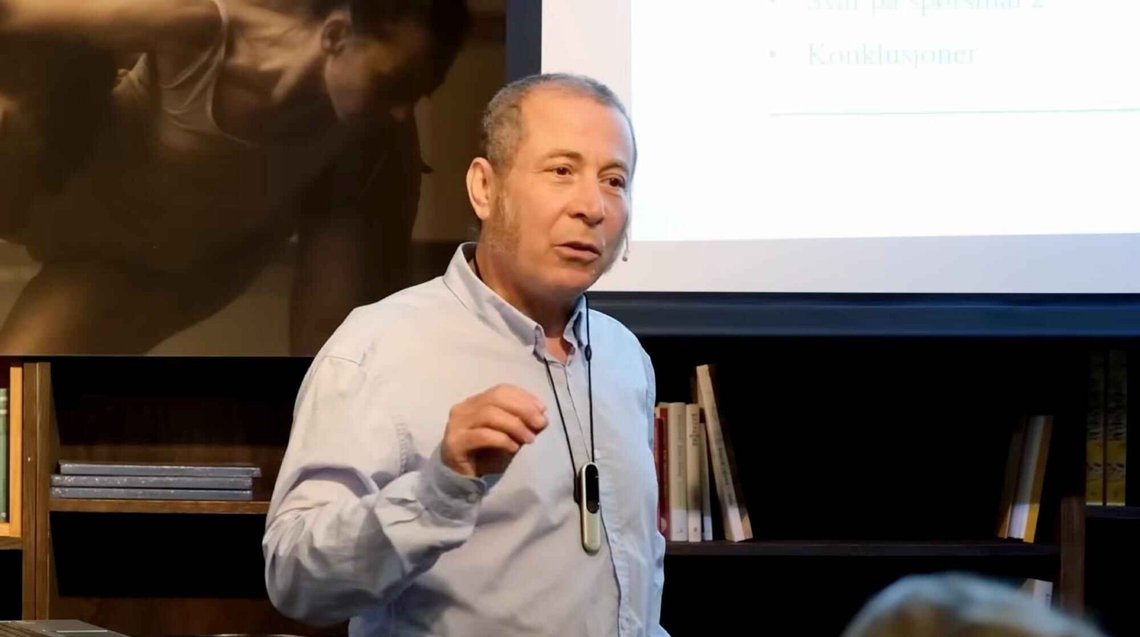


NTNU professor Bassam Hussein launches a frontal attack on the critics following his statement that the 7 October massacre was the “most beautiful” thing to have happened in this century. He is now attacking both Document and NTNU’s own newspaper, and believes that most things are controlled by “the Zionists”.
Hussein’s characterisation of 7 October has sparked major debate after Universitetsavisa (UA) at NTNU reported what he said at a public debate meeting in Trondheim on 21 April. At the House of Literature (Litteraturhuset), organised by Socialist Forum (Sosialistisk Forum), the professor described the attack on Israel on 7 October 2023 as “the most beautiful thing that has happened in our century”.
In a response in UA, the professor attempts to nuance his own words.
“Let me be absolutely clear: I do not regard 7 October as a victory or triumph, particularly in light of the many victims on that day and in the time afterwards,” Hussein writes.
He calls the loss of civilian life “deeply tragic, without the slightest trace of anything beautiful”, and claims that the adjective “most beautiful” was intended to emphasise that the event was a historical turning point – “not as an ethical or moral assessment of acts of violence”.
At the same time, Hussein maintains his underlying narrative. In the response, he refers to 7 October as “a prison uprising after 20 years of brutal blockade”. He claims that Gaza has been subjected to brutal restrictions, “including control over the number of permitted calories per inhabitant”.
He further argues that the terrorist attack “has challenged perceptions of military invincibility, altered the dynamics of strategic deterrence, and raised questions as to whether existing international institutions and norms are in fact enforced equally for all parties”.
The killing of around 1,200 people and the kidnapping of 251, including women, children and the elderly, are not referred to specifically in the response.
The tone towards UA editor Tore Oksholen is sharp. Hussein states that he was contacted the previous evening at 19:31, and that Oksholen followed up already at 20:35.
“The wording appeared more like an order than a request for a statement,” he writes.
He believes the priorities in UA are “telling”: the newspaper has room to scrutinise a single adjective from a two-week-old lecture, but not to cover an NTNU student who “is NOW in the Mediterranean, on the way to Gaza, with a real risk of being kidnapped in international waters and taken to Israel against his will”.
The conclusion is a remarkable accusation directed at Document’s editorial staff:
“Time to follow up and amplify angles from Document.no clearly exists,” the NTNU professor writes.
Hussein’s characterisation of 7 October has dominated the debate in the wake of UA’s coverage. But something else he said the same evening is just as controversial. On the recording from the House of Literature, 47 minutes and 20 seconds into the lecture, he says the following:
“Most social media, and ordinary media, and mainstream media, and TV are controlled by Zionists.”


