
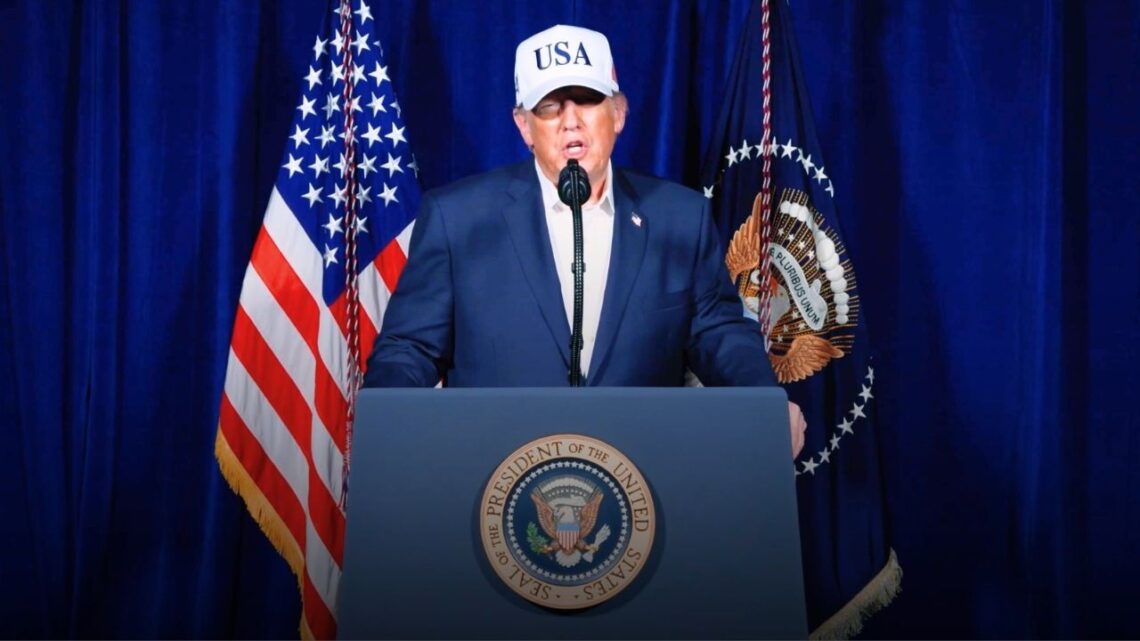
The oil price fell when Trump indicated that the war was as good as over, but rose when he said that two to three weeks remain. The war has become a question of who can endure the most pain. The regime in Tehran does not care about its own population. Trump faces an election in November. That is the difference. But even a regime that does not care about human costs is vulnerable.
A totalitarian regime must have a relationship with its surroundings in order to function. Tehran appears to have discarded this consideration and the need for pragmatism. The clearest expression of this is the attack on neighbouring countries’ infrastructure and oil industry, which directly threatens those countries’ economies and capacity to function.
Trump said last night that the United States may come to eradicate Iran’s electricity grid. Without electricity, much cannot be carried out in a war. It would be the maximisation of crisis that would not affect the oil price. Trump will put the knife to the regime’s throat.
Israel has an entirely different capacity for endurance than the Americans. On Wednesday evening, which was the festival of Seder, ten rockets struck Israel. It was a clear message that Tehran is still to be reckoned with.
For Trump, it is the oil price that is a source of irritation.
“Many Americans have been concerned about the recent increase in petrol prices here at home,” Trump said. “The short-term rise in prices is due solely to the fact that the Iranian regime has launched insane terror attacks against commercial oil tankers and neighbouring countries.”
Trump has achieved one of his principal objectives: to destroy nuclear facilities and the missile industry. If the war ends now, a new president may have to launch new attacks against Iran if they resume the nuclear programme. But will they have the will?
Trump has the will, but he has opponents at home who are whipping up sentiment against the war. It is un-American, but Europeans do not understand how anti-American the media and the Democrats are, because they have the same media and politicians in Europe. In that sense, Trump is fighting a war on multiple fronts.
If the opponents succeed, the West will have lost. Then the West will no longer have the ability to oppose either internal or external enemies.
Except Russia. That war poses no problem for Trump’s opponents. They have driven it forward for four years.
The difference in the attitude to the Iran war, which is almost pacifist, and the rigid attitude to Russia is striking and difficult to explain.
The Europeans will not assist the United States against a theocratic regime that is attempting to acquire intercontinental missiles and a nuclear bomb.
But they direct attacks against the strategic bombers and oil industry of Russia, which possesses 6,000 nuclear weapons.
The rationality is difficult to discern. Europeans can only act tough against Russia because they have the United States behind them.
But now they have arranged matters such that this is by no means certain. The United States says that if you are not there for us, then you cannot take us for granted either.
NATO cannot exist à la carte.
This has not dawned on the Europeans. The great protective hand is no longer there. Europe has placed itself in a situation in which it must manage on its own.
Trump is attempting to assess what the United States has achieved. He stretches the concept of regime change:
“We have never spoken about regime change, but there has been a regime change because all their original leaders are dead. They are all dead,” Trump said. “If there is no deal, we are going to strike hard at every single one of their power plants, and probably simultaneously.”
That is an original definition of regime change as long as no figurehead emerges who wishes to do business with the United States. The opposite appears to be the case. The leader of the Revolutionary Guard has taken over. He is a hardliner.
This places Trump before a major dilemma. If he withdraws with the Strait of Hormuz closed, he will suffer a loss of prestige. His enemies hope that high petrol prices will ensure defeat at the midterm election. Trump also knows that this is a risk.
He is short of time.
Trump appealed to the Americans’ patriotism: to withdraw now would be to betray those who gave their lives.
“Now we must honour them by completing the mission they gave their lives for. And every single one of these people – their loved ones said: ‘Please, sir, complete the mission’ – every one of them. And we will complete the mission, and we will complete it very quickly. We are approaching the goal.”
Other countries are more dependent on oil through Hormuz than the United States. But they are not willing to sacrifice anything. The Europeans chose at an early stage to let the Iranian people fend for themselves and thereby demoralised themselves. No freedom-loving people will any longer look to Europe and expect assistance. Europe has become a gathering place for people from all over the world, but they do not come to find freedom. Rather, to exploit those who work.
Trump finds the parasitic attitude bitter to swallow.
“The countries of the world that receive oil through the Strait of Hormuz must take care of this passage. They must safeguard it. They must seize it and safeguard it,” Trump said.
“We will assist, but they should take the lead when it comes to protecting the oil they are so dependent on.”
Trump suggested that some nations had not supported the United States’ military effort against Iran, and urged them to step up, both militarily and economically.“So for those countries that do not obtain fuel, and many of whom refuse to be involved in bringing down Iran’s leadership, we had to do it ourselves,” he said. “Go to the strait and just take it. Protect it. Use it to your own advantage.”
The United States must do the job alone. When it comes down to it, it is America Alone, as Mark Steyn called his book. This feeling – that Americans see that they stand alone – that Europeans do not care – is something that creates great distance. They see that Europeans do not care about themselves either, and that may prove fatal.
Trump revealed that endurance is short-lived among Americans as well:
“We hold all the cards. They have none,” Trump said. “The United States’ participation in the Second World War lasted three years, eight months and 25 days,” the president continued, noting that the Vietnam War lasted 19 years and the Iraq War eight.
Trump’s opponents counted on the regime surviving a short war. They were willing to let the ayatollahs survive. The war against Trump was, for them, the most important.
Trump is, of course, aware of this. He is not defeated. Not yet.
One question is whether neighbouring countries will enter the war. Then Europeans, Japanese and Koreans will be left standing in the corner of shame.