

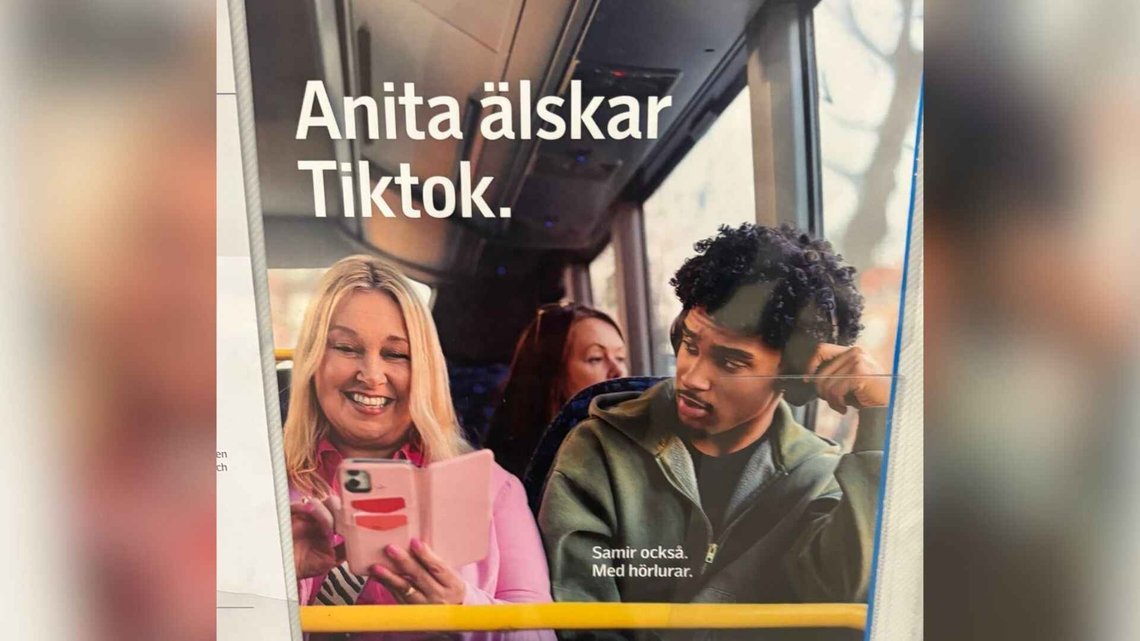


Stockholm’s public transport company (SL) wished to encourage passengers to show consideration. But reversed the roles to such an extent that the campaign is now being ridiculed.
SL has launched the campaign «Din resa är också andras» (‘Your journey is someone else’s too’) – a series of posters and videos intended to remind passengers to show consideration on buses, the metro, and commuter trains. Use headphones. Remove your rucksack in crowded carriages. Give space to the elderly and pregnant.
So far, so reasonable. But one of the posters has ignited debate.
«Anita älskar Tiktok»
The poster shows a smiling, blonde, middle-aged woman – «Anita» – sitting on a bus watching TikTok videos without headphones. Next to her sits a young, dark-skinned man – «Samir» – wearing headphones and with a clearly irritated facial expression.
«Anita älskar Tiktok. Samir också. Med hörlurar» (‘Anita loves TikTok. So does Samir. With headphones’), reads the text.
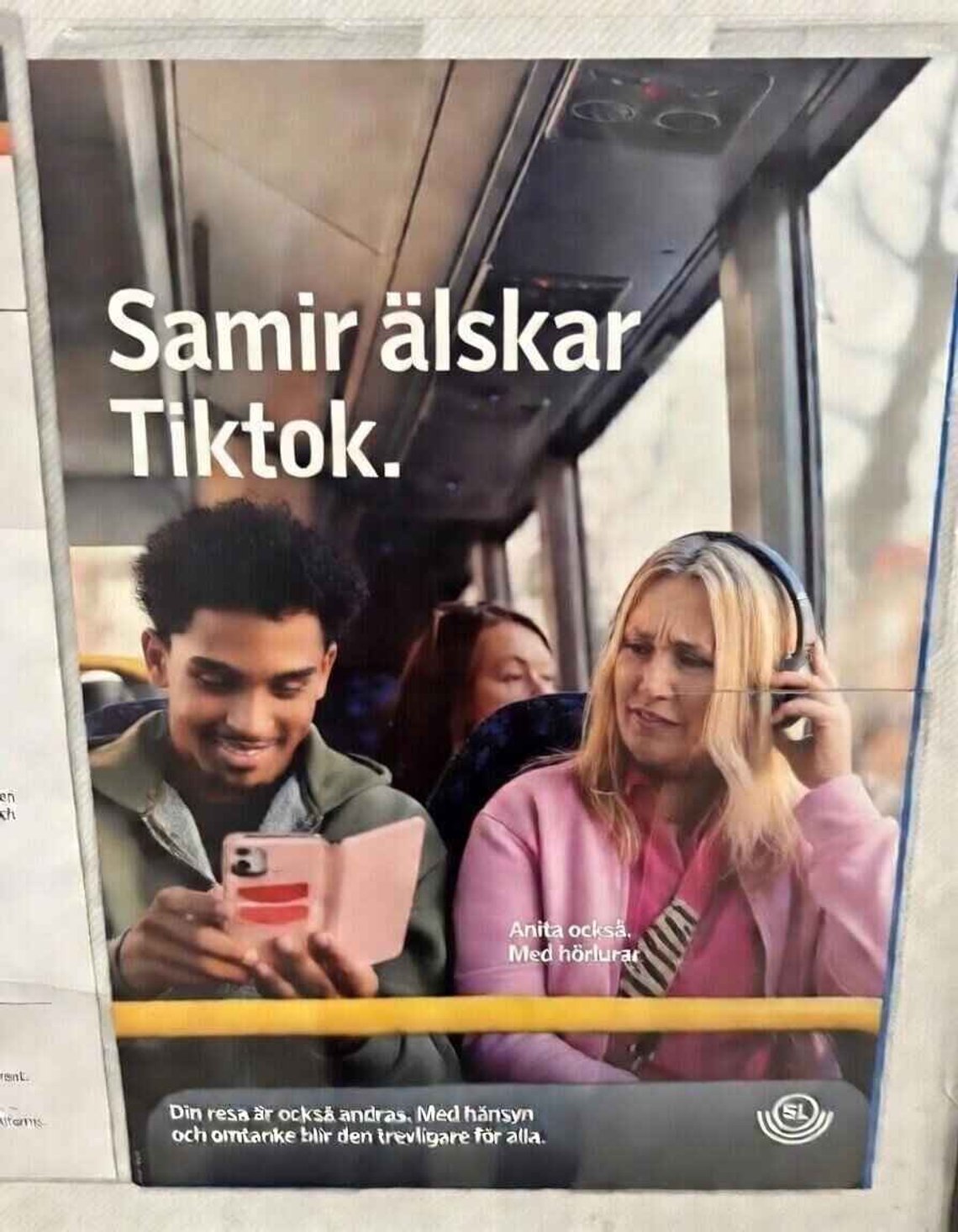
Below it states: «Din resa är också andras. Med hänsyn och omtanke blir den trevligare för alla.» (‘Your journey is also someone else’s. With consideration and thoughtfulness, it becomes more pleasant for all.’)
The message is simple: use headphones, do not disturb your fellow passengers. But what provokes is who in the image is the «offender» and who is the «victim».
«Reversed reality»
Critics argue that the poster turns reality on its head. The problem of loud music and video playback without headphones in Stockholm’s public transport is well known. But, as anyone who has used public transport knows, it is most often young men and women, frequently with an immigrant background, who play sound at full volume.
The writer Bitte Assarmo wrote on Monday in the online journal Det Goda Samhället that she cannot recall ever having experienced a middle-aged Swedish woman behaving inconsiderately and disruptively on a bus or the metro. She believes SL deliberately chose a «safe» scapegoat.
– It is, namely, entirely risk-free to point out ethnic Swedes as a problem – in all conceivable and inconceivable contexts, writes Assarmo, adding that the reactions would have been entirely different if the roles in the poster had been reversed.
Several on social media have described the campaign as «ridiculous» and wholly incompatible with reality.
In the comment sections beneath the post, many recognise the criticism. They consider the campaign a typical example of politically correct advertising that avoids addressing the actual problem.
On X, several have swapped the roles using AI. Here is one of the results:
A real problem
That unwanted noise in public transport is a real and widespread problem in Stockholm, and indeed in Oslo, Trondheim, and Bergen, is beyond doubt.
As recently as early April, the Moderates’ opposition regional councillor Kristoffer Tamsons advocated amending the Public Order Act so that SL personnel can fine passengers who disturb others with loud mobile music. He was inspired by a similar proposal in the United Kingdom, where fines can reach up to £1,000.
When media outlets have asked SL to explain why they chose precisely this depiction in the poster, the press department has, according to several reports, responded that they do not comment on «individual interpretations of the image».
The entire campaign, including videos and other posters, is collected on SL’s website under the heading «Omtanke» (‘Consideration’).
SL is no stranger to controversial campaigns. In 2020, the slogan «Visa kollektivkurage – Titta bort» (‘Display collective courage: Look away’) provoked strong reactions, as many perceived it as an encouragement to passivity in unsafe situations.


