



The Iranian exiled crown prince Reza Pahlavi has addressed the Swedish Parliament following an invitation from the Christian Democrats and the Sweden Democrats. The visit has sparked strong reactions and revealed a deep divide – both in Swedish politics and among the Iranian diaspora.
During his speech, Pahlavi urged the international community to support the opposition in Iran.
– Stand with the Iranian people, he said in connection with the visit.
He also described the Iranian regime as weakened and suggested that a change of power may be within reach.
After the speech, attendees praised Pahlavi by chanting “Javid Shah,” which means “long live the Shah”.
At the subsequent press conference, Pahlavi described developments in Iran as “irreversible” and the protests as “a struggle between occupation and liberation”.
– This is a revolt against the 1979 revolution itself. The regime understands this, he said during the speech, where he also urged Sweden and Europe to choose sides.
– Will you stand with a free people, or follow the oppressors? No one will ask what you said, but what you did.
Seen as the voice of the opposition
Pahlavi, the son of Iran’s last Shah, is presented by some as a potential unifying figure for a future democratic Iran. He has expressed willingness to take a leading role during a transitional period.
Supporters argue that international backing for opposition forces is crucial at a time when protests and political unrest have shaken Iran in recent years.
At the same time, the reception in Sweden is clearly divided. The criticism mainly concerns Pahlavi’s background as the son of the Shah, whose rule is often described as authoritarian.
The visit has also been questioned within conservative circles. Critics ask why “the son of a deposed dictator” is being given a platform in parliament, while others defend the invitation, arguing that background should not disqualify someone from political engagement.
Among the Iranian diaspora, Pahlavi also provokes strong reactions. Some see him as a hope for change, while others fear that his influence could lead to a return to authoritarian rule.
Criticism: lends legitimacy to an authoritarian legacy
The criticism has also appeared on cultural pages. In an article in Dagens Nyheter, writer Elnaz Baghlanian warns that the parliamentary invitation risks granting legitimacy to Pahlavi’s historical legacy.
She argues that the visit means Sweden is indirectly normalizing ties to the Shah’s authoritarian rule and questions whether parliament should serve as a platform for such a controversial political figure.
– The problem is not that Reza Pahlavi is given space to speak. The problem is that, through the invitation to parliament, he is assigned a representative role he has never obtained through political legitimacy. The parliamentary stage is not neutral. It produces legitimacy, Baghlanian writes.
Demonstrations and hanging effigies
The visit has also been preceded by extensive security measures and demonstrations in Stockholm. Thousands of people are expected to participate in protests in connection with his appearance.
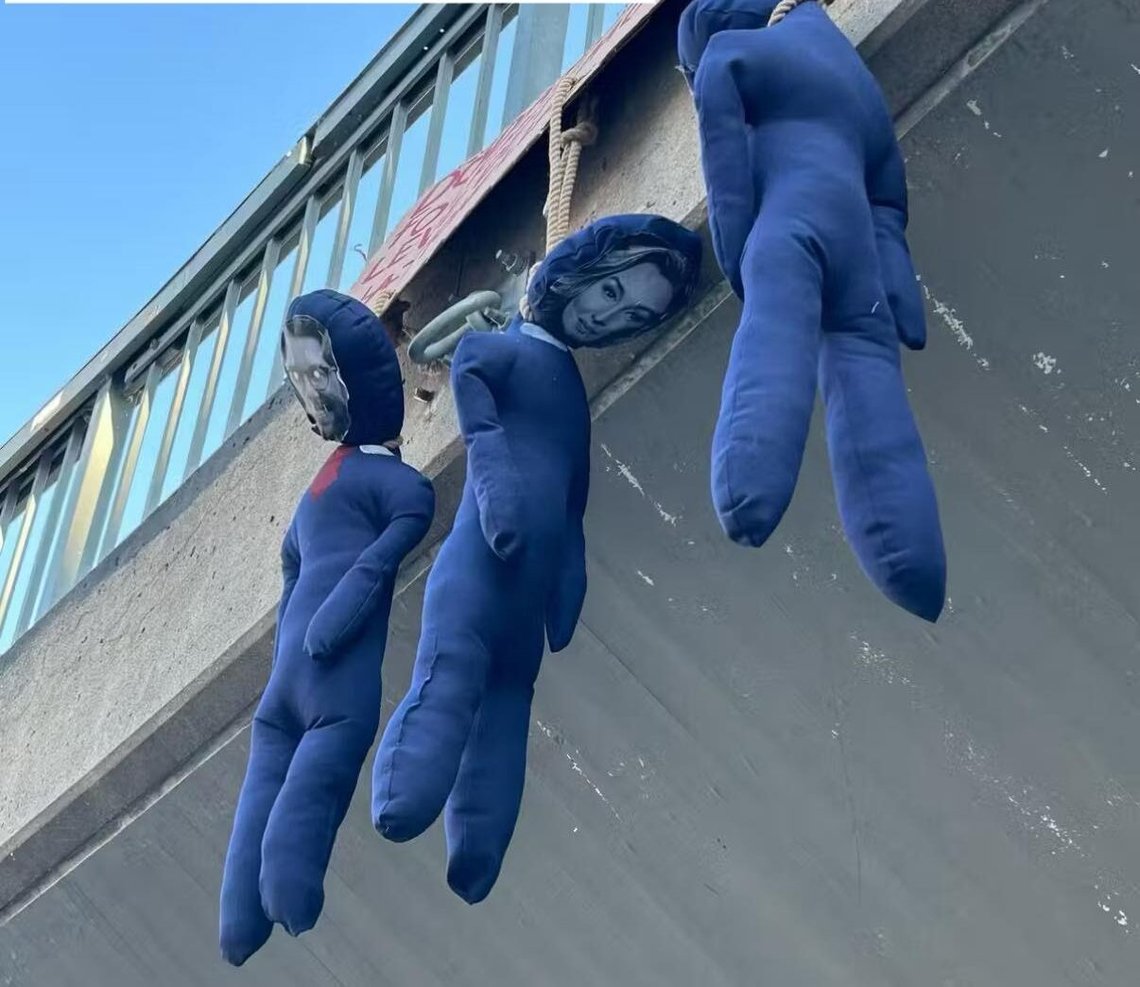
On Monday morning, police were alerted after someone had hung three effigies at Sergels Torg in central Stockholm. The figures depicted Crown Prince Pahlavi, Sweden Democrats leader Jimmie Åkesson, and Christian Democrats leader Ebba Busch. A sign next to the effigies read: “Mass murderers, executioners and lackeys”.
Reza Pahlavi’s visit to Sweden reflects a broader conflict: how the international community should relate to Iran’s opposition — and which actors should be granted legitimacy.
The question of Iran’s future therefore involves not only a struggle against the current regime, but also a contest over who should represent the alternative.


