

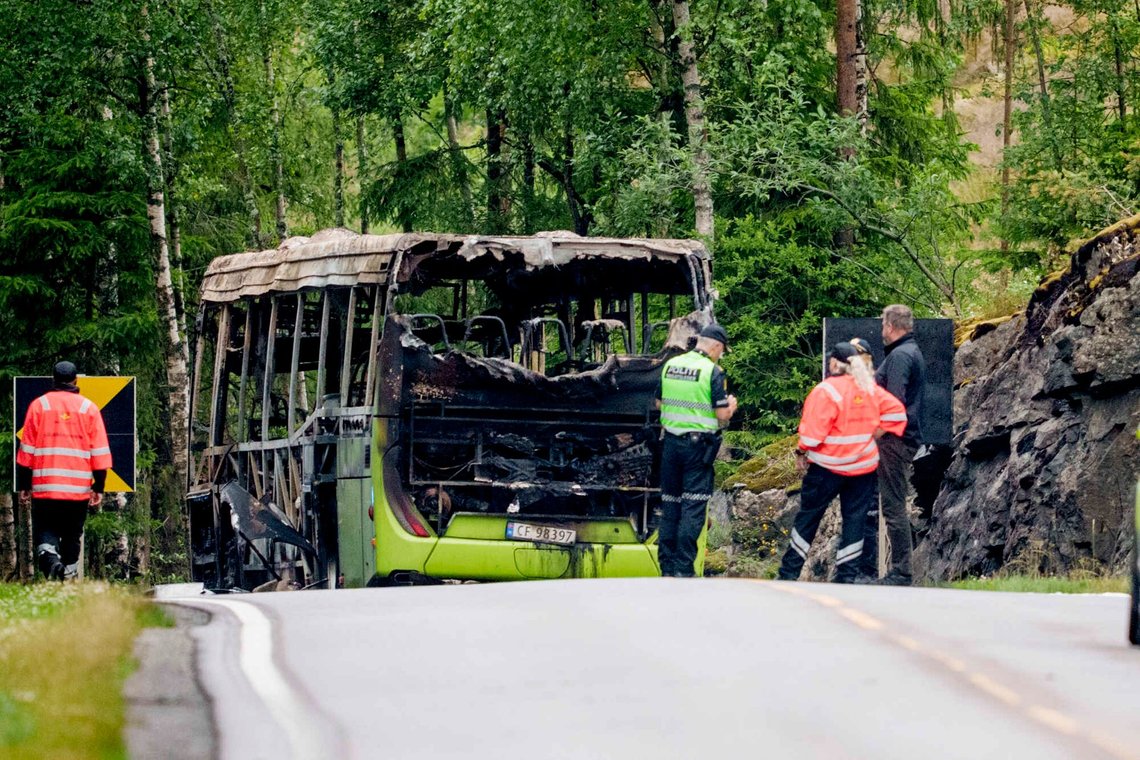
– He belongs to a very small group of youths with repeated and serious criminality.
– It is this group we are particularly concerned about, says Jane Bechmann Dahl of the Oslo police to Aftenposten.
The 15-year-old “Valon” caused 75-year-old Fazia Begum to lose her life, without her being mentioned in this article.
The number of hyper-criminal youths in the Oslo area is increasing, and the criminality is becoming ever more severe.
Dahl cannot comment on Valon’s case specifically, but says that he is part of the group of youths who are registered with ten or more criminal offences per year.
This group consists of between 40 and 60 individuals in the Oslo police district, who each year are responsible for a massive number of criminal cases. They are few, but the risk of repetition and new serious offences is high.
This is particularly because many of them, in accordance with Norwegian law, cannot be punished. Society is thus not protected from their volume of criminality.
– It is this group we are all concerned about, and where the current measures alone are not sufficient. Particularly before they turn 15, says Dahl, who is a police inspector and head of the preventive unit in the Oslo police district.
– When they are under 15, our measures do not reach well enough. We are very clear about that, and precisely because the group is small, it ought to be possible to work more targetedly and earlier with those concerned.
But if the measures do not work, it may be time to ask whether the measures at one’s disposal are the right ones. Buns, soft drinks, pizza and youth clubs have been tried in several countries for many years, without success.
Precisely for that reason, an increasing number are now arguing for lowering the age of criminal responsibility, which was constructed in a completely different time for an entirely different Norwegian society.
The arguments are often that a youth offender who is locked up at least cannot commit new offences, and that it is more important to protect ordinary innocent people than the rights of the criminal youths.
Dahl believes that one should invest in sharing information with schools, the child welfare services (barnevernet) and the health services. But these services cannot share information with the police, due to the duty of confidentiality.
– This means that we can sit in meetings with the child welfare services and schools where they cannot share information with the police.
She refers to Denmark, where it is possible for the child welfare services and other actors to share information with the police and with each other at an early stage as long as it is to prevent crime.
Norwegian media appear to be more concerned about the youth criminals than their victims, and Aftenposten is no exception.
The care for the criminals
In an article on Friday, the once conservative newspaper wrote:
He had been known to the police and the child welfare services for many years. Why did no one manage to stop him?
The age of criminal responsibility is an obvious cause, but that cannot be mentioned by Aftenposten.
They go on to write that Valon sat at the back of the bus and was bored, and accept his explanation that he “forgot” to put the lid on the petrol can he for some reason had with him.
“By coincidence”, he lit a lighter, set the petrol alight, left the bus and killed a human being.
This he also did on the bus journey earlier that day, according to surveillance images. Then everything went fine. It did not this time.
He believes it was the second or third time it caught fire. The 15-year-old stood up and shouted “it’s burning, it’s burning”. The can toppled, and the fire quickly got out of control.
It is typical that Norwegian media show more care for the criminals than for the victims, particularly if it concerns youths and immigrants. Even after writing that he had played with fire several times the same day.
Valon has been known to the police since he was 11 years old. He has been suspected or charged in a total of 133 cases, it is stated in the judgment from the bus fire.
Many Norwegians are tired of hearing excuses such as “overcrowding”, as if many Norwegians (or Poles and ethnic Swedes) have not also lived in cramped conditions during their upbringing and here in Norway. Not to mention most students.
The Norwegian government, with Foreign Minister Espen Barth Eide at the forefront, appears unrelenting in its contempt for Israel, its support for the Palestinian cause and its opposition to a United States under President Donald Trump’s command.
The Iranian theocratic tyranny in Tehran, on the other hand, appears to be accepted, at least indirectly. Anything else would, after all, be to align oneself with our absolutely most important ally, the United States, and that would hardly be well received by the Norwegian regime media.
Thus Valon becomes merely a piece in the large game, so that we can continue to fill the country with non-Western immigrants who cost us enormous sums, but who may secure the Labour Party yet another re-election.
Norway will in that case begin to resemble more and more a one-party state, as it in many ways has appeared previously, as in parts of the post-war period.
But it was a different Labour Party that governed at that time, and other parties were not banned. Today, several parties in Germany wish to ban the country’s currently most popular party, Alternative für Deutschland.
Fortunately, opinion polls indicate that the Labour Party will not succeed. But that was how it appeared before the last parliamentary election as well, until Jens Stoltenberg made a return and significantly increased support for the Labour Party.
Whom the Labour Party may pull out of the hat this time is difficult to see. But unfortunately, it is a long time until the next election, so nothing can be ruled out.


