


Statistics from the Norwegian Institute of Public Health (Folkehelseinstituttet) show that an increasing number of Norwegians between the ages of 15 and 44 are taking cardiac medication. The curve rises steeply from the baseline year 2020.
Since the beginning of the pandemic, purchases and withdrawals of prescription cardiac medications from Norwegian pharmacies have increased by 28 per cent in the aforementioned age group. FHI’s figures concern medications for the heart and circulation in class C.
1 in 16 Norwegians in the age range 15–44 had to take cardiac medication in 2025. The same applies to every eighth individual aged 40–44.
The 35–39 age group stands out. Here the increase is greatest.
- 40.65 per cent increase from 2020 to 2025
- Increased by 7 per cent from 2024 to 2025
- 8.3 per cent in the age group use cardiac medication (32,450 individuals).
Professor Jarle Aarstad at Høgskulen på Vestlandet has produced a graph based on the average figures. It visualises the marked increase that began in 2021.
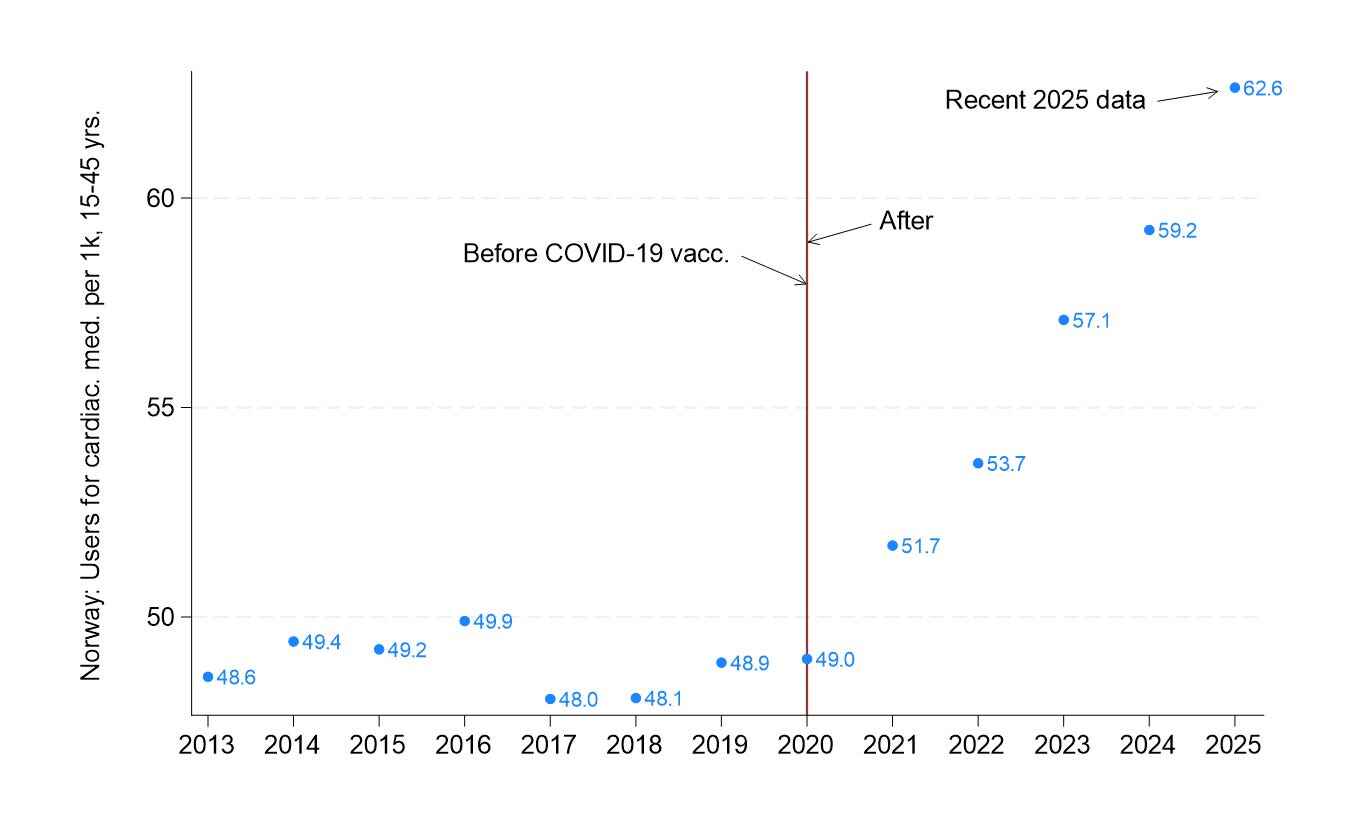 The Norwegian Institute of Public Health’s figures on the use of cardiac medication among younger Norwegians, per 1,000 inhabitants. (Graph: Jarle Aarstad/Substack)
– Since the Norwegian Institute of Public Health has forgotten or been too busy to publish a press release, I am doing it for them. Entirely free of charge, writes Aarstad on Substack.
FHI chose to focus on developments in the use of cholesterol-lowering medications when the data were made public.
Positive trend reversed in 2021
In absolute terms, the largest number of individuals in need of cardiac medication is found in the 40–44 age group. 43,953 individuals in this group received a total of more than 17.7 million daily doses in 2025. That corresponds to 403 doses per person.
The average for the entire patient group from 15 to 44 years was 279 daily doses—38 million doses in total.
Those aged 40–44 experienced a steady decline in heart-related problems every single year from 2013 up to and including 2020. But then the trend reversed. It increased sharply during the period corresponding to the rollout of the mRNA injections.
If we compare with the 70–75 age group, there was also a slight decline up to 2020. However, here too the trend reversed from 2021, although the increase is less dramatic.
In total, 137,458 Norwegians between 15 and 44 were affected by heart disease requiring medication last year.
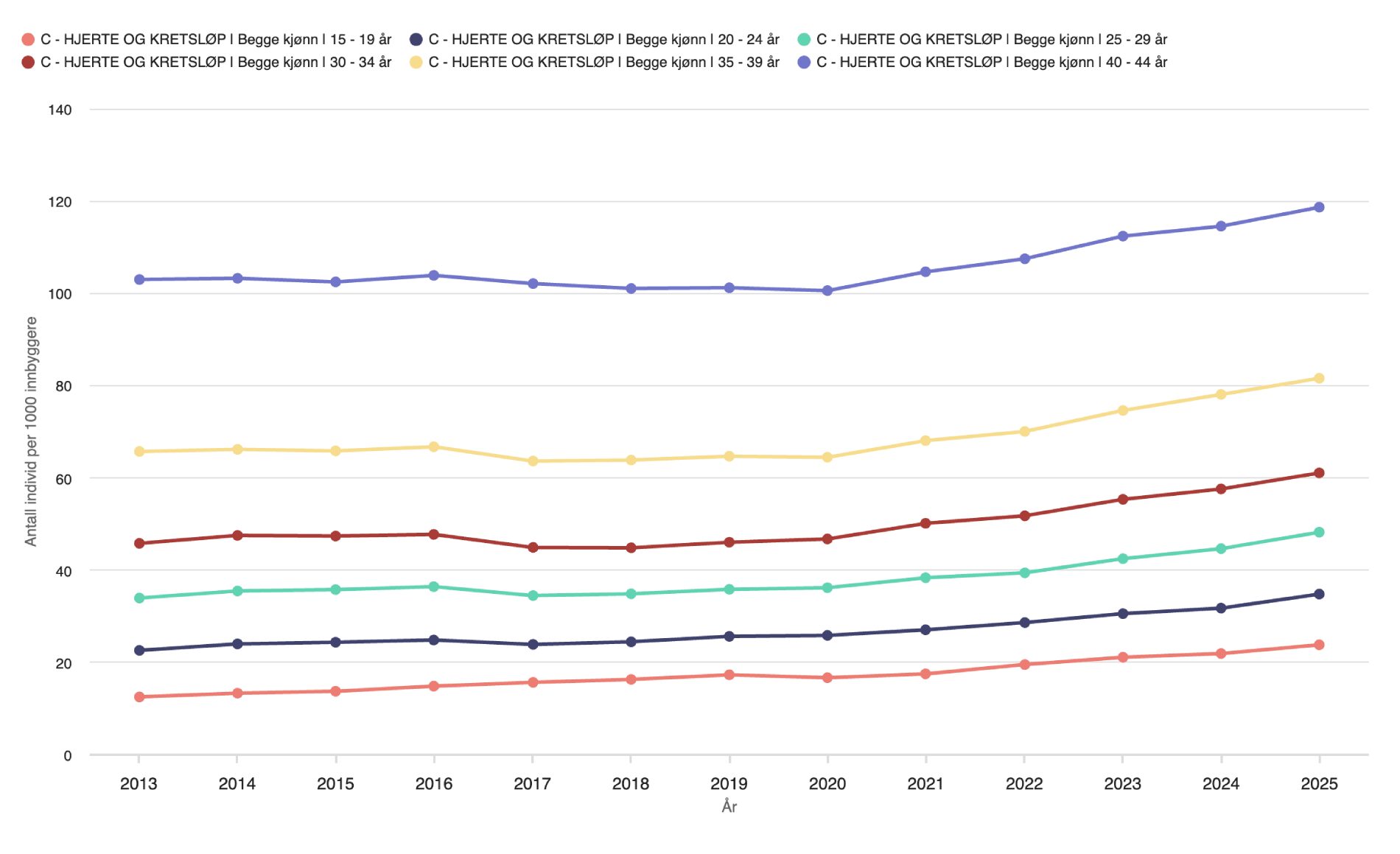 Proportion per 1,000 inhabitants using cardiac medication in the age groups between 15 and 44 years. (Source: FHI)
Aarstad writes:
The increase began in 2021 and coincides with the rollout of the coronavirus vaccine to the younger population from the summer of that year. In the subsequent years, the increase has intensified, and the linear trend does not appear to be abating. On the contrary. There was no increase in 2020, in line with an Israeli study which found no association between myocarditis [inflammation of the heart muscle, editor’s note] and coronavirus infection prior to the rollout of the vaccine.
As early as the end of April 2021, the European Medicines Agency (EMA) suspected that the coronavirus vaccine could entail heart problems, yet nevertheless decided to approve Pfizer/Biontech’s vaccine for children down to 12 years of age. This despite the fact that the vaccine had not even been tested against transmission.
– I have previously pointed out that young people who refrained from the coronavirus vaccine made the best choice. I still maintain this view, and the graph substantiates my position, is Aarstad’s comment.
He now hopes that FHI will do the same and provide its comments on the data material.
Read also:
Hvorfor er Folkehelseinstituttet tause når tusenvis av norske borgere dør?
FHI problematiserer forskergruppens krav om korona-statistikk


