

21-year-old Syrian man convicted of raping a 13-year-old Norwegian girl on a bench and in a bicycle garage near the Harbour Terminal in Tromsø. Due to low IQ, he receives only six months in prison.
The judgment from Nord-Troms and Senja District Court was handed down on 31 March 2026. Abdelmonem Abdelrazak Al-Yousef was found guilty under the Norwegian Penal Code § 300 cf. § 299 – rape of a child under 14 years of age by penetration – for inserting his penis into the mouth of the 13-year-old girl during the night of 7 September 2024.
Met by chance in the middle of the night
According to the judgment, the then 13-year-old girl had sneaked out of her home during the night of 7 September 2024 and gone into Tromsø city centre. At the Harbour Terminal she met the defendant and another man by chance. They started talking, and the girl was given a cigarette. The court notes that “there was minimal dialogue between them since the defendant only speaks Arabic.”
They sat down on a bench by the Edge Hotel, where they began kissing. The defendant then “opened his trousers, took out his penis, grabbed the victim’s head and pushed it down towards his penis, making her suck him.”
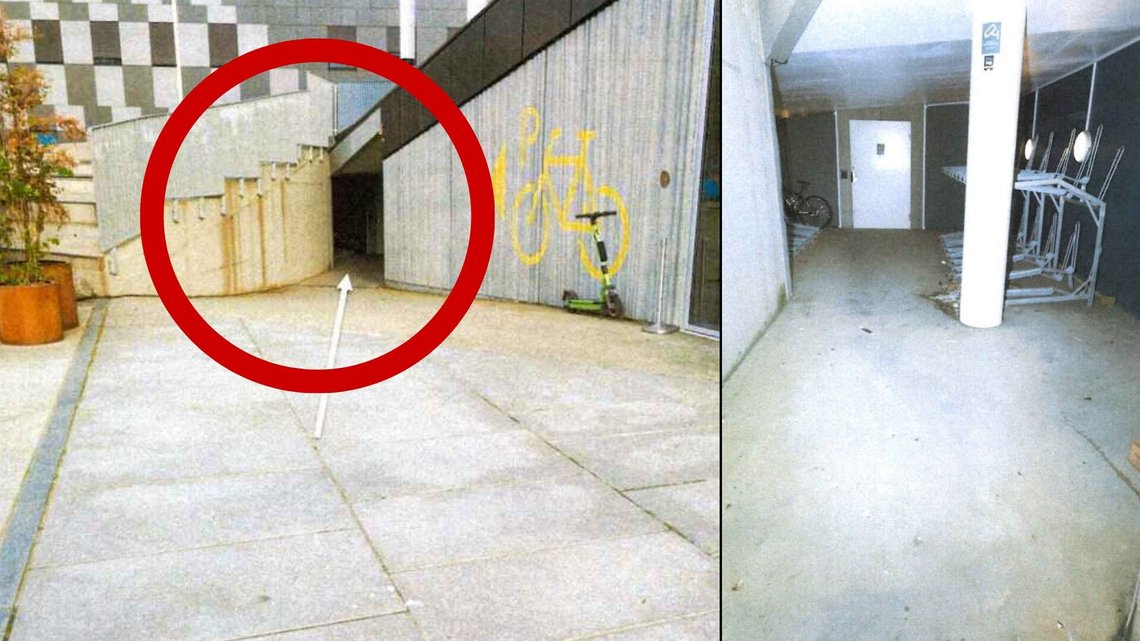
Afterwards they went to a covered bicycle parking area belonging to the Harbour Terminal, where the acts continued. Here the defendant “pulled his trousers down again and made the victim get on her knees and suck his penis.” He also attempted vaginal intercourse, but “did not succeed as the victim did not want to.”
Fact: Legislative change on 1 July 2025
The Storting (Norwegian parliament) repealed the minimum sentence for rape of children under 14 (§ 299 cf. § 300). Previously the minimum sentence was three years’ imprisonment, with a normal level of four years. The new rules give the courts significantly greater discretion and have in practice led to substantially lower sentences in cases of sexual abuse of children. The Supreme Court has in several rulings in 2025 and 2026 established sentences that are markedly below the previous level.
Denied at first – exposed by DNA
During police questioning on 24 October 2024, “he swears that he has never met the victim.” He also denied that he was the person shown in the surveillance images from the area. When the interview was reviewed four days later, he admitted meeting the girl and that they “sucked on each other’s lips,” but denied sexual intercourse. He denied “ever having been in the bicycle room” and “that he never ejaculated there.”
However, when police examined the scene, semen was found on the asphalt. DNA analysis showed that the semen belonged to the defendant. He “expresses incomprehension as to how his DNA was found at the scene.”
The court concludes that “the defendant’s version of events appears entirely lacking in credibility” and that “it is not possible to interpret the evidence in such a way that the defendant is innocent.”
Knew she was a child
The victim stated that she was born in 2008. This information was conveyed to the defendant. The court notes that “the recipient of the information about the year of birth must have assumed she was either 15 or 16 years old.” In a police interview the defendant was shown a photo of the girl and commented that “she is small, probably the same age as his little sister who was born in 2010.”
A witness who was present when they met stated that “the victim appeared underage, that one could see from her face that she was young, and that she appeared childlike.”
The court finds it “clear that the defendant has not met the law’s duty of care” and that “the defendant is strongly to blame for not making further inquiries about her age.”
Low IQ resulted in a milder sentence
The defendant came to Norway from Syria in the winter of 2023. He has “minimal schooling and is described as illiterate.”
Forensic psychiatric examinations conclude that he has mild intellectual disability. An initial expert assessment estimated his IQ at 41 points, but this was considered to be below his actual level.
A new full forensic psychiatric report describes the defendant as a man with “significant difficulties maintaining attention” and “mild impairment in cognitive and daily functioning.” The experts estimate his IQ during the main hearing to be in the range of 64–75.
The court directly applied this as a mitigating factor. Under Penal Code § 78 letter d, consideration shall be given to whether “the offender at the time of the act had reduced understanding of reality due to deviant mental state, mild intellectual disability, disturbance of consciousness or strong emotional agitation.” The court finds that “the defendant’s condition must be regarded as a deviant mental state covered by § 78 letter d.”
Furthermore, the court finds that the defendant, despite being 19 years and 8 months old, can developmentally be considered equivalent to the 13-year-old girl. The court emphasises that the defendant “most likely is not more developed than the victim, and that he appears to have a reduced understanding of reality.”
The six-year age difference was too large for the exemption rule in § 308 to apply, but the developmental equivalence was used as a mitigating factor in sentencing.
Legislative change led to dramatically lower starting point
The case is directly affected by the legislative change that entered into force on 1 July 2025, when the minimum sentence for rape of children under 14 was repealed. Previously the normal sentencing level was four years’ imprisonment, with a minimum of three years.
The court refers to two recent Supreme Court judgments – HR-2025-1727-A and HR-2026-713-S – both confirming the new, more lenient line. In the latter case, the Supreme Court started from two years and six months’ imprisonment in a case involving unprotected vaginal intercourse with internal ejaculation – a case the court describes as “significantly more serious” than the present one.
The court describes the abuse as degrading and exploitative: “The sexual activity took place outdoors in a public place, first on a bench in central Tromsø and then in a public bicycle parking area. They had also only met a short time earlier and went their separate ways relatively soon afterwards. The whole incident appears degrading and clearly exploitative.”
Nevertheless, the court sets a starting point of two years’ imprisonment. After deductions for the defendant’s low level of development and the age of the case, one year and six months are made conditional with a three-year probation period.
This means in practice that the defendant must serve six months in prison for the rape of a child. He has one day in pre-trial detention to be deducted.
Compensation
The victim was awarded NOK 280,000 in compensation for non-pecuniary damage. The court emphasised that the incident was degrading and had a clear element of exploitation. In interviews the victim “has expressed that she did not find the incident particularly burdensome,” but the court points out that “she is young and there is no doubt that such events may later become a burden for her.”
The district court judges were Harald Tore Roaldsen with lay judges Ann-Kristin Nicolaisen and Harald Mathæus Ledsaak-Dyresen.


