

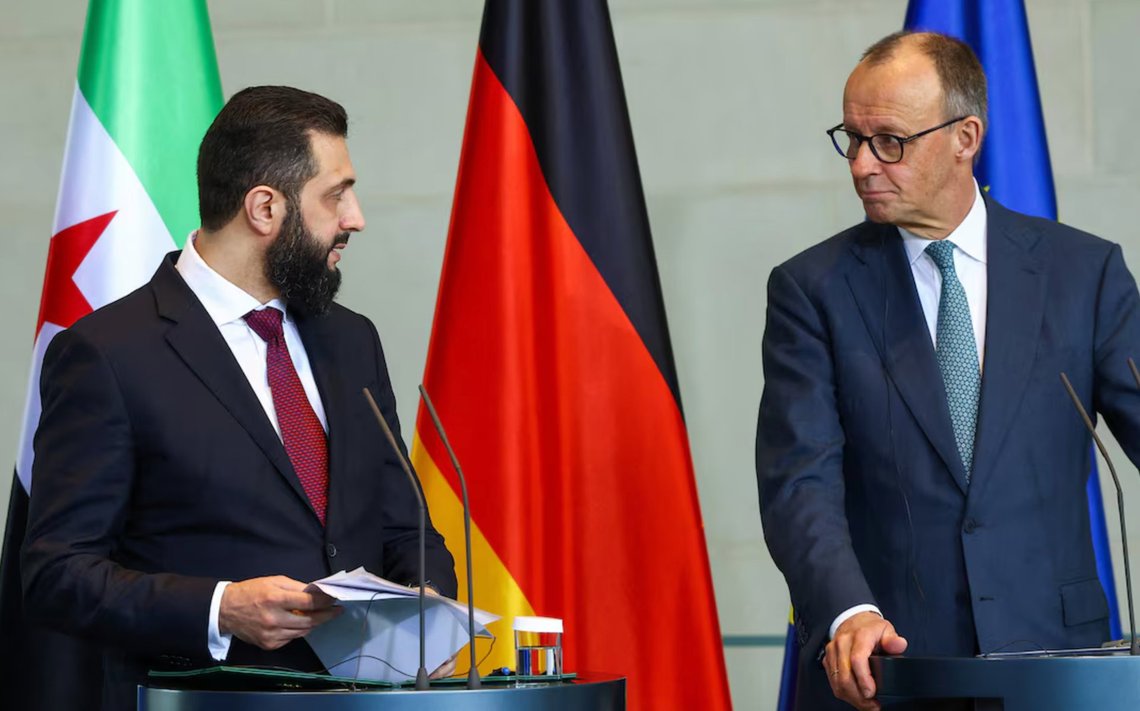


Germany’s Federal Chancellor Friedrich Merz says that 80 per cent of the more than 900,000 Syrians in the country should return to their home country within three years. Syria’s President Ahmed al-Sharaa is not entirely in agreement.
The statement came at a joint press conference in Berlin on Monday, where Merz received al-Sharaa on the latter’s first official visit to the German capital.
– The Syrians who wish to remain in Germany and are well integrated will be able to remain in Germany. But many who are here are needed at home, said Merz.
He estimated that around 80 per cent of the Syrians in the country should be able to return home within a three-year perspective. With more than 900,000 Syrian citizens in Germany, this corresponds to approximately 720,000 people.
Merz added that he has asked al-Sharaa to prioritise the readmission (tilbaketakelse) of Syrians who no longer have a valid residence permit, and particularly those who have committed criminal acts.
– We have a small group here, but it creates problems for us. Syrians who have committed criminal offences, we now wish to repatriate as a priority, said the Chancellor.
Al-Sharaa would not confirm the figure
Syria’s President did not confirm the 80 per cent figure. Instead, he pointed out that 6,000 Syrian doctors are working in German hospitals, and that more than a quarter of a million Syrians pay tax and contribute actively to the German economy. He referred to them as shared values for both countries.
Al-Sharaa proposed a “circular” migration model that would enable Syrians to contribute to the reconstruction of their home country without relinquishing the life they have built in Germany.
– It is impossible to discuss reconstruction without addressing the situation of Syrians in Germany, said al-Sharaa.
Very few have returned so far
Despite the political rhetoric, very few Syrians have so far actually returned. Thus far in 2026, only around 1,000 Syrians have returned to Syria, most with German voluntary return support. Approximately the same number are assumed to have returned on their own initiative.
Germany resumed deportations to Syria in December, but only a small number of cases have been carried out.
Since he assumed office as Chancellor in May last year, Merz has intensified efforts against irregular immigration, inter alia as a countermeasure to the support for the far-right party Alternative für Deutschland (AfD).
The visit was met with protests in Berlin, where demonstrators with Kurdish flags and placards highlighted al-Sharaa’s past as an Islamist militant. At the same time, Syrian supporters also gathered at the Chancellery building to welcome him.


