

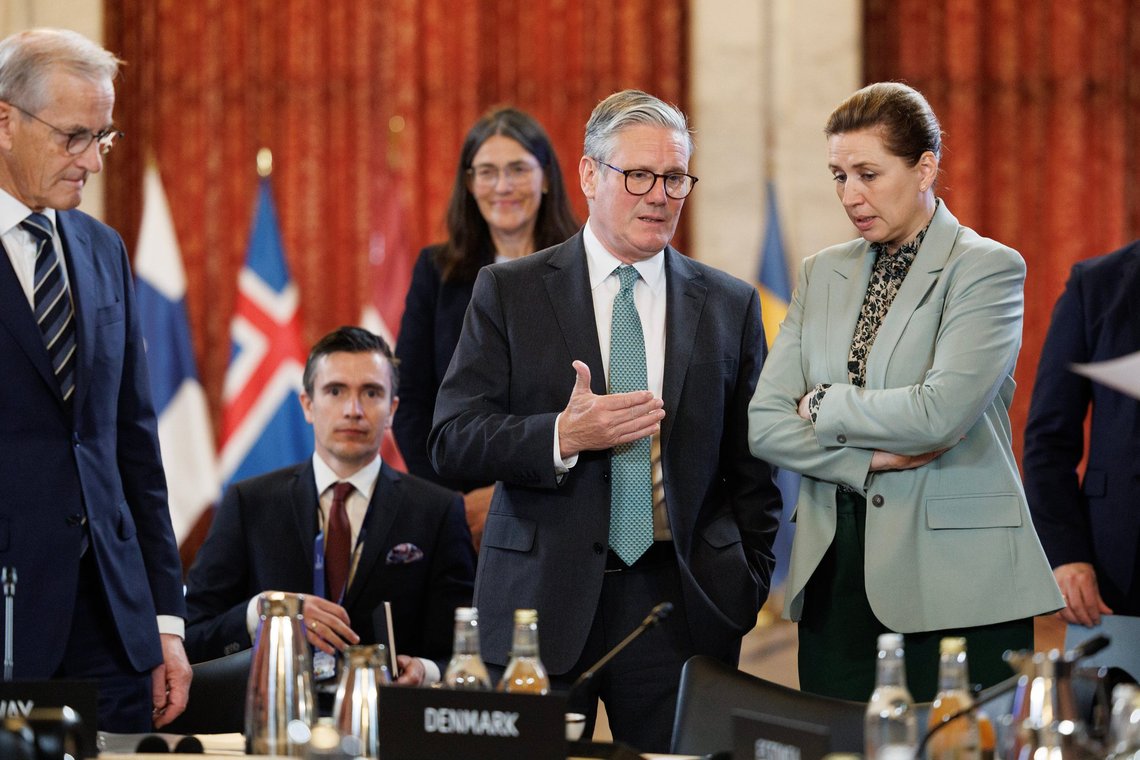
Prime Minister Mette Frederiksen came straight from the Nordic summit in Oslo to a party leaders’ debate with the Liberal Party’s Troels Lund Poulsen (Venstre), who incidentally is the Minister of Defence. Mette is clearly the one who most distinctly distances herself from the present administration in Washington. – “Most important, but not the closest,” was the description she used about the United States. How it is possible for a small country such as Denmark to qualify its view of the United States and nevertheless expect full support in the event of war was a question she was not asked.
Lund Poulsen believed the United States would stand up. But Mette referred to the meeting in Oslo with her Swedish, Norwegian, Finnish and Canadian colleague. There she found the community of values she misses in Washington.
Mette Frederiksen believes defence alliances are à la carte: that one can opt out of what one does not like. She completely forgets to inform the viewers that the balance of power between the small Nordic countries and the United States is so great that it does not allow us to choose. It is the United States that chooses, not us. But that Mette and Jonas forget.
They are so filled with their own moral superiority that they forget to ask the fundamental questions.
Both J.D. Vance and Marco Rubio have said the same as Mette, but from the opposite point of view: the community of values is not what it was, because Europe is no longer Europe. That European leaders cannot bear to hear; they say that Washington attacks Europe.
They say that the new security policy strategy that was rolled out before Christmas is an attack on Europe.
European leaders cannot bear the truth. That is what it boils down to.
And that is the greatest weakness a continent can have.
The borders stand open, and strangers one has no idea who are streaming in, every single day.
In such a situation one would think that Europeans would do everything to preserve a good relationship with the United States.
Instead the EU accuses the United States of wanting to split Europe.
Europe is incapable of reading the situation.
One is incapable of seeing oneself from the outside.
Not even in relation to one’s own population.
The distance between people and leadership becomes steadily greater, and the people see a leadership that spins in thin air, incapable of solving the problems the leadership itself has created.
The question is how much patience the United States has with Europe.
The war in the Persian Gulf means that Europe falls downwards on the list of priorities.
We quite simply no longer matter so much. Our share of world trade has fallen to 13 per cent.
Europeans are beginning to look like losers.
In the hope of compensating for the decline, one arranges ever more summits, takes ever more group photographs and holds ever more press conferences.
It is like pissing in one’s trousers to keep warm.


