

Day 1: Warsaw -> Lviv
31 July. On the overnight coach from Warsaw. Along slow, blacked-out roads, barely an hour beyond the Polish border, we arrive in Ukraine’s magnificent city of Lviv, built in the grand Viennese classical tradition. Or Lemberg, as it was known when it ranked among the most important cities of Austria-Hungary, until the Empire’s retreat during the first winter of the First World War against Russia.
Today, its buildings are once again threatened with destruction from Russian bombardment in the form of attack drones and ballistic missiles, which frequently deliver their deadly payloads into residential apartment blocks under cover of darkness. The terror of war in the regions farther east may seem remote in Lviv, where people wander in summer clothes between parks and cafés, apparently without a care in the world.
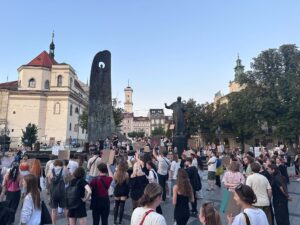
Demonstrators gather at the Taras Shevchenko Monument to demand “Army Reform” and the reinstatement of the 35-year-old reform-minded Defence Minister credited with modernising Ukraine’s armed forces and overseeing the drone strategy that, in recent months, has shifted the momentum of the war in Ukraine’s favour. Photo: CB
Look a little more closely, however, and it becomes clear that the winds of war, though still barely a faint breeze, have reached Lviv as well. There are noticeably more women than men. Many people are in uniform. Others wear prosthetic limbs. At the railway station, a soldier speaks animatedly to his comrades. I am told only that he is “saying something tragic”.
The civilian population has not escaped unscathed. The cities are slowly losing their people, while commercial and urban life continues to contract. Hundreds of thousands have died at the front, while many others have left the country. An estimated one million men have fled abroad, often together with their partners or families – amounting to at least three million people altogether.
Another million men are believed to be living in hiding within Ukraine. Many venture outside only occasionally, slipping out after dark during the curfew between midnight and 5.00 a.m. Every month, several thousand Ukrainian men over the age of 25 are stopped in the street by recruitment units (“TCD”) and conscripted for military service until the war is won. Few will escape death, permanent injury or psychological trauma.
Death Before Dawn
The night before our arrival proved particularly devastating for cities that had previously seen relatively few attacks. Lviv was struck with unusual severity, as were Kyiv, the industrial city of Kryvyi Rih, and Poltava – where the Swedish King Charles XII suffered his crushing defeat in 1709, and where there is little of obvious military significance to target.
Ukraine’s shortage of anti-missile interceptors has become critical. Russia launched 74 cruise and ballistic missiles against Ukrainian cities, of which 55 were intercepted. In addition, 284 attack drones were deployed, 265 of them shot down, according to the Ukrainian General Staff.
In Lviv, residential buildings, particularly in Patona Street and Vyhovskoho Street, were struck by cruise missiles. More than twenty buildings were damaged, including a school and a nursery. Several people were trapped beneath the rubble. So far, only one fatality has been confirmed, reportedly a 35-year-old police officer, while 38 others were injured, among them three children aged six, thirteen and fifteen. A 93-year-old was also wounded. Fifteen people were admitted to hospital.
Air Alert
The war has made Ukraine remarkably innovative in its use of technology. Drone-warning applications are everywhere. The most widely downloaded is Air Alert (Повітряна тривога), which warns users of incoming missiles, allows alerts to be customised by region, identifies the nearest bomb shelter, and announces when the danger has passed. Download alerts for enough regions in western Ukraine – or simply one region in the eastern or southern war zones – and you are almost guaranteed a restless night, interrupted by repeated air-raid sirens sounding from your mobile phone.
The costly Russian ballistic missiles and long-range attack drones capable of reaching the far west of the country are now increasingly directed against civilian targets, most often while people are asleep. The reason lies in Russia’s growing frustration as Ukraine has recently gained the upper hand in the drone war. By striking residential apartment blocks, Moscow hopes to break the will of both soldiers and civilians alike. So far, there is little evidence that the strategy is succeeding.
Up Next:
Tomorrow will be devoted to Lviv itself: its cafés, markets and faded Habsburg grandeur, and to discovering how a city at war continues, almost stubbornly, to live as though at peace. After that, the journey continues eastwards to Kyiv.