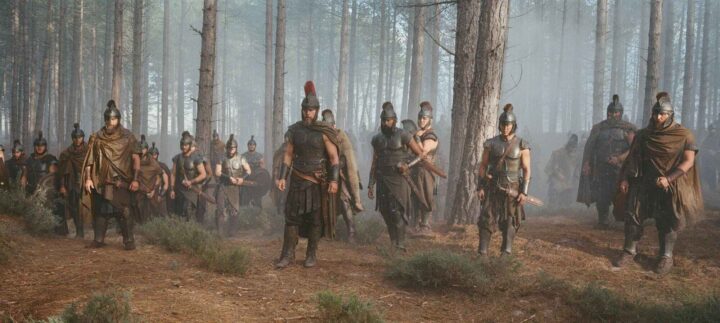
Christopher Nolan is regarded as a wunderkind who can do whatever he wants because Hollywood has decided that he is a genius. I have seen several of his films: The Dark Knight, Inception, Interstellar, Oppenheimer – which was good – Tenet, in which he played with time, and now The Odyssey, where he tackles the Greeks’ national epic and confidently treats it as though it were his own screenplay. Which, of course, it is not. The Odyssey is canon, and if one has understood anything at all about antiquity, it is that man must know his limitations. When man transgresses the boundaries set for mankind, he is punished by the gods. He brings nemesis down upon himself.
This word appears several times in the film and is one of its governing principles. Odysseus is the one whose cleverness conceived the idea of the horse in which they could hide. It was presented as a gift from the gods, and the Trojans believed what Sinon said. He is played by Elliot Page, who is trans.
Nolan has inserted so much race and gender identity into the film that it ruins it. Helen of Troy was the most beautiful woman in the world. So beautiful that all men were struck down by her beauty. She is described as blonde with blue eyes. In the film she is played by Lupita Nyong’o, who is jet black. Is Nolan trying to show that he is above history? Nyong’o has openly admitted that she has never read The Odyssey. It is approaching comedy. She is supposed to portray one of the most famous women in world literature, yet complains about the way women are treated. She also plays her sister Clytemnestra, who kills Agamemnon when he returns home from Troy.
Nyong’o is a bitch. She berates her husband Menelaus and screams at Agamemnon before plunging a knife into him. It feels contrived.
The background to the murder is that he sacrificed their daughter in order to win the gods’ favour and favourable winds for the voyage to Troy.
Nolan has succumbed to the temptation of allowing woke ideology to dictate the story. He has no respect for period authenticity or historical characters. Odysseus’ men look as though they have been taken from a gallery of actors from all over the world. They spit out “fuck you!” and trivialise a great drama. They have been drawn from every corner of the globe, and it is simply not credible.
Nolan has prioritised skin colour over character.
These woke criteria come at the expense of the casting, of the roles. Matt Damon is no Odysseus. He does not possess the masculine gene. He is no warrior. He is not someone who could have conquered Troy.
Agamemnon looks like Darth Vader in larger-than-life armour. When he finally removes the impressive helmet, he turns out to be a somewhat soft, unimpressive little man who dies in the bath when he returns home. We see Odysseus kneel before the king, but this is no king. It is Benny Safdie.
There are moments of brilliance.
Benny Safdie attends the premiere of “The Odyssey” at AMC Lincoln Square on Tuesday, 14 July 2026, in New York. (Photo by Evan Agostini/Invision/AP)
Jon Bernthal attends the premiere of “The Odyssey” at AMC Lincoln Square on Tuesday, 14 July 2026, in New York. (Photo by Evan Agostini/Invision/AP)
Jon Bernthal plays Menelaus, and he has the masculinity these warriors must have possessed. Not many Hollywood actors today have it. I know of Bernthal, who has embodied the role of the Punisher, and Keanu Reeves, who is John Wick. They are killers both on screen and off. You believe them.
Nolan lets these gifts slip through his fingers. He could have made a version faithful to Homer. I remember Irene Papas as Penelope in Franco Rossi’s 1968 adaptation of The Odyssey. She has the gaze and the set of the mouth of a woman capable of withstanding the siege of the suitors for twenty years.
Anne Hathaway is not a poor Penelope either. She is convincing as the woman who gave away her heart once and for all.
There are scenes that are memorable. The one that made the strongest impression was when Odysseus visits the blind seer Tiresias. They sacrifice two sheep, pour out the blood and drink it. The dead soldiers whom Odysseus left behind rise out of the earth and tell him that they still struggle with having been lied to, that they offended the gods, that they unleashed Ragnarök. Troy becomes a symbol of the destruction of civilisation.
This is the kind of dark noir scene at which Nolan excels and which we know from The Dark Knight. He is in touch with a dark side within himself.
The film truly begins when Odysseus returns home. His son Telemachus, played by Tom Holland, gradually acquits himself well.
The most moving scene is when Odysseus, disguised as a beggar, stands outside the gate and is recognised by his dog, Argos. It has waited for its master for twenty years. One of the loathsome suitors has kicked it so that it has been left to die. But it waits. When Odysseus appears, it wags its tail. A dog is never mistaken. Telemachus realises that it is his father standing before him. It is a moving scene. Simple and deeply human.
Then comes the reckoning with the suitors. Here Nolan introduces a story of his own invention. Sinon is mentioned in Virgil’s Aeneid, but not in The Odyssey. In the film he stands in for Antinous, who was bought free by his father so that he would not have to embark on a journey from which he would probably never return. Sinon carries a piece of wood as proof of his sacrifice. He has given it to Odysseus, who uses it in his first move against the overbearing Antinous, who reacts with fury.
When Antinous’ time is up, this wooden stick is thrust into his mouth with the instruction to return it to Sinon when he meets him in Hades.
Penelope is faithful to her husband, and John Leguizamo, as the blind servant Eumaeus, is faithful to his master. When he realises who the beggar is, he helps lock the suitors inside so that Odysseus can give them what they deserve.
One sentence recurs throughout the film: Zeus’ law requiring everyone to show hospitality to strangers. This appears to be Nolan’s message. It rings hollow. It lacks pathos.
The film makes use of an overwhelmingly loud sound that shakes the audience. It feels like an earthquake. But effect is not synonymous with quality.
The Odyssey and the Iliad teem with characters.
If Nolan was going to address abuse, why does he omit the gravest of them all: Ajax raping Cassandra at the feet of Athena in her temple? By the standards of the ancient Greeks, this was an exceedingly grave crime. One that could not go unpunished.
Cassandra, incidentally, is one of the most fascinating and tragic figures in the Greek pantheon.
She was the daughter of King Priam of Troy and Queen Hecuba, and a priestess of Apollo. Apollo promises to grant her the gift of prophecy if she yields herself to him. But after receiving this gift, she rejects his advances. Apollo becomes enraged and decrees as punishment that she shall always speak the truth, but no one shall ever believe what she says. It is a heavy fate to bear: to see her prophecies fulfilled without anyone taking her seriously.
Cassandra becomes a prize of war and is taken back to Attica with Agamemnon. There she is killed together with the king. She knew that would happen as well, but could do nothing except go to meet her fate.
That greatness is absent from Christopher Nolan’s film.
Instead, he allows the rapper Travis Scott both to open and close the film. According to Nolan, rap is like Homer’s rhapsodes.
It simply does not feel that way.
We want the original.