

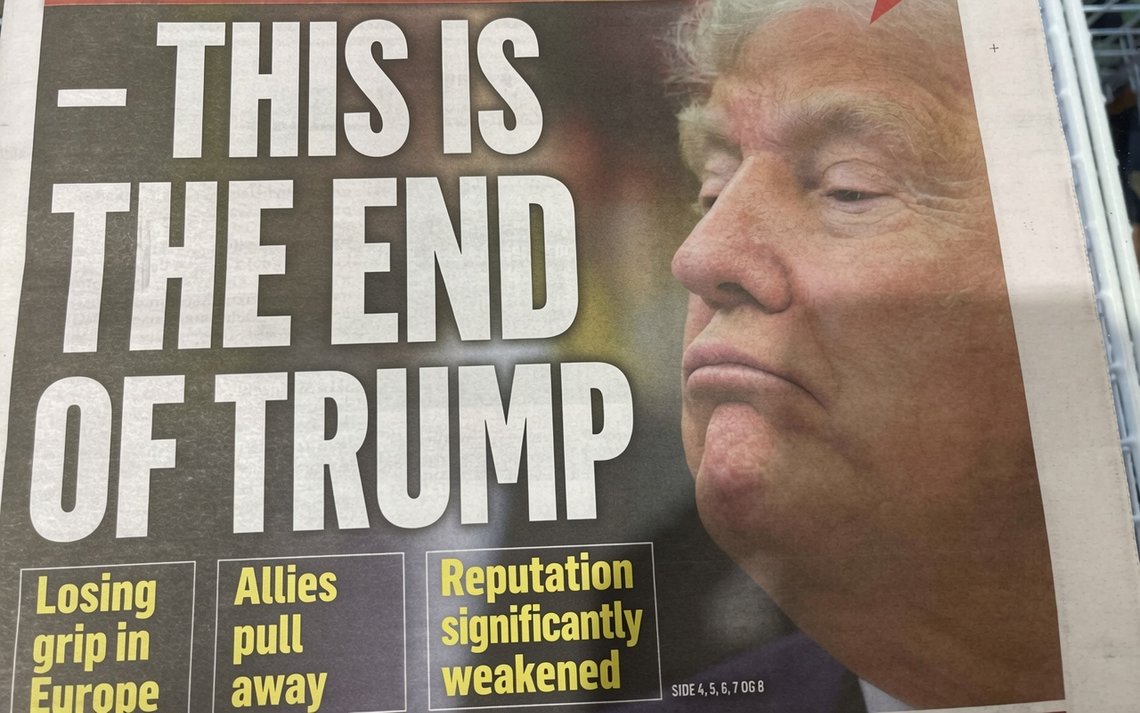


Norwegian and European media have been almost in ecstasy over the memorandum of understanding that President Trump has entered into with the regime in Tehran concerning the terms for negotiating an agreement to end the war within 60 days this summer. In VG we are told that “The agreement between the USA and Iran is a political fiasco.” TV2’s “expert” believes that the agreement is a catastrophe for Israel and that “… the memorandum of understanding between the USA and Iran shows that the regime in Tehran has emerged victorious from the war, while Israel is the big loser.” NRK states that Trump has capitulated.
This is what large parts of the Norwegian people are left with as “knowledge” about one of the most important international events so far this summer: A bombed-out and decimated clerical regime in Iran has defeated the world’s most powerful superpower into capitulation in a 14-point memorandum of understanding.
Internationally the reaction was the complete opposite of the Norwegian one, as evidenced by the flood of congratulations President Trump received from leaders around the world. Here there is reason to ask whether we live in the same world? What is it in this document that causes the entire Norwegian press corps to conclude so diametrically differently from the rest of the world?
In an attempt to find an answer to this puzzle, we have looked more closely at the 14 specified points in the agreement, in an attempt to bring clarity to what they actually convey and how they can or cannot be understood as premises for an international negotiation process. We must then begin by stating that it is only in a couple of points that we find the parties have already committed themselves to actions that are to take place immediately and not wait until the negotiations on a final agreement have been concluded after 60 days.
The central “deal” the parties have already agreed upon is that the lifting of the USA’s blockade of the Strait of Hormuz shall begin immediately, and Iran shall contribute to secure passage (points 4 and 5) pending a final agreement, and (point 10) that Iran shall immediately be permitted to export oil while the negotiations on a final agreement are ongoing. With this, Trump has already achieved a realpolitik victory: Iran no longer has the international economy as a hostage.
Otherwise the parties express an intention to negotiate on a range of issues, including Iran’s nuclear programme, which not only concerns bilateral relations between the USA and Iran, but which directly imposes tasks and obligations on Iran’s neighbouring states in the region, which are to provide an assistance programme to Iran of 300 million dollars. Risky obligations are placed on Israel, which has not participated in the preparation of this memorandum of understanding. Tasks are also assigned to the IAEA and the UN Security Council, which are assumed to accede to the final agreement in the form of a binding resolution pursuant to Chapter VII of the UN Charter on measures against threats to the peace, breaches of the peace and acts of aggression.
It is in itself rather remarkable that an agreement is entered into that rests on assumptions of accession by a number of other parties that have not participated in the negotiations at all or been asked about any possible involvement and contribution. Now this problem is probably not entirely insurmountable in the present case, but it raises questions about whether the parties that concluded the agreement seriously envisaged that these were insignificant details that in this instance would not cause the negotiation process to collapse. In any case, it represents a significant deviation from normal international negotiation practice.
A more serious question that arises when one studies the wording, the imprecisely formulated conditions and all the extensive desiderata to be negotiated is whether the parties in their innermost minds took these negotiations entirely seriously, or whether perhaps none of them envisaged achieving anything other than a breathing space in a war that for Iran’s part was necessary in order to gather and reorganise what might remain of the old regime, and which for President Trump’s part would relieve the national and international pressure during the observance of, inter alia, the USA’s 250th anniversary, the football World Cup and the run-up to the autumn mid-term elections?
The entire document deviates in form and content from what is normal procedure in international treaty negotiations rooted in international legal tradition and practice where the requirement for precision and clarity is strict. Taken together this creates a sense that the entire initiated negotiation process is not actually intended to result in a successful peace agreement in which both parties achieve outcomes they can live with in the long term. This applies particularly to the Iranian regime, which must relinquish all control of its nuclear programme to the International Atomic Energy Agency, IAEA. Reports are already coming in of frequent Iranian breaches of the agreed ceasefire that is a precondition for the agreed negotiations. There is little to suggest that the formal government has control over the regime’s radical military organs.
It is almost inconceivable that the most radical Islamic organs, which with military force control the country and the people, and are led by apocalyptic believers and actors who for 47 years have organised the entire country’s economy and military organisation towards one single goal – to destroy the Jewish state of Israel – should abandon all their prioritised religious objectives, declare defeat and give up. Are they expected to admit that Trump and Netanyahu won the war, and therefore choose to join an Abraham Accord with Israel? That is probably one of the least likely outcomes of the agreed negotiation process.
We must be prepared for the fact that we are facing a both protracted and bloody development for the Persian nation. In the end it is only those who can change the conditions of their own society. But the process that has been initiated cannot be stopped with endless use of weapons either. Israel is now cooperating with Lebanese authorities to clean up the terror-infested border area. This is a direct consequence of Trump’s neutralisation of the Iranian regime’s international network. But the road to final peace must be expected to be long and difficult. At home there is a job to be done in getting our own mass media to realise that they are on the wrong track. Nor will that be easy.


