

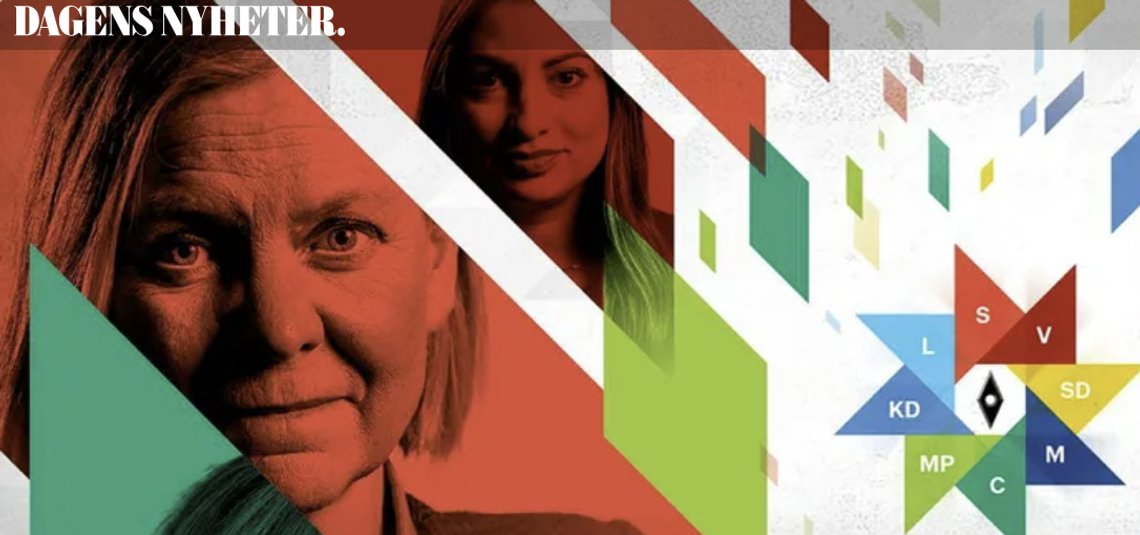


While Dagens Nyheter claims to open its website for free “for the sake of democracy”, young voters are instead served a carefully curated universe of emotional journalism, left-leaning narratives, and political agenda-setting. The question is no longer whether the media influences public opinion — but how openly it does so.
So-called news reporting is an art form — especially when the goal is not primarily to convey neutral news, but instead to engage in agenda-setting journalism.
Dagens Nyheter has perfected this agenda-setting role, something that became especially clear to anyone visiting the newspaper’s website on Tuesday.
“Journalism” — “For the Sake of Democracy”
Readers scrolling past headlines about cleaning companies without collective agreements, the negative effects of Botox injections on young people’s relationships, and yet another article claiming that “Putin’s time is beginning to run out”, are met with the recurring daily message that DN is unlocking its entire website for young voters until the parliamentary election. “For the sake of democracy”.
– Access to independent journalism gives young people the tools they need to become active citizens. That is important for democracy, says DN editorial manager Anna Åberg.
That may sound reasonable enough. There is only one problem: with the best will in the world, DN’s journalism can hardly be described as “independent”. Or even journalism. Possibly “journalism”.
New voters between the ages of 18 and 25 are, for example, invited to read a tear-soaked cultural essay titled: “Why my wife and I are saying goodbye to the dream of a life in Sweden — Swedish citizenship and marriage are not enough” — before eventually reaching the real centerpiece: the Voting Compass.
“Which party suits you best? Take the Voting Compass”, DN urges. By answering a certain number of questions, readers are told which political party they should vote for. The voting compass appears to work perfectly — an acquaintance who selected “Skip” for every question was advised to vote for the Green Party of Sweden…
There is, of course, also a specially designed version aimed specifically at these young voters, with questions tailored to the target audience: affordable rental housing, whether children should be sentenced to prison, age limits for social media, and whether police should be allowed to wiretap people under the age of 15.
Anyone who consistently wants things to become better, cheaper, and more compassionate is — unsurprisingly — guided toward voting left. The further left, the better.
Immediately after these questions comes an article about the United States continuing its attacks on Iran. This is followed by an editorial by Lisa Magnusson under the headline: “Compassion has been completely erased from Swedish debate — the Sweden Democrats’ hostility toward immigrants has distorted the way we reason”.
Then comes an entire feature section: “DN Investigates Foreign Aid”.
– Can’t Ask About Terror Links
So what aid is DN investigating? Aid previously directed to Islamic Relief — the “aid organization” with alleged links to both Hamas and the Muslim Brotherhood, and whose leaders have become known for openly antisemitic statements. The organization was banned in Bangladesh as early as 2017 because of alleged terrorism links. Germany and Switzerland stopped funding Islamic Relief in 2020, while the United States and the Netherlands followed the year after.
But naturally, this is not the argument emphasized by DN, which instead highlights a quote from Islamic Relief Sweden director Waseem Ahmad: “Are we supposed to conduct intelligence work?”
Yes. One could reasonably argue that this is entirely appropriate for an organization repeatedly attracting extremists and antisemites — especially if you claim to be conducting investigative journalism.
– We cannot ask employees whether their relatives have terrorist connections, Ahmad says.
Of course you can. Not only can you — you should. For an organization that received approximately 1.3 billion SEK from Swedish taxpayers between 2014 and 2024, that is hardly an unreasonable demand.
“Being Kept Alive by Swedish Taxpayer Money”
But naturally, this is not a perspective the new voters DN claims to care about are supposed to encounter. Instead, young readers are presented with a report about six-month-old Bahasan, who is allegedly “being kept alive by Swedish taxpayer money”. In one week, the aid funding ends, DN writes. What happens then? The implication is obvious: Bahasan will die if Swedish taxpayers stop paying.
If the first-time voter still is not sitting in tears, DN doubles down with a feature story about Mohamed, an eight-year-old Ethiopian boy without a father. His father was killed while trying to “protect the village”, and now the future is uncertain — unless Sida continues pumping Swedish taxpayer money into the terrorism-accused organization, of course. Then both Bahasan and Mohamed will supposedly live wonderful lives. Or?
DN has sent its news team to Ethiopia to portray how hope turns into despair and children die in large numbers the very moment the supposedly ‘heartless’ Swedish government demands that aid organizations stop financing terrorism.
But DN also wants to make sure young readers not only wish to send their parents’ money to alleged extremist financiers — hearts and wallets should also open domestically.
After an explanatory article about why alcohol and hangovers cause anxiety — apparently a highly relevant issue for young voters — readers meet Home Guard soldier Anders, who describes crying with joy after finding the two-year-old boy who had been missing for 14 hours before eventually being found in the forests around Nyåker in Nordmaling.
The boy’s family are beggars from Romania. Despite the mother speaking better Swedish than many people who have lived in the country for decades, the family claims they have only been in Sweden for three weeks. This time. Yet no critical questions are asked — naturally — because that could undermine the intended narrative and message.
The examples above are only a small sample of today’s “independent journalism” à la DN. All served free of charge to young voters. “For the sake of democracy”.
Or rather, for the sake of social democracy?
Agenda-Setting Journalism
Agenda-setting journalism is a concept within media studies and journalism describing the media’s ability to influence which issues people perceive as important in society.
By repeatedly reporting on certain topics — such as crime, climate, or migration — and placing them prominently in the news cycle through headlines and front-page placement, the media can direct public attention so that these issues appear more important than others, while alternative subjects fade into the background.
When Peter Wolodarski became editor-in-chief of Dagens Nyheter in 2013, he announced that he intended to focus on agenda-setting journalism. He appears to have succeeded beyond all expectations.


