

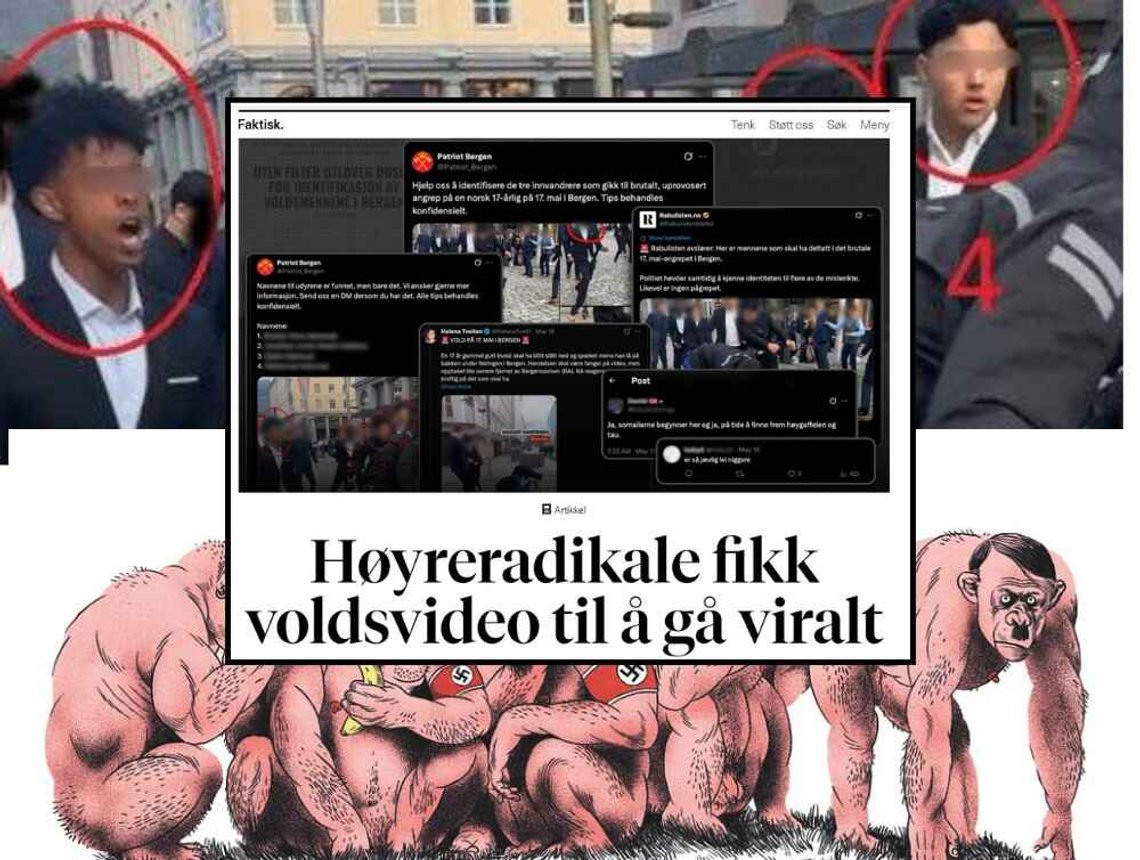


One can no longer be surprised by what is happening in our dear country of Norway. But the absurdity is almost too great to comprehend.
Faktisk.no and Bergensavisen have mapped the dissemination of the violence video following 17 May. The report was published on 29 May, just one day after Hamse Ali was sentenced to 45 days’ imprisonment for making a false report.
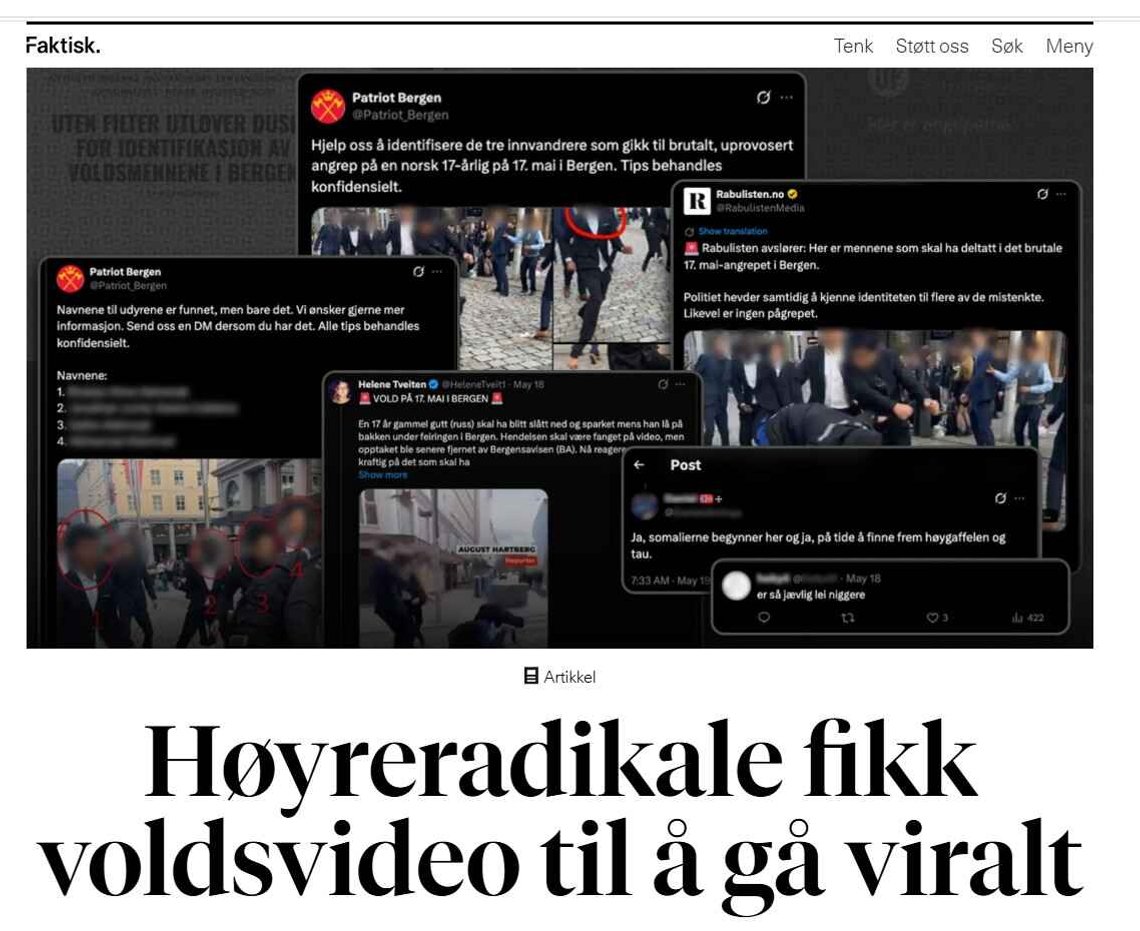 Screenshot from Faktisk.no.
As is well known, it was Bergensavisen that first spread the false story about Hamse Ali being beaten up in Nygårdsparken by “six racist white men from Bergen”. No video. No evidence. No police report. Only Ali’s word.
Instead of directing attention to the media’s own role in one of the most heated, sensational, and dishonest witch hunts Norway has seen in a long time, Bergensavisen has now joined forces with Faktisk.no to hunt down alleged far-right radicals who shared the violence video from 17 May:
Before the police had interviewed the suspects, the 17 May video had already been circulated as racism against Norwegians. Faktisk.no and Bergensavisen have mapped its dissemination.
Within a few days, and before the police had identified all those involved, the film triggered a digital lynch mob.
The report gives the impression that the video was shared by people who judged the perpetrators in advance, solely on the basis of skin colour.
I cannot prove it, but it is embedded in the very wording of the report: The idea that this may have been a racist attack on a white Norwegian boy appears entirely beyond discussion for Faktisk.no and Bergensavisen.
One can no longer be surprised by what is happening in our dear country. But the absurdity is almost too great to comprehend.
Bergensavisen in particular was central and complicit in constructing a completely fabricated racism narrative that should have been obviously false to anyone familiar with the Norwegian people. It threw the political left into a collective rage and a lynch mob over a racism threat that did not exist.
This ugly affair has been going on for almost two years, has cost dearly, and has divided the people. Now that Hamse Ali has finally been convicted and we have received a form of closure, what do Bergensavisen and Faktisk.no do? They launch a large-scale hunt for ordinary private citizens who shared actual evidence of a serious and racist assault.
It is also worth noting that this concerns private individuals on social media, not editor-controlled media outlets that are supposed to follow ethical guidelines, which Bergensavisen and others plainly violated in the Hamse Ali case.
In addition to ordinary citizens, Progress Party (FrP) representative Jon Helgheim and individuals connected to the “far-right party Norgesdemokratene” are thrown into this basket of “far-right deplorables”.
Particularly troubling is the treatment of Helene Tveiten, whom they call a “political influencer”. Tveiten’s account is depicted in the main image of the article. She dared to question how safe it is to celebrate 17 May and published seven posts about the incident.
I do not know very much about Helene Tveiten. She has 50,000 followers on Facebook and describes herself as a journalist. Conservative commentator. Politics, international affairs, facts. Proud Norwegian. The latter is practically a crime in today’s Norway.
The journalists combed through her comment section on X, where they found users writing “So fucking sick of niggers” and “Yes, the Somalis are starting here and yes, time to get out the pitchfork and rope”. No one defends such terrible comments.
But we have all seen far more severe and hateful statements in the comment sections of established media outlets, politicians, and Islamic organisations and individuals, without triggering the same aggressive campaign to publicly shame anyone. Private citizens are apparently expected to spend hours removing hateful comments, while resource-rich media organisations get away with it.
When Faktisk.no contacted her, Tveiten explained that she published the video because it had significant public and news value. She emphasised that she actively moderates and removes hateful comments and strongly distanced herself from the comment about the pitchfork and rope.
Nevertheless, the Faktisk.no team returned days later, found the comments still visible, used them against her, and labels her far-right radical. On X one cannot delete comments, only hide them, something the smug journalists at Faktisk.no themselves point out.
It is deeply troubling that Helene Tveiten is being publicly pilloried in this way, practically portrayed as a far-right extremist danger to society simply because she exposed violent offenders who make our streets unsafe.
Others receiving extensive coverage in the report are Patriot Bergen, Rabulisten.no, and Powerfrode. The latter has been thoroughly investigated, a person who has had the honour of becoming the subject of Filter Nyheter’s special investigation.
I in no way share extreme views, if these are accurate. Nevertheless, it is striking that Filter Nyheter has made it its life’s mission to hunt right-wing extremists while consistently ignoring Islamism and left-wing extremism, the greatest threats in Norway today. The same one-sided focus is evident at Faktisk.no, Bergensavisen, and their like-minded associates.
The alternative online newspapers Uten Filter and Rabulisten.no receive extensive attention because they shared the video, and Faktisk.no devotes considerable space to emphasising their allegedly close ties to Norgesdemokratene. Investigative journalism at its finest.
Thank goodness these dangerous connections are being uncovered. Now we can finally breathe a sigh of relief. Norway’s streets have, after all, become considerably safer as a result:
The editors of the two online newspapers have close ties to the far-right party Norgesdemokratene. Øyvind Eikrem, editor of Uten Filter, is listed as the party’s deputy leader. Tore Rasmussen, editor of Rabulisten, is a former lead candidate for the same party, according to Filter Nyheter.
Dagbladet is treated with kid gloves. Even though it published an incorrect source who claimed that the graduating secondary-school students in blue overalls (blårussen) “had gone through the group of boys and created a tense atmosphere”. It later emerged that the source had not filmed the video at all.
Dagbladet’s news editor, Mads A. Andersen, told Faktisk.no that they genuinely believed the source had filmed the video himself. “With the benefit of hindsight, we should have conducted further checks before publishing,” he says.
Translated: We were so determined to place partial blame on the victim that we could not be bothered to check whether the source had actually filmed the video.
Just another ordinary day in the life of a Dagbladet editor.
But no harsh criticism from Faktisk.no. Just a shrug over a rather serious source error. And while alternative media outlets mentioned in the case are labelled “far-right radical” or “far-right”, Dagbladet and other major media organisations escape without any political label.
The team at Faktisk.no and Bergensavisen have truly invested great effort in this report. The entire matter concerning Jon Helgheim’s Facebook post is described in minute detail, with timestamps, screenshots, and reactions. They do not directly call him far-right radical in the text, but since he “spread” the story, it seems obvious that in their eyes he nevertheless is.
The journalists insert small, subtle insinuations that there may be more behind the story and allow the defence counsel for one of the perpetrators to speak. Jørgen Riple tells BA that there was a precipitating event leading to the violence, which they consider relevant to understanding the context of what occurs in the video.
The seriousness of the brutal group assault, in which a young man is kicked while lying on the ground without any possibility of defending himself, is trivialised and described as a “fight”. The tone is so matter-of-fact that one wonders what is wrong with these people:
Among several fights in Bergen on 17 May, there was one in Strandgaten in particular that set the agenda. A video shows four youths with immigrant backgrounds punching and kicking a graduating secondary-school student in blue overalls (blåruss) on the ground.
They make a great deal of the fact that Patriot Bergen may have been mistaken about the boy’s age: “Patriot Bergen asks its followers for help identifying the boys in the video. In this and several other posts it is claimed that the victim is a 17-year-old boy. This is not correct; the injured blåruss is 18 years old.”
As though the one-year difference has any relevance whatsoever. At the same time, they consistently refer to the perpetrators as “boys”, without mentioning their ages at all. Apparently, they are the victims in this case.
As I see it, there is a constant witch hunt or “lynch mob” from the political left directed at the conservative segment of the population. They know that they control the debate and determine what it is acceptable to think and say, and the level of arrogance is unbelievable. At the same time, it shines clearly through the entire report that they are seeking to protect the four violent perpetrators.
The most remarkable aspect is that Bergensavisen and Faktisk.no devoted substantial resources to this extensive report just one day after their own “racism victim”, Hamse Ali, was convicted of making a false report, a story they themselves helped to spread.
I am very curious about the motive behind such a report, and why they did not instead reflect on their own role and involvement in the Hamse Ali case in the wake of the verdict. Therefore, I will be working on an open letter containing questions that I will send to all journalists and leaders at Faktisk.no and Bergensavisen. It will be published at a later date.
At the end of the report, Faktisk.no writes that in the wake of the attention surrounding the 17 May video, a number of other violence videos have begun circulating on social media, including videos showing Norwegian schoolchildren. Rune Fimreite, section head at the Joint Preventive Unit (Felles enhet for forebygging) in the Vest Police District, has gone to the media and publicly urged the public to exercise source criticism.
Once again, Faktisk.no is concerned that perpetrators who beat up Norwegian schoolchildren might be identified.
But it is unfortunate that they did not follow the same advice about exercising source criticism in the Hamse Ali case, or in a number of other similar cases, for that matter.
Another truly remarkable detail is that Faktisk.no has not published a single article about the Hamse Ali case. Unless my search engine is displaying incorrect results.
That will be one of my questions to the team: Why has Faktisk.no not written a single article about the Hamse Ali case?


