



Climate activism is beginning to encounter a certain degree of resistance, yet the EU and Norway still have legally mandated net zero greenhouse gas emissions by 2050 and a 55 per cent reduction by 2030. Not only are these ambitions insane and unattainable, but the attempts to fulfil them are destroying Europe’s economy. Nevertheless, no political initiatives are being taken to scrap the “climate targets”.
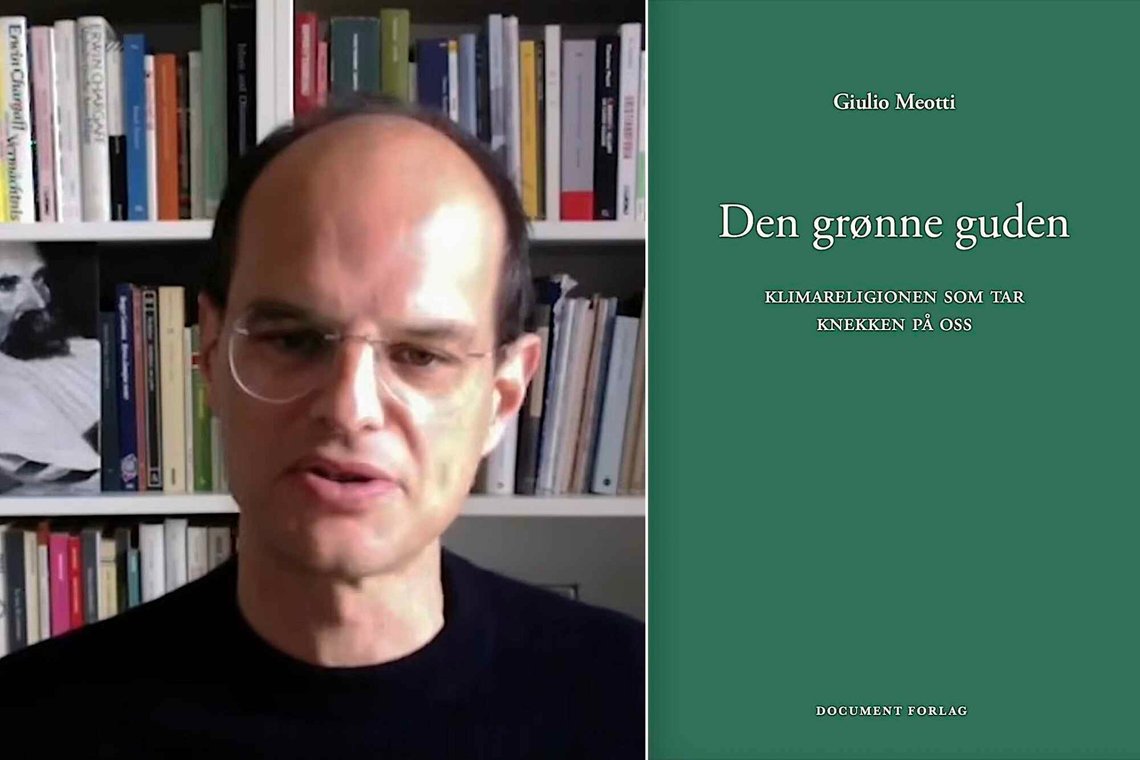
So why does Europe insist on destroying itself? Because climate policy became a religion, explains Giulio Meotti in his book “The Green God”, which Document Forlag is now publishing.
Combating greenhouse gas emissions is thereby not merely an indisputably good act, but a moral imperative binding upon the whole of society. It is not the first time Europe has attempted to destroy itself with bad ideas. But how did it happen this time?
People do not understand what has struck them, because it concerns a creeping process. In this short book, the Italian journalist and author shows that it has been under way for more than fifty years.
Among the many who over the years have contributed to the delusion with toxic ideas, we find authors, philosophers, academics, priests, media figures, filmmakers, politicians, activists, lawyers, bankers, governments, NGOs, supranational organisations …
“The Green God” documents enough of their nonsense for one to understand how distorted ideas this time as well have seeped down from the social elite and penetrated the minds of many millions of people, where they have caused great harm.
In Christianity, man has value because he is created in the image of God. When that idea was rejected and many in the West instead developed a religious relationship to nature, Western people (never anyone else) became a foreign element that ought to disappear from the face of the earth. These sources of pollution and corruption ought preferably to go away and die, and in any case not have children. Preferably sterilise yourself, abort if necessary right up until birth, and resort to euthanasia afterwards if required.
Environmental protection is a good cause, but Meotti demonstrates that it was quickly hijacked by totalitarian ideologues who turned environmental activism into a misanthropic monster. The moment conservation and the fight against pollution were overshadowed by the “climate struggle”, the totalitarian ideas became an all-encompassing policy. If all human activity produces CO2, and laws are enacted with the aim of combating CO2 emissions, then policy becomes an enemy of mankind. It simply destroys us, as the book’s subtitle announces.
But that is precisely the intention. For we receive no forgiveness for our climate sin, and we may simply forget salvation: We are instead to die a slow death, both by ruining the economy and importing new populations capable of replacing the white, polluting and racist peoples of the West.
This “convergence” of struggles shows that there is a line running from climate policy to liberal immigration policy. In this worldview, we sin against the climate today just as we sinned against the Third World yesterday by plundering it.
The end of the Cold War was therefore not the end of Marxist thinking; it merely assumed new forms – as irrational as before. Some found a new evil to combat, not Western capitalism in itself, but the West’s greenhouse gas emissions. These have allegedly made us rich at the expense of poor countries, and now it is payback time.
Class struggle has in this way become climate struggle. It is still a secular religion, and the human cost is of no interest this time either. Is it any wonder that Islamists, who see their opportunity to take over Europe, welcome the development and engage themselves in green parties?
Giulio Meotti is one of Europe’s sharpest journalists, and in this book he sheds light as no one else does on the history of how we became subjected to the green god. We are then better equipped to tear ourselves free from its iron grip. There is no time to lose, for we grow weaker with each day we remain trapped in it.


