

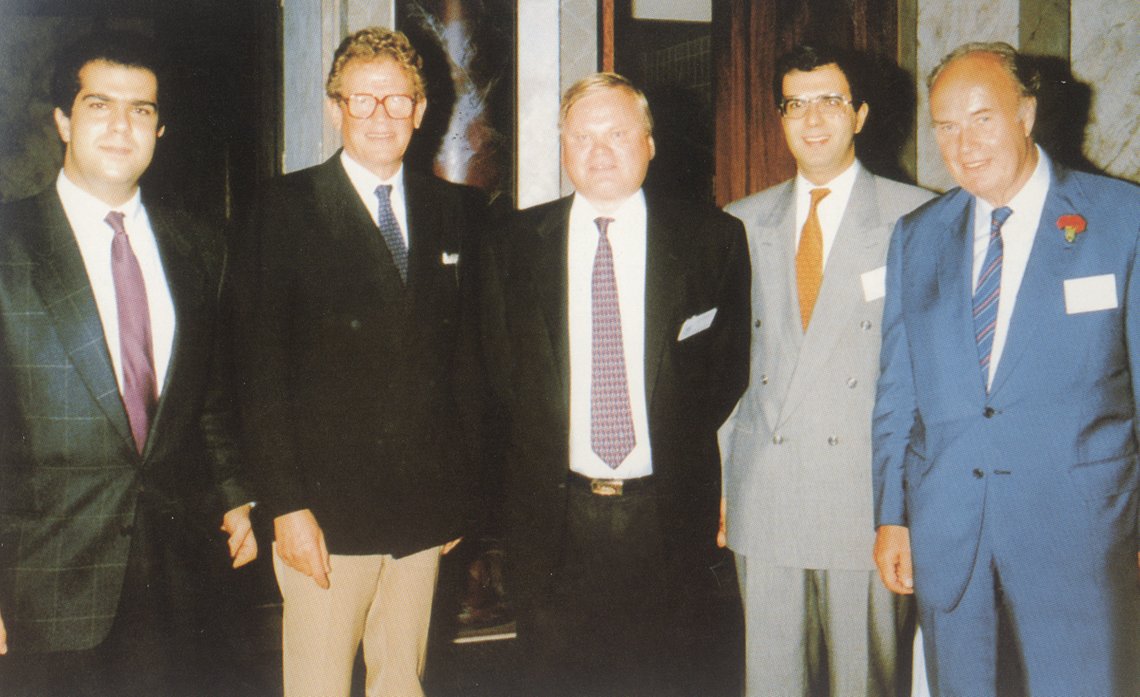
Abroad he was alternately called the «King of Kharg» and the «lifeline of the Ayatollahs». In financial circles at home he goes by the nickname «Big Wolf». He has his own table at Theatercafeen. The table is called «Kharg Island».
It concerns John Fredriksen, the world’s 178th richest man. Long since a tax exile in Cyprus, with well over NOK 200 billion in his coffers.
Between 1983 and 1987 he sent his supertankers to Iranian oil ports, primarily to Kharg, in order to transport Iranian crude oil out of the war zone, and often to Syria or other places that were not overly concerned with formalities. Iran needed money in the war against Iraq and paid exorbitant freight rates because few others dared.
Marine Management AS, as Fredriksen’s shipping company was then called, had several vessels in shuttle traffic during the Iran/Iraq war. In total, nine of Fredriksen’s ships were hit by missiles, mainly Iraqi Exocet missiles, which Saddam had purchased from France together with French Mirage F1 fighter aircraft.
The insurance situation was difficult. Lloyd’s and other insurance companies, including the Norwegian Gard, declared the Gulf a war zone and introduced exorbitant insurance premiums, up to 7.5% of the total value of the ship and cargo.
But the Iranians needed the money for the war against Iraq. And Fredriksen willingly took the risk, registered his ships under flags of convenience and transported as much oil as he could out of the Gulf. It yielded enormous revenues and laid the foundation for his vast fortune.
In total, 9 of Fredriksen’s ships were hit by missiles. Out of a total of 116 seafarers killed, 167 wounded and 37 missing in the tanker war, at least 7 Norwegian seafarers were killed, of whom 4 were on Fredriksen’s ships.
I remember it well. I was myself stationed at the embassy in Tehran during the tanker war, the land war between Iran and Iraq and the war of the cities with constant air and missile attacks between Baghdad and Tehran. Everything was in turmoil. Those who paid the price included Norwegian seafarers.
In order to earn even more, Fredriksen sailed several of the ships on bunker oil from the cargo instead of ordinary diesel. Gard discovered abnormally large losses of oil during discharge and initiated an investigation. It revealed that the crews systematically used parts of the cargo as fuel.
In June 1986, the police raided Fredriksen’s offices in Oslo. Several top executives were arrested, and Fredriksen himself spent 113 days in pre-trial detention, where, according to his own account, he “knitted sweaters for the family and developed a difficult relationship with the Norwegian authorities”.
It ended with a settlement, USD 800,000 in compensation to Gard and a fine of NOK 2 million for having endangered the lives of the crew by using explosive crude oil as fuel. The most serious charges of gross theft, insurance fraud and irregular accounting were dropped.
The tanker war in the 1980s was a significant part of the war between Iran and Iraq. Iraq had lower oil exports, and a large part of Iraq’s oil was transported by pipeline over land to Saudi Arabia and Turkey. Iraq was thus less exposed, but Iran’s war chest was severely affected.
Iraq carried out 283 attacks on Iranian shipping, the Kharg terminal and the shuttle tankers between Kharg and Larak Island. Iran carried out 168 attacks on ships transporting oil from Iraq. 55 of 239 tankers were completely destroyed. Insurance rates soared, but the Gulf was kept open by the national Iranian oil company NIOC and people such as Fredriksen.
The oil got out, and the tanker war therefore had a limited impact on the oil price. Before the war, the price, adjusted for inflation in 2026 dollars, was USD 60–65 per barrel. The market managed to absorb the risk without price increases. The oil price even fell to USD 35–40 per barrel when the tanker war was finally over in 1988.
The situation now is entirely different.
Iran is not Venezuela, Greenland or Cuba. Iran is very far away from the United States. Iran is vast. The country is larger than Germany, France and Spain combined. Iran has more than 90 million inhabitants.
And even more importantly: many of them are deeply religious Imami Shiites (imamitter), far more than we like to believe in the West. Iran is the largest Shia Muslim country in the world. And as Marco Rubio said about the Iranian clerical regime:
«They are religious zealots who can never be allowed to possess a nuclear weapon because they have an apocalyptic vision of the future.»
Rubio is entirely correct in this. The clerical regime in Tehran will gladly wage holy war against the United States and Israel, «the great» and «the little Satan». If you had ever heard the masses’ rhythmic chants in the streets of Tehran, “Marg bar America. Marg bar Israel”, you would understand what I mean. Iran controls the Strait of Hormuz and thereby the world economy. It did not do so in the 1980s when Fredriksen sailed in the Gulf. The risk of American ‘overstretch’ is therefore considerable, particularly if the United States’ allies are not willing to contribute to keeping the strait open.
Today the Strait of Hormuz accounts for 20% of the world’s oil exports. Approximately 11% of this comes from Iran. During the tanker war in the 1980s, only about 5% of oil exports passed through Hormuz.
If the Houthis in Yemen also become involved, they together will control oil exports through the Red Sea and a further 12%, and in total one third of the world’s oil exports.
During the tanker war, Iran, with the help of people such as Fredriksen, attempted to keep traffic going in order to finance the land war against Iraq. Now the mullah regime in Tehran is fighting an existential war. They are employing the means at their disposal to keep it closed, in order to affect the world economy and thereby the United States and the West.
And in contrast to the 1980s, when Iran used primitive Russian Scud-B missiles purchased from Libya, with limited range, payload and precision, as well as Silkworm rockets from China, with even shorter range, Iran has developed its own advanced missile programme that not only controls the Strait of Hormuz but can reach targets throughout the Middle East.
The Iranian missile programme is characterised by mass production of a varied arsenal of different, inexpensive, precision-guided and long-range (>2000 km) mobile missiles in underground storage facilities with an infrastructure that can be rapidly rebuilt.
The asymmetry in costs is one of Iran’s military-strategic advantages. An Iranian ballistic missile is estimated to have a production cost of down towards USD 500,000. A Shahed drone only USD 20,000. An American Tomahawk cruise missile costs up to USD 3 million. A THAAD up to USD 15 million.
How large the Iranian stockpiles are, and how many remain intact after the American and Israeli air strikes, we do not know. Iran has dispersed production and storage across the entire country in underground facilities, which makes complete destruction difficult.
It is estimated that Iran had approximately 2000–2500 ballistic missiles when the war began, and that more than half have now been destroyed. However, production continues at an estimated rate of more than 100 new ballistic missiles per month. Iran’s mine-laying capacity is not known in detail, but they are said to have several facilities concealed in tunnels along the eastern side of the long Gulf coastline.
The missile programme is therefore not crushed. Iran still has the ability to control the Strait of Hormuz and threaten the entire Middle East. It does not require many missiles and mines. And inexpensive production enables them to endure for a long time. That the United States cannot do! The danger of ‘overstretch’ both logistically, militarily and politically is imminent.
Much therefore suggests that Trump this time may have bitten off more than he can chew, both with regard to Iran and with regard to Europe, where there is no assistance to be had.
But let there be no doubt: in contrast to the many US-led wars in the Middle East previously, all of which have ended badly, the Trump administration’s intervention against Iran is both necessary and correct.
The erratic and unpredictable clerical regime in Tehran cannot be permitted to possess nuclear weapons. It cannot continue to threaten and terrorise Israel and the rest of the region with missiles and terror. It cannot be allowed to control and restrict the export of neighbouring countries’ oil through the Strait of Hormuz and thereby control the world economy.
But the belief in a rapid regime change has failed. As warned previously in these pages, the opposition’s will and ability to overthrow the fanatical clerical regime still appears to be less than the mullahs’ and the Revolutionary Guard’s ability to maintain it.
A larger portion of the population than we like to admit in the West, the proletariat in the poorer parts of Tehran and the major cities as well as the rural population, are deeply religious and support the clerical regime.
The Pasdaran and the Basij militia effectively suppress any uprising with the Qur’an in one hand and an AK-47 in the other. The war against an external enemy has also strengthened cohesion and neutralised the opposition.
The most important factor, greatly overlooked in an ethnocentric and technologically fixated West, ideology in the form of religious conviction, is severely underestimated.
Superior technology has led the United States to win all battles against fanatical Muslims of various kinds across the Middle East, but they have lost all the wars.
Trump understands this. A larger ground operation is therefore out of the question. He will never enter the quagmire his predecessors did in Afghanistan and Iraq.
But Iran still controls the Strait of Hormuz for the foreseeable future, and thereby also the development of the world economy.
That is unacceptable, not only for the United States, but it ought also to be for Europe and the rest of the world, not least for Norway, the world’s fifth largest shipping nation.
IMO reports that nearly 3000 ships with approximately 20,000 seafarers are now locked inside the Gulf. Of these, nearly 200 are large oil tankers with an estimated 190 million barrels of crude oil. The ships hardly dare move.
Should the Houthis resume missile and drone attacks and close or severely disrupt traffic through the Red Sea, as they did in 2023, the world economy will truly struggle.
Houthi leader Abdulmalik al-Houthi recently stated that they are ready with “their finger on the trigger”. At the time of writing, it is reported that the Houthis have launched a long-range missile towards Israel.
The world economy is already feeling it. Marine insurance companies cancelled war risk insurance as early as 5 March. The oil price has since soared. At the time of writing it stands at USD 116 per barrel. Before the war began, on 28 February, it was USD 65–72 per barrel.
We feel it even here at home. Petrol prices have soared. Food prices are expected to increase further. And Norges Bank signals another interest rate rise before the summer. An arrogant and ineffectual Støre government lacks the capacity to act and has committed yet another political blunder as a consequence of the war in the Gulf.
And not least, this affects petrol prices, food prices and interest rates in the United States. The MAGA movement is divided. The Democrats are exploiting this to the full. At the time of writing, there are demonstrations against the war across the United States. It may cost Trump dearly in the mid-term elections in November.
The Trump administration therefore feels the pressure. Trump has even temporarily eased sanctions on Russian oil in order to increase supply and dampen the oil price.
Trump is short of time. The Iranians are not. The most striking aspect, however, is not the resilience of the fanatical Iranian regime.
The most striking aspect is the lack of support from the European NATO countries.
The attitudes of European heads of government and the positions adopted by European countries towards the war in Iran are in the process of burying transatlantic relations for good.
Instead of supporting the Trump administration’s efforts to neutralise the mullah regime in Tehran, they have actively distanced themselves from Trump’s conduct of the war. This is neither in NATO’s nor in the EU’s long-term interest.
The NATO country Spain has even closed its airspace to American aircraft connected to the Iran operations. The left in Italy has pressed to block American aircraft from using Italian bases.
Støre, among others, has distanced himself from the war and pointed out that it is contrary to international law, as if that meant anything in Serbia, Afghanistan, Iraq and when Norway contributed to bombing Libya back to the Stone Age in 2011?!
The gulf between the United States and the EU only grows deeper and deeper. Ursula and Jonas simply cannot stand Trump.
They simply cannot bear to be confronted with the truth: that Europe has neglected its own security by failing to maintain an adequate defence and by leaving its borders completely open to non-Western immigration.
We see it with regard to the war in Ukraine. The EU wishes to keep the war going. We saw it during the war in Gaza. The EU took the side of the terrorists against Israel. And we see it now, in the war against the clerical regime in Tehran. The EU actively opposes the United States.
The Støre government follows as usual in the skirts of von der Leyen. Instead of assisting the Americans and immediately sending Norwegian minesweepers to the Gulf, Støre distances himself from Trump’s efforts to neutralise the mullah regime.
Norway is the world’s fifth largest shipping nation and has strong interests and a long tradition of contributing to keeping maritime routes open.
It is incomprehensible. Europe has ended up on the wrong side of history. And the Støre government follows willingly in the wrong direction.
Together with the EU, the Støre government contributes to making the task of neutralising the clerical regime in Iran even more difficult. That will not be forgotten in Washington.
Even though Iran’s air defence has been eradicated and Iran’s navy now lies at the bottom of the sea, and the United States’ two carrier strike groups are militarily superior to anything the Iranians can muster, Iran still holds the key to Hormuz and thus also control over the further development of the world economy.
How long they can maintain this, we do not know. It may last longer than the world economy can withstand. It also depends on what the EU countries, China, India and the international community as a whole will do.
The EU is now dragging its feet, despite the fact that the EU, together with China and Japan, is heavily dependent on oil, while the United States is self-sufficient in oil and gas, like Norway.
Trump could have needed both Norwegian minesweepers and someone like «Big Wolf», who dares to sail through Hormuz under the protection of the American carrier group USS «Abraham Lincoln».
But Fredriksen’s Frontline, the world’s largest shipping company, with more than 80 supertankers, is for understandable reasons avoiding the Gulf like the plague.
The man with the nickname «King of Kharg» and «the lifeline of the Ayatollahs» occasionally frequents Kharg Island, but that is at his old table at Theatercafeen. He prefers to swim in his money bin in Cyprus.
That is probably not so unwise! It is not his responsibility to keep Hormuz open.
But Støre, who has a responsibility to contribute to keeping the international maritime routes open – and, not least, to safeguard Norwegian security interests vis-à-vis the United States – hides cowardly in the skirts of von der Leyen.
That may prove costly for Norwegian security and for all of us here in Norway.


